A writer’s voice is never born in a vacuum. It is shaped by the red earth, the relentless monsoon, the cacophony of a crowded market, and the heavy silence of a forgotten valley. For Arundhati Roy, an author whose words are as much about the geography of the soul as they are about the geography of a nation, the landscapes of India are not mere backdrops. They are characters in their own right—breathing, bleeding, and bearing witness. To read Roy is to be transported, to feel the sticky humidity of Kerala, to navigate the layered histories of Delhi, and to hear the whispers of dissent rising from a river valley. To travel through her India is to embark on a pilgrimage, not to a sacred shrine, but into the very heart of her narrative world. This is a journey that follows the ink of her pen, from the rain-lashed backwaters that birthed her debut novel to the bustling, conflicted capital that serves as a stage for her sprawling second act, and into the contested heartlands where her activism took root. It’s a path that reveals how a place can forge a perspective, how the personal can become political, and how the smallest of things can echo with the weight of the world. We begin where her stories began, in the intricate, interconnected landscapes that gave life to her most powerful prose, tracing the map of a mind that is as complex and compelling as India itself.
This journey into the landscapes that shape a writer’s voice is a form of literary pilgrimage, much like tracing the epic routes of other great storytellers.
The God of Small Things: A Monsoon-Soaked Pilgrimage to Kerala
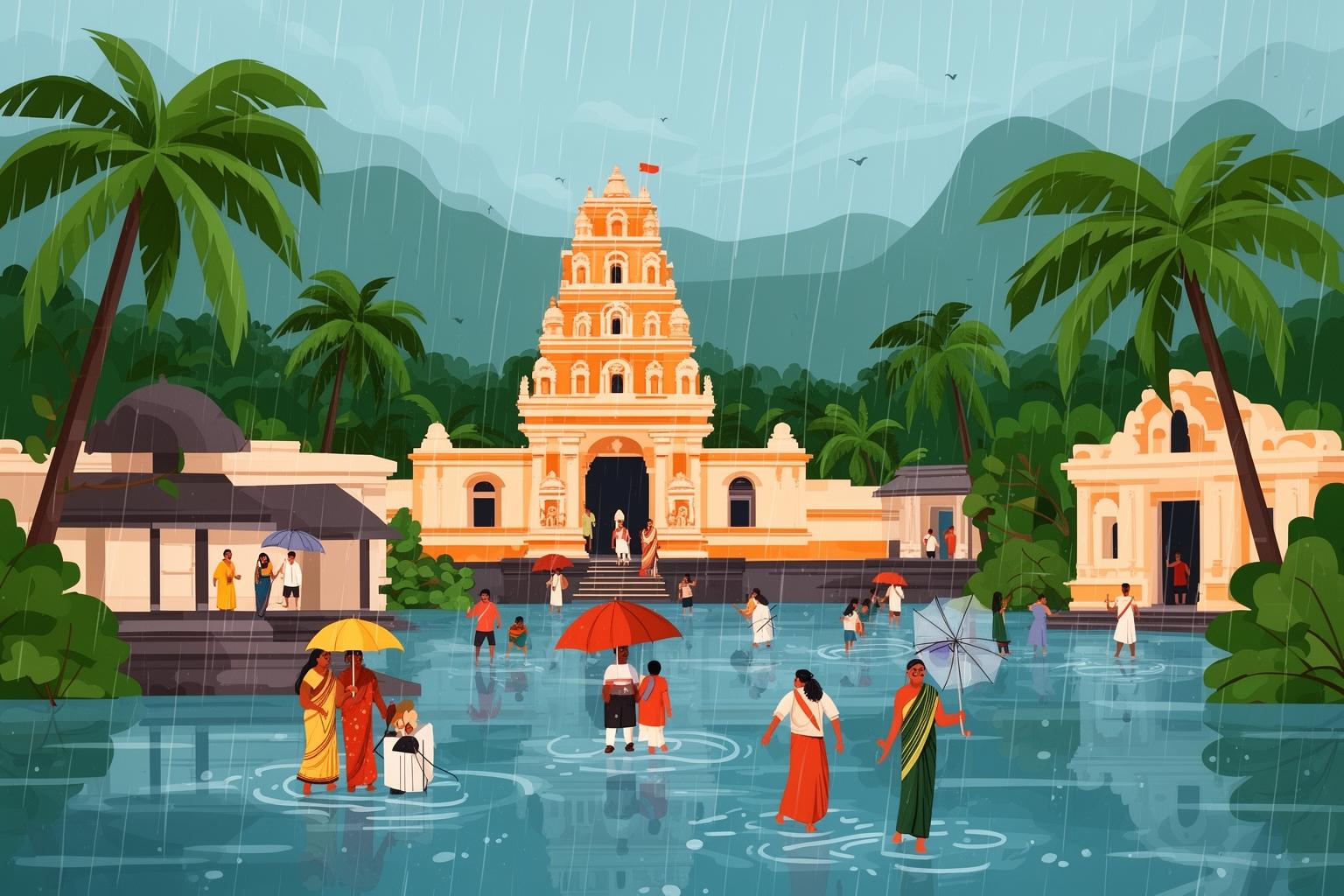
Our journey starts in the south, in a land awash with a thousand shades of green, where water sets the pace of life. Kerala, the backdrop of Roy’s Booker Prize-winning novel The God of Small Things, is more than just a location; it is the novel’s lifeblood. The narrative is steeped in the humidity, the scent of jackfruit and decay, and the slow, constant flow of the Meenachil River. To visit this region of India is to let the novel’s atmosphere settle into your skin, to view the world through the eyes of the twins, Estha and Rahel, and to grasp how a place can embody both stunning beauty and deep sorrow.
Aymanam: Where Fiction Comes Alive
At the heart of the novel lies the small village of Aymanam, just a whisper away from the town of Kottayam. This is not a spot marked by signs pointing to fictional places; its charm lies in its authenticity. It is a living, breathing village where the story’s world feels tangibly present. As you stroll through its narrow paths, bordered by lush paddy fields and canals shimmering under coconut palms, you are walking through the book’s pages. The air hums with the buzz of insects and distant bird calls, a soundtrack seemingly lifted straight from Roy’s prose. Here, the “small things” truly count: the dive of a kingfisher, the rustle of a banana leaf in the breeze, the bright hues of bougainvillea spilling over a weathered wall. This is a place for slow travel, for observation, and for letting the landscape’s story unfold around you.
The Scent of Spice and Rain: Experiencing the Backwaters
The essence of Aymanam and its surroundings is one of vibrant, almost overwhelming life. The monsoon season, which features prominently in the novel, transforms the landscape into a watery realm. The rain is not merely a weather event; it is a presence, drumming on tiled roofs, swelling the rivers, and washing the world anew, leaving behind the scent of wet earth and blooming flowers. Even outside the monsoon, water’s presence is constant. The backwaters—a network of lakes, canals, and lagoons—are the region’s veins. The air carries the faint briny aroma of water mingled with the sweet fragrance of jasmine and the sharp, invigorating scents of spices like cardamom, pepper, and cloves from nearby plantations. It is a sensory immersion directly connecting you to the vivid world Roy created, governed by the slow, inexorable rhythms of nature.
Tracing the “History House”: Seeking the Ipe Family’s Inspiration
Fans of the novel frequently search for the real-life inspiration for the “History House,” the decaying Kari Saipu home central to the story. While there is no single identifiable house, the spirit of it can be found among the old Syrian Christian homes dotted nearby. Many believe the Baker House, a colonial-era bungalow on the banks of Vembanad Lake near Kottayam, offers a close architectural and atmospheric parallel. This beautiful building, now part of a hotel complex, captures that sense of faded grandeur and historical depth. Whether visiting or simply viewing similar heritage homes from road or boat, it’s easy to imagine the echoes of the past that haunt the Ipe family. These houses, with sloping roofs, intricate woodwork, and airy verandas, stand as monuments to a bygone era, their quiet dignity a moving reminder of time’s passage and the secrets old walls keep.
The Meenachil River: The Story’s Lifeblood
The Meenachil River is arguably the most vital character in The God of Small Things. It is the site of childhood innocence, forbidden love, and tragic loss. It gives life and takes it away. To experience the Meenachil is to grasp the novel’s soul. While the river today may be gentler than the one described in the book—its currents altered by time and development—its essence remains unchanged.
Life on the Water: Houseboats and Hidden Canals
The best way to connect with the river and backwaters is to spend time on the water. Hiring a traditional houseboat, or kettuvallam, for a day trip or overnight stay is quintessentially Keralan. As the boat glides silently, you witness a world in perfect harmony with the river. You’ll see villagers washing clothes on the banks, children splashing in the shallows, and fishermen casting nets. For a more intimate journey, try a smaller canoe or local guide through the narrower, less-traveled canals. It is in these quiet, shaded waterways where you truly sense the intimacy and secrecy the river holds in the novel. You can almost hear the splash of the twins’ small boat, the one that carried them toward their fate.
The Sounds and Silences of the Riverbank
Notice the soundscape: the gentle lap of water against the boat, birds chattering, the rhythmic thud of a coir maker, the distant call of temple bells or church choirs. These are the sounds that filled the lives of the novel’s characters. The river is a place of both soft noise and profound silence. As evening falls, the world hushes, the water turns glassy, and the setting sun paints the sky in orange and pink hues. In these moments of quiet reflection, the emotional depth of Roy’s story feels most present.
Kottayam: The Town of Big Things
Kottayam functions as the novel’s link to the outside world, the “town” where the family shops, watches movies, and confronts the “Big Things” the children struggle to comprehend. It is a bustling commercial hub, at the center of India’s rubber and spice trade. Though it lacks Aymanam’s dreamy quality, it is a vital part of the pilgrimage. Visiting Kottayam highlights the contrast between the secluded, fading world of the Ayemenem House and the noisy, modernizing world beyond. Wander its markets, visit historic churches reflecting the region’s strong Christian roots, and feel the energy of a place with one foot in the past and the other stepping toward the future.
Practical Guide to Pilgrimage in the Land of Small Things
Reaching Aymanam and Kottayam is relatively easy. The closest major airport is Cochin International Airport (COK), about a two-to-three-hour drive away. Kottayam hosts a major railway station connecting to the rest of India. From Kottayam, Aymanam is a short taxi or auto-rickshaw ride. The best time to visit is from September to March, after the heaviest monsoon rains, when the weather is pleasant and the landscape is vibrant. Accommodation choices range from luxury resorts on Vembanad Lake to charming homestays in Aymanam, offering a genuine chance to experience local life and hospitality.
A Woman’s Journey: Traveling Kerala with Confidence
For women travelers, Kerala ranks as one of the safer and more accessible regions in India for solo trips. Locals are generally respectful and used to international visitors, though it’s always wise to observe standard safety measures. Dress modestly, especially when visiting religious sites—a light scarf is a handy accessory. Avoid walking alone in isolated areas after dark. When using taxis or auto-rickshaws, agree on fares beforehand or ensure the meter is used. Ride-sharing apps can also provide an added sense of security. Local transportation such as buses and trains is efficient but can be crowded. For greater comfort between towns, consider hiring a car with a driver, a common and reasonably priced option. Above all, trust your instincts. Keralan hospitality is warm and sincere, and engaging with local people remains one of the greatest joys of traveling here.
The Ministry of Utmost Happiness: Navigating the Labyrinth of Delhi
From the lush, water-logged landscapes of Kerala, our journey abruptly shifts northward into the vast, chaotic, and endlessly captivating metropolis of Delhi. This vibrant city serves as the primary setting for Roy’s second novel, The Ministry of Utmost Happiness. While The God of Small Things unfolds within a single, powerful landscape, Ministry is an expansive epic mirroring the city it inhabits—a place teeming with overlapping stories, where ancient history coexists with a frenetic present. Delhi is not a city easily comprehended. It is a maze of power, faith, poverty, and aspirations. Following Roy’s path here is to delve into the city’s many contradictions and to discover humanity in its most unexpected places.
Old Delhi: A City of Ghosts and Dreams
Much of the heart of Ministry pulses within the tangled, crowded lanes of Old Delhi, the historic core of the Mughal capital, Shahjahanabad. It is here that Anjum, one of the novel’s central characters, lives, loves, and makes her home in a graveyard. This part of the city is an all-encompassing sensory experience, and that is precisely its strength. It is a place that refuses to be sanitized or simplified, much like Roy’s writing.
Chandni Chowk and the Jama Masjid: A Sensory Overload
Walking through Chandni Chowk, the main artery of Old Delhi, is an essential experience. The air is thick with the aromas of sizzling street food, incense, spices, and exhaust fumes. The cacophony is a constant symphony of vendors calling out, the clang of cycle rickshaw bells, the call to prayer from the majestic Jama Masjid, and the murmur of countless conversations. Roy captures this beautiful chaos perfectly. As you weave through the crowds, you cease to be merely a tourist; you become part of the city’s relentless energy. Look up at the tangled web of electrical wires Roy describes as a “manic knitting project,” and you will find poetry in the urban disorder. Visit the Jama Masjid, one of India’s grandest mosques, and climb one of its minarets for a breathtaking, panoramic view of the sprawling old city below. From this vantage point, the scale and complexity of the world Anjum inhabits begin to unfold.
In the Footsteps of Anjum: The Khwabgah of Mehdiyan
Anjum’s home, the Jannat Guest House, is situated in a graveyard behind a hospital. Though its exact location is a creation of Roy’s imagination, its essence can be found in the many small, overlooked graveyards and Sufi shrines scattered across the city. These spaces are not merely resting places for the dead; they are centers of intense life where people come to pray, rest, and find community. Visiting places like the Feroz Shah Kotla complex—with its ancient ruins and djinns—or the Nizamuddin Dargah, the tomb of a beloved Sufi saint, offers a glimpse into this unique blending of the sacred and the profane, the living and the dead. These sites radiate deep spiritual energy and serve as social hubs where people from all walks of life converge, embodying the novel’s theme of discovering family and refuge in the most unlikely settings.
New Delhi: Corridors of Power and Protest
In stark contrast to the organic chaos of Old Delhi stands New Delhi, the planned city of grand avenues and colonial-era architecture designed by Lutyens and Baker. This is the heart of government, embassies, and the domain of the “Big Men.” Roy’s novel flows effortlessly between these two worlds, revealing how decisions made within these corridors of power ripple outward to affect the lives of ordinary people tucked away in the city’s neglected corners. It is also a city of protest, a place where the voiceless find their voice.
Lutyens’ Delhi: The Architecture of Empire
To grasp the Delhi of power, take a drive or a leisurely walk around India Gate, Rashtrapati Bhavan (President’s House), and the grand boulevards of the Central Vista. The monumental scale of these structures is designed to inspire awe and project authority. This is the state’s domain, a stark contrast to the intimate, human-scale life of the old city. It is within this landscape that novel characters like intelligence officer Amrik Singh and the enigmatic Tilo operate. Observing this environment helps one appreciate the vast machinery of the state that Roy frequently critiques in her fiction and non-fiction.
Jantar Mantar: The Voice of Dissent
Not far from the seats of power lies Jantar Mantar, an 18th-century astronomical observatory now designated as Delhi’s prime site for protests and demonstrations. This small patch of land plays a vital role both in Ministry and in India’s real-life political tapestry. Here, the marginalized, the dispossessed, and the idealistic gather to make their voices heard. Visiting Jantar Mantar, you might witness multiple protests simultaneously—farmers demanding fair prices, activists advocating human rights, families seeking justice. It is a living testament to India’s noisy, vibrant democracy and perfectly encapsulates Roy’s role as both storyteller and public intellectual—a space where the nation’s narrative is continuously contested and rewritten.
A Traveler’s Guide to Roy’s Delhi
Navigating Delhi requires some planning and a spirit of adventure. While the city is vast, its efficient Metro system makes it surprisingly accessible. Exploring Old Delhi is best done on foot or by cycle rickshaw, whereas auto-rickshaws and ride-sharing apps are convenient options for New Delhi. The city experiences extreme weather—scorching summers and chilly winters—with the most pleasant visiting seasons being spring (February–March) and autumn (October–November).
Surviving and Thriving: Tips for the Urban Explorer
Delhi’s intensity can overwhelm first-time visitors. Pace yourself. Don’t attempt to see everything in one day. Allow time for quiet moments in places like the peaceful Lodhi Gardens, a lovely park dotted with ancient tombs. Female travelers are advised to dress more conservatively than in many other global capitals, especially in Old Delhi and when visiting religious sites. Stay alert in crowded areas to avoid pickpockets. Avoid traveling alone late at night and use trusted transportation methods. Delhi rewards both the curious and the cautious equally.
The Taste of the City: A Culinary Map
To experience Delhi is to savor it. The city is a paradise for food lovers. In Old Delhi near the Jama Masjid, sample legendary Mughlai cuisine—kebabs, biryanis, and rich kormas. Chandni Chowk is famous for its street food, notably the parathas (stuffed flatbreads) of Parathewali Gali and the chaat (savory snacks). In New Delhi, find everything from sophisticated fine dining to trendy cafes in areas like Khan Market and Hauz Khas Village. Eating your way through the city offers another means to explore its history and diverse cultural influences.
Before the Words: Tracing Roy’s Roots in Shillong
Long before Arundhati Roy’s novels and essays, her journey began in a place far removed from Kerala’s backwaters or the plains of Delhi. She was born in Shillong, the capital of Meghalaya in Northeast India, a region known for its rolling hills, pine forests, and dramatic waterfalls. Once called the “Scotland of the East” during the British Raj, Shillong offers a unique atmosphere that melds colonial charm with the vibrant culture of the indigenous Khasi people. Visiting Shillong provides a glimpse into the world that furnished the initial sensory experiences for a future writer—a landscape of mist and memory that beautifully contrasts with the other important places in her life.
The Scotland of the East: The Soul of a Colonial Hill Station
The city’s colonial heritage is reflected in its architecture and street layout. One can sense this history while wandering through places like Police Bazar or strolling around Ward’s Lake, a picturesque artificial lake surrounded by flower gardens. The old churches, gabled houses with tidy gardens, and one of India’s oldest golf courses all speak of a bygone era. This colonial layer, set against the striking backdrop of the Khasi hills, creates a complex identity. Shillong feels both familiar and distinctly alien—an experience commonly explored in postcolonial literature.
The Essence of the Khasi Hills: Mist, Pine, and Memory
Shillong is defined by its atmosphere—the cool, crisp air scented with pine needles and damp earth. The weather is famously changeable; bright sunlight can quickly give way to thick, rolling mist that envelops the landscape in an almost otherworldly silence. This constant interplay of light and shadow, clarity and obscurity, serves as a powerful metaphor for memory itself. It’s easy to imagine a young Roy absorbing this environment, learning early how a landscape holds secrets and how quickly the visible world can fade into a dreamlike haze. A walk along the Pine Walk at Laitkor Peak offers stunning views of the city and surrounding hills, providing the perfect setting for reflection.
Echoes of Childhood: Discovering the Townscape
Though Roy moved to Kerala with her mother at a young age, Shillong was her first home. Rather than pinpointing specific childhood spots, it’s more about immersing oneself in the environment that shaped her early years. Picture the world through a child’s eyes: the vivid hues of traditional Khasi attire worn by women in the markets, the thrill of watching clouds drift below from a hilltop, and the stories and folklore of the local tribes. Exploring the bustling Bara Bazar (Iewduh), one of the largest traditional markets in the region, immerses visitors in the living Khasi culture. It’s a vibrant mix of colors, sounds, and smells, offering everything from local handicrafts to exotic forest produce.
The Matrilineal Pulse: Insights into Khasi Culture
A defining feature of this region is that the Khasi people, the main indigenous group, follow a matrilineal system. Inheritance and lineage pass through the women of the family—the youngest daughter inherits ancestral property, and children take their mother’s surname. Growing up with even a peripheral awareness of such a society, so distinct from mainland India’s patriarchal norms, must have provided a powerful alternative perspective on gender and power. This cultural backdrop adds an intriguing layer to understanding the development of a writer who later emerged as a strong feminist voice, persistently challenging established power structures in her work.
The Journey to the Clouds: Practical Information
Although Shillong is more remote than Delhi or Kerala, the journey is part of the experience. The primary access points are the airport and railway station in Guwahati, Assam, which are well connected to major Indian cities. From Guwahati, a scenic three-to-four-hour drive through the hills leads to Shillong. Shared taxis and buses are readily available.
Best Time to Visit and Travel Tips
The ideal seasons to visit are autumn (September–November) and spring (March–May), when the weather is pleasant and skies are generally clear. The monsoon season (June–August) brings heavy rains that create spectacular waterfalls but may also disrupt travel. Exploring Shillong and its surroundings is most convenient by hiring a local taxi for the day, allowing flexibility to visit viewpoints like Shillong Peak and nearby attractions such as Elephant Falls at your own pace. For female travelers, Northeast India is generally considered very safe; the culture is relaxed and respectful, making it a comfortable region to explore independently.
The Greater Common Good: A Journey into the Heart of Activism
Our final pilgrimage leads not to a fictional setting but to the landscape that sparked Arundhati Roy’s powerful voice as an essayist and activist. This journey takes us to the Narmada Valley, a vast river basin spanning central India, mainly across the states of Madhya Pradesh and Gujarat. Unlike typical tourist destinations, this area is a site of profound struggle, the heart of a significant social and environmental movement opposing the construction of multiple large dams on the Narmada River. Roy’s engagement with this movement, the Narmada Bachao Andolan (Save the Narmada Movement), and her influential essay, “The Greater Common Good,” marked her public shift from novelist to one of the world’s most incisive critics of globalization and state authority.
Beyond the Tourist Trail: The Narmada Valley
There are no resorts or curated experiences here. A journey into the Narmada Valley is a journey of conscience. The landscape itself is starkly beautiful—a wide, powerful river carving through agricultural plains and rocky gorges. Yet, it is also a landscape of loss. The Sardar Sarovar Dam, the largest and most contentious of the projects, has created a vast reservoir that submerged hundreds of villages and displaced hundreds of thousands, mostly from indigenous (Adivasi) communities.
Understanding the Struggle: The Dam and the Displaced
To truly understand this place, one must first grasp its story. The Indian government promoted the dams as essential for providing water and electricity, presenting them as symbols of national progress. The Narmada Bachao Andolan, however, contended that the human and environmental costs were far too great. They advocated for the rights of those whose homes, lands, and ways of life were sacrificed for what Roy famously called “the greater common good.” Her essay revealed the flawed reasoning and the harsh human consequences of this development model, bringing global attention to the struggle.
The Landscape of Resistance
Traveling through the valley, the story is etched into the land. You see the vast reservoir—a serene and beautiful expanse that conceals submerged forests and villages beneath its surface. You may visit resettlement sites where displaced communities struggle to rebuild their lives under often harsh conditions. More importantly, you can sense the remarkable resilience of the people. The movement fostered a strong community spirit and a tradition of non-violent resistance that has endured for decades. The landscape is dotted with small ashrams and community centers that served as movement hubs. This journey is not about sightseeing; it is about bearing witness.
A Pilgrimage of Conscience
This stage of the journey is for travelers ready to confront difficult questions and uncomfortable truths. It is for readers moved by Roy’s non-fiction who wish to understand the reality beneath her words. It offers a chance to witness firsthand the clash between modernity and tradition, between state power and people’s rights—the tensions central to much of her work.
How to Approach the Journey Responsibly
If you decide to visit, it is vital to do so with sensitivity and respect. This is not a destination for casual tourism. The best approach is to connect with grassroots organizations or activists in the area, which requires research and advance contact. This is not a trip to be improvised. Your intention should be to listen and learn, not to intrude. Simple acts like purchasing local handicrafts or dining at local venues can support the communities you visit. Approach conversations with humility, always asking permission before photographing individuals.
Reading as Preparation
The ideal preparation for a journey to the Narmada Valley is reading. Read “The Greater Common Good.” Explore other works on the topic. Understand the history, the politics, and the human experiences involved. This knowledge will elevate your visit from a simple trip to a meaningful act of solidarity and insight. It will help you look beyond the landscape’s surface and connect with the profound human drama unfolding there—a drama that continues to influence the debate over India’s future.
The Geography of a Voice: Reflections on a Literary Landscape
From the green heart of Kerala to the concrete labyrinth of Delhi, from the misty hills of Shillong to the contested waters of the Narmada, the map of Arundhati Roy’s India reflects both her intellect and her soul. Each place has added a unique note to her powerful, polyphonic voice. Kerala bestowed upon her a language rich in sensory detail and an understanding of history’s deep currents. Delhi offered the vast canvas for her exploration of the modern Indian state, with all its fractures and complexities. Shillong revealed a glimpse of a different social order and the quiet, misty beginnings of her worldview. And the Narmada Valley forged her conscience in the fires of activism, transforming her from a storyteller into a witness of our times. To journey through these landscapes is to realize that Roy’s work is not merely written about India; it is written from India—its earth, its water, its conflicts, and its incredible, enduring spirit. A pilgrimage in her footsteps is more than a literary tour; it is a profound lesson in how to see, listen, and understand the intricate, often heartbreaking, yet always compelling story of a nation.