New York City. The name itself echoes through the halls of global culture, a titan of a metropolis that has served as the backdrop, the main character, and the silent muse for countless stories. It’s the city where Peter Parker swung between skyscrapers, where Carrie Bradshaw typed her columns, where the Ghostbusters set up shop, and where the sprawling urban conflicts of countless anime like Banana Fish unfolded in shadowy alleys and gleaming high-rises. To walk its streets is to step onto a film set, to turn a corner and find yourself in a panel from a comic book, to hear the rhythm of a song you’ve known your whole life. But the New York of the silver screen, the city of yellow cabs and cinematic montages, often centers on one iconic island. The true New York, the sprawling, diverse, and endlessly fascinating megacity, is a tale of five boroughs. Manhattan, Brooklyn, Queens, The Bronx, and Staten Island. Each is a city in its own right, with a distinct heartbeat, a unique flavor, and a universe of stories waiting to be discovered. The ultimate pilgrimage for any fan of urban landscapes and narrative settings isn’t just to see Times Square; it’s to experience the whole vibrant ecosystem. And the most authentic way to do it? The way real New Yorkers do it every day: on public transportation. Forget the tourist traps and the overpriced taxis. This is a guide to conquering the five boroughs with the power of an OMNY tap or the swipe of a MetroCard, an epic journey through the veins of the city, the MTA’s sprawling network of subways, buses, and ferries. It’s about to get real, it’s about to get local, and it’s about to be an adventure you’ll never forget. This is your map to the real New York, the one that lives and breathes beyond the postcard views.
While this guide focuses on the urban pilgrimage of New York, you can also embark on a spiritual pilgrimage to Ubud, Bali for a different kind of soulful journey.
Manhattan: The Mythic Core
The journey begins where most New York tales start: Manhattan. This long, narrow island stands as the undeniable heart of the city’s global identity, a tireless powerhouse of culture, finance, and art. It’s a vertical expanse of steel and glass, where the streets pulse with an energy so vivid you can feel it in the soles of your shoes. From the moment you step out of a subway station, you are engulfed in the sensory overload that defines this borough. The roar of sirens, the murmur of countless languages, the aroma of street cart hot dogs mingling with expensive perfume—it’s intoxicating. The entire island feels like a living movie set, and navigating it via the subway is an integral part of the experience. The numbered and lettered lines create a complex web beneath the streets, a subterranean realm connecting every corner of this iconic island.
The Cinematic Heart: Midtown and Times Square
Your first destination is almost invariably Midtown. Take the 1, 2, 3, 7, N, Q, R, W, or S train to Times Sq-42 St, and you’ll emerge into a canyon of light and sound. Times Square is overwhelming—a dazzling assault of digital billboards and throngs of people. It’s the New York of endless movie montages, the place where Spider-Man swings through to save the day and where countless New Year’s Eves have been celebrated on screen. While many locals avoid it, a first-time visitor must experience its chaotic energy. Walk a few blocks east, and you’ll find the stoic grandeur of Grand Central Terminal, a masterpiece of Beaux-Arts architecture. Its main concourse, with its celestial ceiling, has been the backdrop for dramatic reunions and thrilling chase scenes in films like The Avengers and North by Northwest. It’s more than a station; it’s a cathedral of transit. From here, you can stroll past the New York Public Library, guarded by its iconic stone lions, Patience and Fortitude, a site featured prominently in Ghostbusters and The Day After Tomorrow. A short walk further leads you to the Empire State Building and the Chrysler Building, art deco titans that have defined the city’s skyline for nearly a century.
Practical Transit Tips for Midtown
Navigating Midtown requires understanding the grid. The subway lines running north-south along avenues like Broadway, 7th, 6th, and Lexington serve as your main arteries. Crosstown buses, though slower, offer excellent views of the city’s architecture and street life. A handy tip is to use the MTA app to track bus locations in real-time, sparing you from long waits at stops. Also, know the difference between local and express trains. Express trains, marked with a diamond shape, skip many stops and can significantly reduce travel time, but confirm your destination is one of their stops before boarding.
Downtown Dreams: The Village, SoHo, and the Financial District
Board a downtown train like the 4, 5, or 6 from Grand Central, or the A, C, or E from Times Square, and watch the scenery transform. As you head south, Midtown’s rigid grid gives way to the charming, winding streets of Greenwich Village. This neighborhood has long been the soul of New York’s counter-culture. It’s the birthplace of the Beat Generation, the cradle of the folk music revival, and the heart of the LGBTQ+ rights movement. Walking through Washington Square Park, with its iconic arch and ever-present street performers, you can almost sense the ghosts of Bob Dylan and Allen Ginsberg. The brownstones and tree-lined streets feel worlds away from the canyons of Midtown. This is the New York of Friends, with the famous apartment building exterior at the corner of Grove and Bedford Streets. It’s a place to get lost, wander into a historic jazz club, browse a dusty bookstore, or simply sit on a bench and watch the world go by. Further south, SoHo’s cast-iron buildings host high-end boutiques and art galleries, while the Financial District towers with the weight of history. Here, you’ll find the 9/11 Memorial and Museum, a powerful and moving tribute, and the defiant One World Trade Center piercing the sky. The Charging Bull statue and the New York Stock Exchange stand as icons of global capitalism, often portrayed in films like The Wolf of Wall Street as symbols of ambition and excess.
A Moment of Reflection
While exploring the Financial District, the atmosphere shifts noticeably. The energy here is more focused, more intense. The presence of the 9/11 Memorial casts a profound shadow of remembrance over the area. It’s crucial to approach this part of the journey with respect and contemplation. It stands as a testament to the city’s resilience, a theme echoed in so many of its stories. From this point, the southern tip of Manhattan offers breathtaking views of the Statue of Liberty and Ellis Island, powerful symbols of the immigrant dreams that built this city. You can take the 1 train to South Ferry or the R/W to Whitehall St to reach the ferry departure point, though our journey will continue on a different, equally iconic boat ride later on.
Brooklyn: The Creative Epicenter
A brief subway ride across the East River carries you from Manhattan’s dense vertical skyline to Brooklyn’s expansive, diverse landscape. For many years, Brooklyn was considered the grittier, quieter counterpart to Manhattan. Today, however, it has risen as a global epicenter of cool, creativity, culture, and culinary innovation. The atmosphere here is distinct—the pace is a bit slower, the spaces more open, and there’s a strong sense of community and artistic vitality. Brooklyn is far from uniform; it’s a mosaic of unique neighborhoods, each with its own narrative. Getting here adds to the experience. Riding the A or C train to High Street, the F to York Street, or the 2 or 3 to Clark Street places you in the heart of some of its most iconic areas. For a truly cinematic entrance, stroll across the Brooklyn Bridge from Manhattan, a journey offering stunning, ever-expanding views of the skyline.
DUMBO and Williamsburg: At the Forefront of Cool
Emerging from the subway in DUMBO (Down Under the Manhattan Bridge Overpass) feels like stepping straight into a photograph. The cobblestone streets, the grand arch of the Manhattan Bridge framing the Empire State Building, the repurposed warehouses—it’s a visual delight. This iconic scene, especially from Washington Street, is one of the most Instagrammed locations worldwide and a frequent film and television backdrop, offering a gritty yet beautiful city perspective. Once an industrial wasteland, this area now hosts art galleries, tech startups, and trendy boutiques. A short ferry ride from the DUMBO terminal or a quick trip on the G or L subway lines will bring you to Williamsburg, the heart of Brooklyn’s hipster image. Bedford Avenue boasts vintage shops, independent record stores, and artisanal coffee spots. The vibe is youthful, lively, and endlessly creative. Brick walls are covered in street art, and weekends see crowds flocking to Smorgasburg, a vast outdoor food market showcasing inventive and delicious treats. This is the Brooklyn portrayed in shows like Girls—a hub of artistic ambition and youthful enthusiasm.
Discovering Brooklyn’s True Spirit
To genuinely grasp Brooklyn, you must explore beyond the fashionable waterfront neighborhoods. Take the L train further into the borough to Bushwick, where the Bushwick Collective, an open-air art gallery, covers entire blocks with world-class murals and graffiti. It highlights Brooklyn’s dynamic street art scene. Alternatively, head south on the Q or B train to Prospect Park, designed by Central Park’s architects but with a wilder, more natural feel—a genuine urban sanctuary serving as a backyard to many borough residents. Nearby neighborhoods like Park Slope, with its lovely brownstones and family-friendly vibe, and Crown Heights, rich in Caribbean culture and vibrant during the annual West Indian Day Parade, offer stories of immigration, gentrification, and community. Each neighborhood unveils a unique chapter of Brooklyn’s narrative.
Coney Island: A Realm of Nostalgia
For a radically different Brooklyn experience, take a longer but rewarding ride on the D, F, N, or Q train to the terminus at Coney Island-Stillwell Av. As you step off the train, the salty air and distant screams of thrill-seekers greet you. Coney Island is a slice of vintage Americana, a place of faded charm and timeless amusement. It serves as the backdrop for the climactic scenes in The Warriors and retains a gritty, dreamlike quality that has captivated artists and filmmakers for decades. Stroll the famous boardwalk, try a hot dog from Nathan’s Famous, ride the historic Cyclone roller coaster, and admire the Wonder Wheel. The ambiance is a peculiar yet beautiful blend of nostalgia, carnival frenzy, and seaside calm. It feels like the city’s edge, where concrete meets the vast ocean. For pop culture fans, it’s a must-visit pilgrimage—both deeply familiar and entirely unique.
Queens: The World’s Borough

Cross the East River from Brooklyn again or hop on the 7, E, F, M, or R train from Manhattan, and you’ll find yourself in Queens, the most ethnically diverse urban area in the world. If Manhattan represents the city’s iconic face and Brooklyn its creative heart, Queens embodies its global soul. This vast borough is home to over 150 languages, and each subway stop can feel like entering a new country. The atmosphere here is one of genuine, lived-in community. It’s less about towering landmarks and more about vibrant neighborhoods, amazing food, and a rich mosaic of cultures living side-by-side. For many, Queens is best known as the home of Peter Parker, Spider-Man’s friendly neighborhood alter ego from Forest Hills. Exploring this borough offers a glimpse into the everyday New York that grounds so many of its most incredible stories.
A Culinary World Tour on the 7 Train
The 7 train, which runs mostly elevated through much of Queens, is affectionately known as the “International Express.” Riding this line is like traveling across the globe. Get off at 46th Street-Bliss Street in Sunnyside, where you’ll find a neighborhood rich with Irish and Turkish influences, full of cozy pubs and excellent kebab spots. Continue to 61st Street-Woodside for a taste of Little Manila, boasting fantastic Filipino restaurants and grocery stores. The next major stop, 74th Street-Broadway in Jackson Heights, bursts with South Asian culture. The streets come alive with colorful sari shops, the aroma of spices from Indian eateries, and the sounds of Bollywood music. Further down the line, stops in Corona and Flushing bring you into the heart of New York’s Latin American and East Asian communities, respectively. Flushing’s Main Street station serves as the gateway to one of the city’s largest and most lively Chinatowns, a paradise for anyone craving authentic dumplings, hand-pulled noodles, and bubble tea.
The Real Taste of NYC
Exploring Queens is largely a culinary adventure. The best way to experience it is with courage and a hearty appetite. Point to something on a menu you can’t pronounce. Step into a bakery where the pastries are unfamiliar. Follow the lines to a bustling street cart. This is where the true flavor of New York lives, far from Manhattan’s tourist-filled restaurants. Queens rewards curiosity and an open mind. For comic book fans, taking the F or R train to Forest Hills-71st Av and wandering through the quiet residential streets gives a genuine sense of the world Peter Parker grew up in—a sharp contrast to the Manhattan skyline he watches over as Spider-Man.
Beyond the Food: Parks, Museums, and Film History
Queens is much more than a food destination. In Flushing Meadows-Corona Park, you’ll find the Unisphere—the iconic steel globe built for the 1964 World’s Fair and famously destroyed by a crashing spaceship in Men in Black. The park also houses the Queens Museum, home to the amazing Panorama of the City of New York, a room-sized scale model of the entire city. It’s a stunning sight that helps frame the vast scale of your five-borough journey. For film enthusiasts, Astoria is a must-visit. Take the N or W train to Broadway or 36th Av. This neighborhood is home to the Museum of the Moving Image, a remarkable institution dedicated to the art, history, and technology of film, television, and digital media. Nearby, Kaufman Astoria Studios has been a key production center for over a century, hosting everything from silent films to Sesame Street and modern Hollywood blockbusters. The neighborhood itself has a laid-back Greek-American vibe, offering another unique cultural experience within the borough.
The Bronx: The Resilient Birthplace
Travel north from Manhattan on the 2, 4, 5, B, or D trains, and you’ll reach the Bronx—the only one of New York’s five boroughs situated on the mainland. The Bronx carries a complex and often misunderstood reputation. For many years, it was stereotyped and criticized, yet it remains a borough rich in cultural significance, resilience, and pride. It is the birthplace of hip-hop, a global cultural phenomenon that emerged from the struggles and creativity of its communities. The borough is also home to iconic sports landmarks and beautiful green spaces. The atmosphere in the Bronx pulses with raw, unapologetic energy. It’s a place rooted in history, community, and an unmistakable rhythm. You can feel the beat of its legacy echoing through the streets.
The Birthplace of Hip-Hop
Any cultural journey to the Bronx must begin with its musical heritage. Take the 4 train to 161st Street-Yankee Stadium and stroll south into the Concourse neighborhood, an area steeped in history. A bit further south, near the 167th Street station, stands the Andrew Freedman Home—a grand, weathered palazzo now transformed into an artists’ hub. Yet the real heart of the story lies in the West Bronx. In the 1970s, at community parties and block gatherings, pioneers like DJ Kool Herc, Grandmaster Flash, and Afrika Bambaataa created a new art form using just two turntables and a microphone. Although the exact locations of these legendary parties are now residential buildings, their spirit remains vivid. Walking down the Grand Concourse—a magnificent boulevard designed to be the Bronx’s Champs-Élysées—reveals stunning Art Deco and Art Moderne apartment buildings, relics of a different era in the borough’s history. This environment inspired early graffiti artists who covered subway cars with vibrant tags, an art form now embraced worldwide. The film Joker prominently featured the Bronx, with the iconic “Joker Stairs” scene shot on a steep staircase between Shakespeare and Anderson avenues at West 167th Street. Taking the 4, B, or D train to 167th Street station puts you within walking distance of this now-famous landmark.
Navigating the Boogie Down
The subway lines are the Bronx’s main arteries, flowing from south to north like great rivers. The 4 line runs along the Jerome Avenue elevated line, offering sweeping views of the neighborhoods below. The D train travels through the Grand Concourse corridor. Crosstown buses, such as the Bx12, are vital for east-west travel, linking different subway lines and neighborhoods. Don’t be intimidated; Bronx residents are proud of their borough and often happy to help visitors find their way.
Green Spaces and Grand Views
The Bronx is more than urban grit; it’s also New York City’s greenest borough. Take the B or D train to Bedford Park Blvd, and you’ll arrive at the entrance to the New York Botanical Garden, a 250-acre oasis of stunning landscapes and historic greenhouses that feels worlds away from the city. A short bus ride from there is the Bronx Zoo, one of the largest and most renowned zoos globally. For a quieter, off-the-beaten-path experience, take the 6 train to its last stop, Pelham Bay Park. This park is more than three times the size of Manhattan’s Central Park and offers woodlands, marshes, and even a public beach—Orchard Beach. It provides a rare sense of wilderness and escape within the city. For something truly unique, take a bus from Pelham Bay Park to City Island, a small, charming island in the Long Island Sound that feels more like a New England fishing village than a part of New York City, famous for its seafood restaurants and nautical character.
Staten Island: The Unexpected Sanctuary
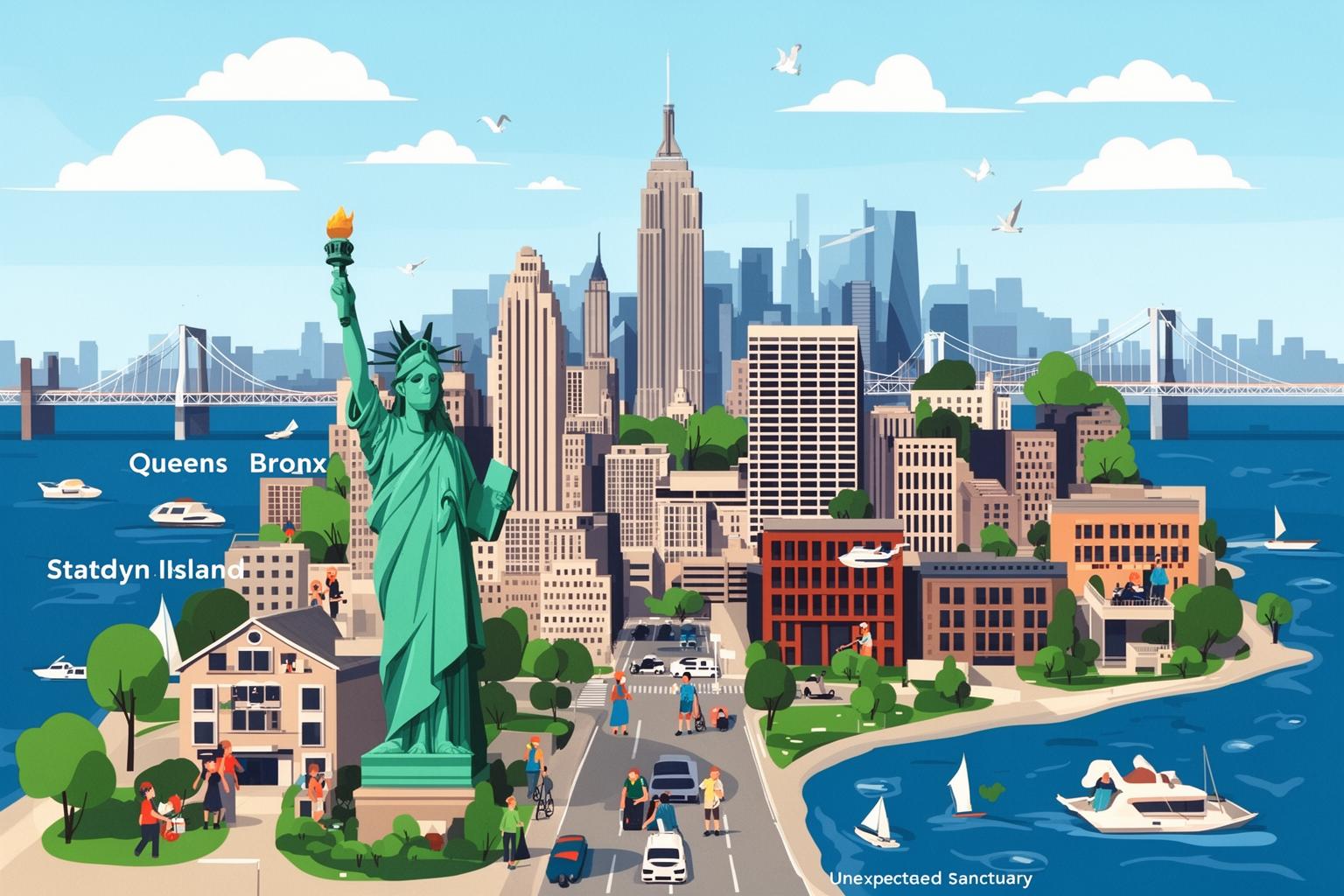
Our final borough is the one most frequently overlooked, the one you can’t reach by subway: Staten Island. Getting there is an adventure in itself and, best of all, it’s free. From the southern tip of Manhattan, at the Whitehall Terminal (accessible via the R/W trains at Whitehall St or the 1 train at South Ferry), you board the Staten Island Ferry. This 25-minute boat ride offers one of the best experiences New York has to offer. It sails past the Statue of Liberty and Ellis Island, providing panoramic views of the Lower Manhattan skyline, the harbor, and the Verrazzano-Narrows Bridge. This journey has been immortalized in countless films and shows, from establishing shots in Law & Order to the dramatic ferry disaster in Spider-Man: Homecoming.
The Greenest Borough and Its Hidden Gems
Upon arriving at the St. George Ferry Terminal in Staten Island, the pace of life immediately slows. The air feels fresher, the streets quieter. Staten Island is often called the “Borough of Parks” due to its abundant green spaces. The atmosphere here is suburban, a stark contrast to the dense urban environment of the other four boroughs. Directly from the terminal, you can hop on the Staten Island Railway (covered by your MetroCard or OMNY tap) or catch one of the many bus lines that branch out from the terminal. A short bus ride on the S40 or S44 will take you to the Snug Harbor Cultural Center & Botanical Garden, a beautiful complex of Greek Revival buildings that once served as a home for retired sailors. It’s a serene and lovely place to explore. For something truly unique, take the S62 or S92 bus to the Greenbelt, a network of parks and trails that feels like a real forest in the middle of the city. For a dose of history, the S76 bus can take you to Historic Richmond Town, a living history village preserving the island’s colonial past.
A Different Side of NYC
Staten Island reveals a side of New York that many visitors—and even many New Yorkers—rarely see. It’s a place of quiet residential neighborhoods, sprawling parks, and waterfront views looking back toward the distant, glittering skyline. It’s also home to the Wu-Tang Clan, one of hip-hop’s most legendary groups, whose gritty lyrics depicted life in the borough’s housing projects—a world apart from the tranquil gardens. This contrast is what makes Staten Island so captivating. It challenges your preconceived notions of what New York City is. A walk along the North Shore waterfront near the ferry terminal offers stunning views and a sense of calm. You can watch massive container ships glide into the harbor and see the city you just crossed laid out before you like a map.
The Journey’s End: A City United by Transit
As you ferry back from Staten Island to Manhattan, the setting sun casting shades of orange and purple across the skyline, you ponder the vastness and diversity of the city you’ve just explored. Five boroughs, countless neighborhoods, a multitude of cultures, all linked by the steady, unrelenting rhythm of the MTA. You’ve witnessed Manhattan’s cinematic shine, felt Brooklyn’s creative heartbeat, savored Queens’ global flavors, heard the Bronx’s foundational beats, and discovered Staten Island’s unexpected calm. You’ve journeyed from the Atlantic’s edge through the city’s dense core to quiet, tree-lined streets—all without stepping into a car. Navigating New York City by public transit is more than simply moving from point A to point B. It’s an immersion. A great equalizer where people from all walks of life share a space, a ride, a fleeting moment in the city’s life. You learn the city’s map not as a tourist, but as a commuter. You grasp its flow, its energy, its magnificent complexity. You’ve followed in the footsteps of legendary characters and pioneering souls, and in doing so, crafted your own New York story—one swipe, one tap, one journey at a time.