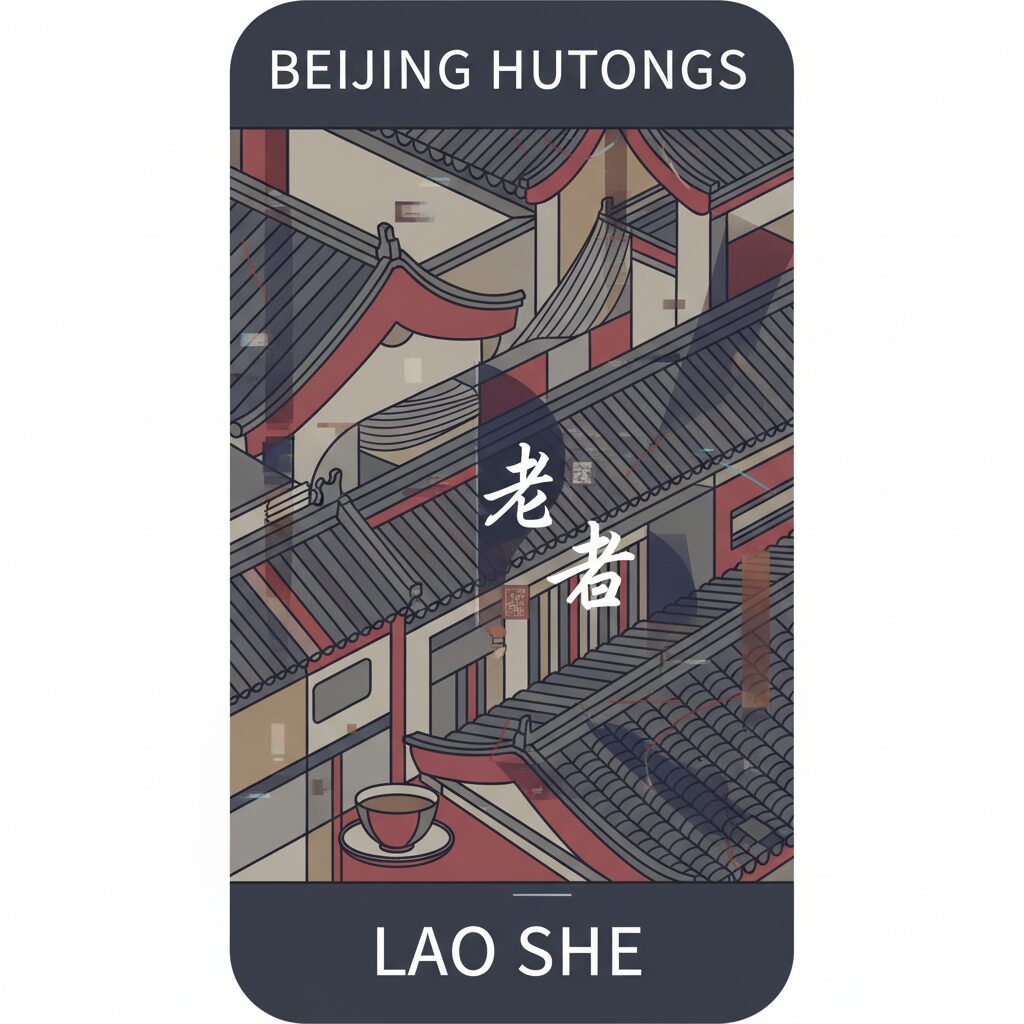
There are writers who capture a city, and then there are writers who become the city. Lao She, born Shu Qingchun, is the living, breathing soul of Beijing. To walk through the labyrinthine hutongs of China’s capital is to walk through the pages of his novels. His words are etched into the grey brick walls, whispered on the breeze that rustles the persimmon trees, and served steaming in the boisterous teahouses that still dot the urban landscape. He gave voice to the common person—the rickshaw puller, the beleaguered teahouse owner, the struggling artist—and in doing so, he chronicled the turbulent soul of a nation grappling with its own identity in the 20th century. A journey into the world of Lao She is more than a literary pilgrimage; it’s an intimate conversation with the past, a way to understand the heart of modern China through the compassionate, witty, and ultimately tragic lens of its most beloved storyteller. This is not a journey to monuments of stone, but to living spaces, to the quiet corners and bustling streets where his characters loved, suffered, and endured, and where the author himself penned a legacy that could not be erased. It is a quest to find the faint, yet persistent, pulse of Old Peking, a rhythm that still beats beneath the gleaming surfaces of the new Beijing.
This quest to find the pulse of Old Peking through its literature is a form of literary pilgrimage that connects readers to the soul of a place.
Beijing: The Cradle of a Literary Soul
To truly understand Lao She, one must begin in Beijing. It was not only his birthplace and muse but also the backdrop for his most poignant tragedies and comedies. The city is more than just a setting in his work; it acts as a character itself—a living entity with its own dialect, customs, and indefatigable spirit. Born a Manchu, a member of the Red Banner, in a small hutong near the city’s heart, the echoes of this identity, amid a declining dynasty and the dawn of a new era, resonate throughout his entire body of work. Our journey begins here, in the quiet alleys that nurtured his brilliance and later bore witness to his sorrow.
The Revered Grounds of Fengfu Hutong
Nestled in the Dongcheng District, just a short walk from the bustling Wangfujing, lies a haven of deep tranquility: No. 19 Fengfu Hutong. This is the Lao She Memorial Hall, the author’s final residence and where he spent his most prolific post-war years. Passing through its modest gate is like stepping out of the 21st century and into a time capsule preserved from the 1950s. The atmosphere feels distinct, heavy with untold stories. The small courtyard, shaded by two persimmon trees planted by Lao She and his wife, Hu Jieqing, invites contemplation even before entering the home. In autumn, their branches bend under fiery orange fruit, symbolizing prosperity and happiness—an evocative contrast to the writer’s later days. He called his home the ‘Courtyard of the Persimmons,’ speaking of these trees with deep affection.
The house itself is a classic Beijing Siheyuan, or courtyard residence, though modest in size. It exudes quiet dignity. The rooms remain exactly as he left them. The living room’s simple furniture and family photos tell the story of a man who, despite fame, treasured a life of domestic simplicity. You can see the chrysanthemums he cultivated—a passion that provided a gentle counterbalance to the often-harsh realities reflected in his writing. Yet, it is his study that commands the most reverence. This small, sunlit room is almost monastic in its austerity. A wooden desk, an inkstone, brushes, and stacks of books. Here, at this very desk, he penned some of his most enduring works, including the magnificent play Teahouse. Standing in the doorway, one can almost feel the creative energy that once filled this space—the silent scratch of pen on paper, the mind of a master weaving the destinies of dozens of characters through half a century of Chinese history. The silence here stands as a powerful testament to a voice that, though silenced, continues to speak profoundly. Visiting the memorial is an intensely personal experience best savored on a weekday, when crowds are sparse, giving you space to absorb its atmosphere. Pause in the courtyard beneath the persimmon trees and reflect on the immense creative spirit and humanity this humble home contained.
Pursuing Xiangzi’s Shadow: Walking the Streets of Rickshaw Boy
To fully grasp Lao She’s Beijing, one must step beyond the museum and follow the ghostly footsteps of Xiangzi, the tragic protagonist of his most renowned novel, Rickshaw Boy (Luotuo Xiangzi). The novel presents an unvarnished, gritty depiction of life at society’s lowest rungs in Republican-era Beijing. Xiangzi’s dream is simple: to own his own rickshaw. This modest aspiration becomes a heroic struggle against fate, social injustice, and the city’s crushing indifference. His journey offers a tour of Beijing’s soul—from grand boulevards to destitute slums.
While the towering city walls that once defined Xiangzi’s world have given way to the roaring traffic of the Second Ring Road, their memory lingers. You might begin near Andingmen or Deshengmen, gates through which Xiangzi would have pulled his rickshaw, hauling goods and passengers, his body straining under the weight of his dreams. From there, imagine his route. He would have moved through the wide-open spaces near the Forbidden City and Beihai Park—places of imperial splendor where he remained an invisible servant, his sweat and toil sharply contrasting with the leisurely lives of those he ferried. Now polished for tourists, these areas were once the domain of the powerful—a world Xiangzi could see but never penetrate.
Next, explore the hutongs surrounding the Drum and Bell Towers. These ancient landmarks once set the pace for the city, and the alleys around them teemed with working-class life. Though many hutongs have been gentrified, some still preserve the essence of old Beijing. Notice small details: a resident tending to potted plants, the clatter of a mahjong game from an open window, the aroma of street food being prepared. This was Xiangzi’s world—a close-knit, often struggling community. Further south lies Tianqiao, the “Bridge of Heaven.” In Xiangzi’s time, this area thrived as a chaotic hub of popular entertainment. Acrobats, storytellers, opera singers, and food vendors filled the streets, providing inexpensive diversions for the city’s poor. Today, Tianqiao is more sanitized, but its heritage as a folk art and performance center endures. Visiting the Tianqiao Performing Arts Center or simply wandering the neighborhood, one can try to summon the cacophony and vitality Lao She depicted so vividly. Tracing Xiangzi’s path is a lesson in social geography, revealing the stark divides between rich and poor and how a person’s fate could be shaped entirely by their birthplace. It’s a compelling way to link the text to the physical landscape and appreciate the profound social critique woven through Lao She’s narrative.
The Stage of an Era: Seeking Out the Old Teahouses
No exploration of Lao She’s Beijing would be complete without honoring the teahouse. In his masterpiece Teahouse, the Yutai Teahouse is not just a setting; it is a microcosm of China itself. Through its patrons’ conversations over fifty years—from the last Qing days to the Republic’s rise and the aftermath of war—Lao She chronicles his country’s dramatic and often painful transformations. The teahouse served as old Beijing’s public living room, where business was conducted, disputes resolved, news exchanged, and art performed. It was the beating heart of the city’s social life.
Though the original Yutai Teahouse is fictional, its spirit survives. To experience it, visit one of the city’s modern establishments embracing this tradition, such as the Lao She Teahouse in Qianmen. Though a tourist spot, it offers an excellent introduction to the culture. Here, you can sip fragrant jasmine tea, sample traditional Beijing snacks like flaky pastries and seasoned beans, and enjoy performances ranging from Peking Opera excerpts to acrobatics and magic shows. It’s a dazzling display that captures the lively, immersive spirit of historic teahouses. The visit provides a tangible connection to the world of Manager Wang, the play’s beleaguered protagonist, who simply seeks to run his business peacefully amid relentless political upheaval.
For a more genuine local experience, stray from the main tourist areas. Seek out smaller teahouses tucked in the hutongs—places where elderly men gather with their caged birds, spending hours chatting and sipping tea. These venues are quieter, less theatrical and more community-centered. Here, you feel the slow, contemplative rhythm that defined teahouse life. Listen to the cadence of the Beijing dialect, the sharp click of mahjong tiles, the melodic chirping of birds. This is the atmosphere Lao She knew and cherished—the wellspring for the hundreds of voices populating his works. In these humble spaces, it becomes clear that the teahouse was far more than a business; it was an essential institution, a stage upon which the grand drama of everyday life played out, cup by cup.
Jinan: The City of Springs, A Writer’s Respite
After the intense and often overwhelming energy of Beijing, Lao She’s time in Jinan marked a period of relative calm and remarkable productivity. He relocated to the capital of Shandong province in 1930 to teach at Qilu University and called it his “second hometown.” The city’s gentle charm, characterized by its many natural springs and the tranquil Daming Lake, offered a soothing refuge that inspired a flood of creativity. It was here that he penned several novels and countless essays, including the elegant prose piece, “The Springs of Jinan,” a heartfelt tribute to the city’s distinctive landscape.
Following the Water: Baotu Spring and Daming Lake
A pilgrimage to Lao She’s Jinan is a journey led by water. The city’s essence lies in its springs, with Baotu Spring being the most renowned. Lao She described its rushing waters with poetic admiration. Visiting the park surrounding it today, one can still witness this natural wonder. The crystal-clear water gushes from the earth in three powerful streams, producing a steady, gentle roar. On a cool morning, steam rises from its surface, creating a mystical ambiance. Wandering through the park, adorned with traditional pavilions, rockeries, and willow-lined ponds, it becomes clear why the place enchanted him. It’s a landscape that invites peaceful contemplation. Settling on a stone bench to listen to the water and perhaps read his essay on the springs allows you to see the scenery through his eyes.
From the springs, the water flows northward, forming the stunning Daming Lake. Unlike the imperial lakes of Beijing, Daming Lake feels more natural and deeply woven into the city’s daily life. Lao She wrote about the lotus flowers that covered the lake in summer and the weeping willows along its shores. A boat ride on the lake is a must. As you glide across the water, the modern city skyline fades, leaving you surrounded by timeless beauty. The Lixia Pavilion, situated on an island at the lake’s center, provides an ideal viewpoint. It’s easy to imagine Lao She taking such a boat ride himself, gathering inspiration that would flow into his writing. Jinan’s atmosphere exudes gentle elegance, a city that seems to move more slowly, its rhythm set by the steady flow of its springs. For Lao She, it was a creative sanctuary, a refuge from the political unrest of the time where he could simply write. Exploring its natural beauty connects one with a happier, more peaceful chapter in the author’s life.
Qingdao: A Coastal Interlude of Modernist Inspiration
Lao She’s journey led him to another city in Shandong province, but one with a distinctly different character: Qingdao. This coastal city, with its history as a German concession, presented a unique fusion of European architecture and Chinese seaside life. He lived here from 1934 to 1937, during which time he completed his masterpiece, Rickshaw Boy. The city’s relaxed ambiance, fresh sea air, and distinctive urban landscape offered a fresh source of inspiration, far removed from the dusty hutongs of Beijing and the serene springs of Jinan.
German Villas and Seaside Views
To discover Lao She’s Qingdao, you should explore the city’s older districts, especially the area known as Badaguan. This neighborhood is renowned for its elegant villas, each designed in a different European architectural style, surrounded by lush gardens and tree-lined streets leading to the sea. The atmosphere feels less like China and more like a peaceful European spa town. This unique setting served as the backdrop for Lao She’s life here. His former residence, located at 33 Huangxian Road, is a charming yellow villa now part of a cultural complex. Though its interior has been renovated, the exterior and neighborhood remain well preserved. Standing outside, you can look down the quiet street and imagine him taking daily walks, breathing in the salty air from the Yellow Sea.
He likely strolled along the city’s stunning coastline, from the lively Zhanqiao Pier to the golden sands of its numerous beaches. The sea is a constant presence in Qingdao, its vastness and rhythmic tides offering a profound sense of perspective. For a writer wrestling with the immense social issues of his country, this coastal setting may have provided a much-needed sense of space and clarity. A recommended pilgrimage for literary enthusiasts is to retrace this walk—starting at his former home, wandering through the streets of Badaguan to admire the architecture, then heading down to the boardwalk. Feel the sea breeze, watch the waves crashing on the shore, and reflect on how this change of scenery shaped the final chapters of Xiangzi’s story, which he was passionately writing at the time. Qingdao gave Lao She a modern, cosmopolitan environment, and this exposure to a different kind of Chinese city, heavily influenced by foreign presence, expanded the scope of his literary world.
Chongqing: A Writer’s Stand in the Wartime Capital
The peaceful interlude in Jinan and Qingdao abruptly ended with the onset of the Second Sino-Japanese War in 1937. Like millions of his fellow countrymen, Lao She was compelled to flee inland. He ultimately settled in Chongqing, which had become the provisional capital of Nationalist China. The war experience profoundly changed him and his writing. His time in Chongqing was not characterized by tranquil creativity, but by patriotic responsibility. He assumed leadership of the All-China Resistance Association of Writers and Artists, a highly influential organization that rallied intellectuals to support the war effort. His life there was marked by hardship, political involvement, and steadfast resilience.
The Mountain City of Fog and Resistance
Chongqing is a city shaped by both its geography and adversity. Nestled on steep hills at the meeting point of the Yangtze and Jialing rivers, it is known for its stifling summer heat and constant fog. During the war, this fog offered some protection against relentless Japanese bombing raids aimed at breaking the spirit of Chinese resistance. Life was incredibly harsh. Resources were limited, and the threat of death ever-present. This is the environment Lao She endured for nearly eight years. To fully grasp his wartime experience, one must first appreciate the city’s dramatic terrain. Riding the cable car across the Yangtze River reveals the vastness of the landscape, the sheer cliffs, and the swirling waters that shielded the capital. Imagine the city plunged into darkness at night, the silence broken only by the terrifying sound of air raid sirens.
Lao She lived in Beibei, a rural suburb where many universities and intellectuals had relocated. His small, modest home became a gathering spot for the literary community. Today, visitors can see the site, which, although not as meticulously preserved as his Beijing residence, still conveys a powerful sense of that era. It was here, amid the chaos and deprivation of war, that he wrote patriotic plays, organized writers, and wielded his pen as a weapon. His work from this time shifted from the subtle character studies of his earlier novels to more explicit themes of resistance and national salvation. A visit to the Stilwell Museum, dedicated to the American general who collaborated with Chinese forces, provides further insight into the vast international effort centered in this mountain city. Walking the hilly, winding streets of Chongqing offers an understanding of the determination that Lao She and his generation embodied. It was a period of immense suffering but also remarkable unity and resolve—a chapter in his life that established his legacy not only as a great writer but also as a devoted patriot.
London: The Awakening of a Modern Novelist
Long before the upheaval of war, a different journey had profoundly shaped Lao She as a writer. In 1924, he accepted a position teaching Mandarin at the School of Oriental Studies (now SOAS) in London. He spent five years in the city, a period that became his literary apprenticeship. Immersed in a foreign culture and language, he eagerly consumed English literature, particularly the works of Charles Dickens. This encounter was transformative. In Dickens’s London, with its sharp social contrasts, quirky characters, and deep empathy for the poor, Lao She found a model for what he aimed to achieve in his own writing about Beijing.
From the Fog of London to the Soul of Beijing
Following Lao She’s footsteps in London requires imagination, as the city has changed dramatically. Yet the atmosphere that inspired him can still be sensed. He lived in Bloomsbury, near the university, an area known for its leafy squares, Georgian townhouses, and intellectual vibrancy. A stroll through Russell Square or Gordon Square, where students and professors hurried by, connects you to his academic world. By all accounts, he was a committed teacher, but his true education took place beyond the classroom.
It was through exploring the broader city that his novelist’s eye was honed. He would have been captivated by the London fog, the “pea-soupers” that famously enveloped the city in a mysterious haze. This atmospheric detail, central to Victorian literature, likely influenced his own skillful use of setting. More significantly, he witnessed the severe poverty in areas like the East End, a realm of docks, slums, and factories that reflected the hardships endured by the underclass in his native Beijing. He observed how Dickens used humor and pathos to humanize the marginalized, making their struggles both compelling and unforgettable. It was in London that Lao She wrote his first novels, experimenting with the techniques he was learning. This overseas experience gave him a critical distance from his own culture, enabling him to see it with fresh eyes. When he finally returned to China, he came back not only as a teacher but also as a novelist with a clear goal: to become the Dickens of Beijing. A visit to the Charles Dickens Museum at 48 Doughty Street offers a fascinating parallel journey. Seeing the place where Dickens wrote Oliver Twist and Nicholas Nickleby allows one to feel the direct influence on Lao She’s own study in Beijing and his creation of Rickshaw Boy.
A Final Bow: Taiping Lake and an Enduring Legacy
The story of Lao She ends where it began: in Beijing. Yet, the city to which he returned was not the same as the one he had left. Following the establishment of the People’s Republic in 1949, he was initially honored as a “People’s Artist.” However, with the onset of the Cultural Revolution in 1966, the political climate changed with alarming speed. Alongside countless other intellectuals, he was labeled a counter-revolutionary, publicly humiliated, and brutally beaten by the Red Guards.
On a grim day in August 1966, after enduring one final, vicious “struggle session,” the great writer left his home and made his way to Taiping Lake in the western part of the city. What followed remains cloaked in the painful silence of that era. He was found dead the next day. The official ruling was suicide—a final, desperate act of a man whose spirit had been shattered. His death is a profound tragedy and a stark symbol of a time when China turned against its most brilliant minds.
Today, Taiping Lake no longer exists in its original form. The site has been redeveloped into a park and financial district, with no grand monument marking the place. Visiting the area offers a somber experience, a space for quiet reflection on the fragility of art and life amid ideological fury. Yet, Lao She’s story does not end at the waters of Taiping Lake. His legacy proved far more enduring than his persecutors. After the Cultural Revolution concluded, his works were rehabilitated and republished, embraced by a new generation eager to reconnect with their nation’s genuine cultural heritage. His voice, once brutally silenced, rang out again, speaking truth to power with wit, compassion, and deep insight into the human condition.
To journey through Lao She’s world is to understand that his spirit is not confined to his former homes or the pages of his books. It lives on in the streets of Beijing—in the resilient humor of a taxi driver navigating traffic, in the quiet dignity of an elderly woman tending her plants in a hutong courtyard, and in the lively arguments and laughter spilling from a neighborhood restaurant. He captured the soul of a people, the distinctive “Beijing flavor” that is both earthy and profound. He taught us that the greatest dramas often lie in the small, everyday struggles for dignity and survival. To walk through his city is to realize that every face tells a story, and every alley holds an echo of the past. Lao She gave these stories a voice, making him not just a writer but the eternal, unforgettable conscience of Beijing.