To walk through Cairo is to walk through the pages of a story written in stone, spice, and the ceaseless murmur of human life. It’s a city that breathes history, a living labyrinth where every corner holds a tale, every shadow a secret. And no one, perhaps in the history of modern literature, has captured this city’s soul quite like Naguib Mahfouz. The 1988 Nobel Laureate in Literature didn’t just write about Cairo; he inscribed its very essence into his novels, making the city a character as vital and complex as any of the unforgettable figures who populate his works. For those who have been moved by his Cairo Trilogy, mesmerized by the allegory of Children of Gebelawi, or haunted by the desperation in Midaq Alley, a journey to Cairo is more than a vacation. It is a pilgrimage. It is an opportunity to step beyond the ink and paper and into the tangible world that forged a literary giant, to see the very alleys that echoed with the footsteps of his characters, and to sit in the same smoky cafes where he sat, observing the grand, chaotic, and beautiful drama of Egyptian life unfold. This is a guide to that pilgrimage, a journey not just through physical space, but through the heart of Mahfouz’s imagination, a city that remains, to this day, as vibrant and enigmatic as he rendered it.
Just as Mahfouz’s Cairo offers a pilgrimage through literary space, you can also trace the contours of exile and identity in the footsteps of Milan Kundera.
The Birthplace of a Legend: Gamaliya, the Heart of Old Cairo
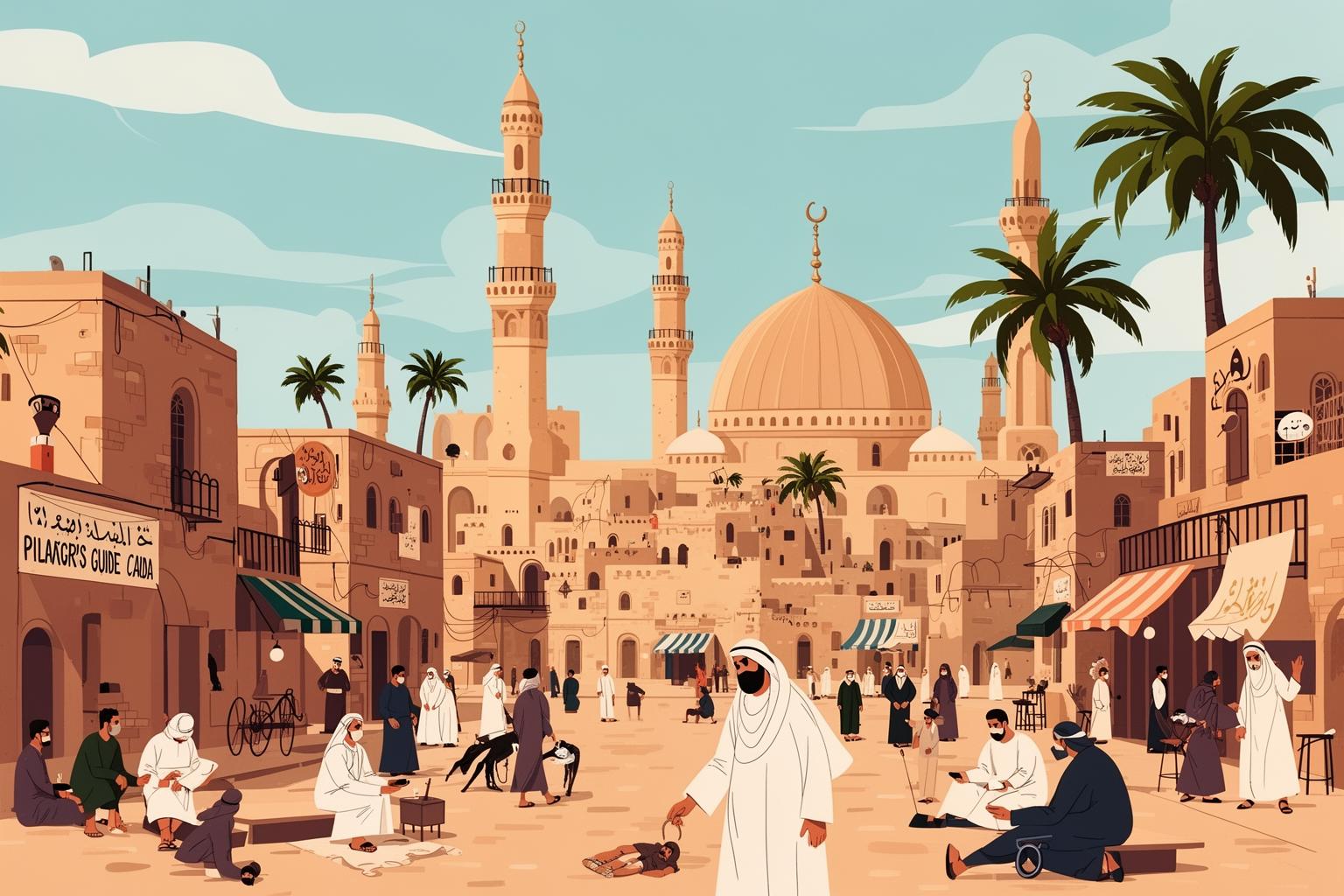
Our journey starts where his began, in the ancient district of Gamaliya. Born here in 1911, Mahfouz’s earliest memories were filled with the sensory richness of this medieval quarter. This is the heart of Islamic Cairo, a place where time appears to fold upon itself. The grand history of sultans and scholars feels as immediate as the lively bustle of merchants and schoolchildren. To navigate Gamaliya is to abandon the logic of straight lines and surrender to the flow of its narrow, winding streets. The air is a dense tapestry of aromas: the sweet perfume of shisha smoke blending with the sharp fragrance of ground cumin and coriander from a spice vendor’s stall, the strong scent of freshly brewed coffee, and the ever-present, dusty smell of history itself. This is the world Mahfouz absorbed, the essential setting for much of his literary universe.
A Labyrinth of Inspiration
The alley, or hara, embodies the quintessential Mahfouzian landscape, and Gamaliya stands as its living model. These are not just streets; they are intimate, semi-private realms, social ecosystems where every drama, from the most trivial family quarrel to the deepest existential crisis, unfolds in the public-yet-private theater of the lane. As you walk, look up. The intricately carved wooden balconies called mashrabiyas lean toward each other, nearly touching, forming a canopy that filters the harsh Egyptian sun into a soft, dappled light. They allowed the women inside to watch the street below without being seen, a perfect metaphor for the silent observation Mahfouz himself mastered. It was in these alleys that he learned to listen, to watch the complex dance of social duties, forbidden desires, and resilient faith that formed the foundation of his storytelling. The vendors’ shouts, the call to prayer from a dozen minarets, the laughter of children playing football with a makeshift ball—these sounds compose the city’s eternal soundtrack, a rhythm that pulses through his prose.
Echoes of the Cairo Trilogy
Nowhere is Gamaliya’s spirit more vivid than in Mahfouz’s masterpiece, the Cairo Trilogy. The three novels—Palace Walk, Palace of Desire, and Sugar Street—are named after actual streets in and around this district. While you won’t find the exact home of the tyrannical patriarch al-Sayyid Ahmed Abdel Gawad, you will find his world perfectly preserved. The architecture of a traditional Cairene merchant’s house, with its grand wooden door, hidden inner courtyard, and separate quarters for men and women, reveals much about the society Mahfouz portrayed. You can almost sense the formidable patriarch striding these streets, a man of stern piety at home and unrestrained indulgence outside. You can picture his sheltered daughters, Aisha and Khadija, peering through the mashrabiya, their world confined to the house, and his rebellious son Kamal, grappling with the profound changes of modernity, philosophy, and unrequited love. Walking through Gamaliya is like walking alongside the al-Jawad family, to feel the political fervor of the 1919 revolution against British rule, and witness the slow, painful, and exhilarating birth of a new Egypt. Take your time, wander without a map, and let the stones themselves reveal the stories.
Finding Bayt al-Qadi
For a particular point of reference, explore the area around Bayt al-Qadi, a Mamluk-era palace. This square, with its grand public spaces and adjacent winding alleys, is often mentioned as a key influence on the Trilogy’s settings. It embodies the intersection of power and everyday life. Here, you can sit on a stone bench and absorb the atmosphere. Observe artisans in their workshops, hammering intricate patterns into copper and brass, a craft handed down through generations. The endurance of these traditions stands as a testament to the resilience of the culture Mahfouz captured. This is not a sanitized historical theme park; it is a living, breathing neighborhood. The best way to experience it is to shed the tourist’s identity and become an observer. Find a small, local ahwa, order a glass of sweet mint tea, and simply watch. This is precisely the approach Mahfouz used, transforming quiet observation into profound art.
The Cafes of Cairo: Intellectual Hubs and Observational Posts
If the hara was Mahfouz’s school, then the Cairene coffeehouse served as both his university and office. These were far more than mere places to grab a drink; they were the lifeblood of the city’s intellectual and social existence. It was within these walls that ideas were debated, political movements took shape, and the raw essence of human character was openly displayed. For Mahfouz, a creature of habit, certain cafes became indispensable to his daily routine and creative process. Visiting them today provides a direct link to his living, working spirit.
Al-Fishawi’s: A Reflection of Time
Hidden in the heart of the lively Khan el-Khalili bazaar, Al-Fishawi’s Cafe stands as perhaps the most renowned coffeehouse in the Arab world. Founded in 1797, it feels less like a cafe and more like a time capsule. Upon entering, you are immediately surrounded by ornate, age-stained mirrors, dark wood, and the steady, rhythmic clatter of tea glasses and backgammon pieces. The mirrors that cover every wall were said to help the owner oversee the entire establishment, but today they offer a more poetic role. They reflect the continuous flow of humanity that has passed through these doors for over two centuries: merchants, tourists, revolutionaries, lovers, and, naturally, writers. Naguib Mahfouz was among its most devoted patrons. He had a favored corner where he would meet friends, engage in discussions, and quietly absorb the theater unfolding around him. It was an ideal vantage point for a novelist, a place to study the gestures, conversations, and hidden anxieties of his fellow Cairenes. Sitting in Al-Fishawi’s, one can sense his presence. Order a pot of strong Egyptian coffee or a warm glass of mint tea, and watch the reflections in the mirrors. You’ll witness the modern world of smartphones and tour groups alongside a timeless, unhurried rhythm of life Mahfouz would have immediately recognized.
Riche Cafe: A Parisian Salon in the Heart of Cairo
If Al-Fishawi’s symbolizes Cairo’s traditional, Oriental soul, Riche Cafe represents its cosmopolitan, European-influenced intellectualism. Situated in the grand, Haussmann-style downtown district, Riche exudes a distinctly different energy. Established in 1908, it became the favored gathering spot for the city’s political and literary elite. Its ambiance resembles more a Parisian salon than an Eastern ahwa. This was the epicenter of political intrigue; plans for the 1919 revolution were reportedly devised within its walls. For Mahfouz and his peers, it was a crucial forum for artistic and philosophical debate. Here, he would engage with literary giants such as Taha Hussein and Tawfiq al-Hakim, deliberating the future of the Arabic novel. The history held within these walls is tangible, and at times, violent. Just outside his cherished Riche, Mahfouz survived an assassination attempt in 1994—an act of extremism by those who misinterpreted his allegorical novel Children of Gebelawi. The attack left him with lasting nerve damage, yet Cairo’s intellectual community, nurtured by cafes like Riche, united in a powerful show of solidarity. Visiting Riche today is to honor not just Mahfouz but the entire tradition of free thought and artistic expression he upheld.
The Culture of the Ahwa
Beyond these two iconic venues, travelers should take time to appreciate the broader culture of the ahwa (coffeehouse). Found on nearly every street corner—from the most ancient alley to the most modern boulevard—they have traditionally been male domains where men come after work to unwind, play dominoes or backgammon, smoke shisha, and discuss everything from football to politics. This social institution is key to understanding the fabric of Egyptian society, which Mahfouz so thoroughly documented. It is in the relaxed, unguarded environment of the ahwa that the true character of the city reveals itself. For visitors, sitting quietly in one of these establishments offers a more authentic glimpse into everyday life than any museum. There is no need to feel intimidated; a polite greeting is generally met with warmth. It is within these simple, everyday spaces that the spirit of Mahfouz’s democratic, human-centered literature truly lives on.
From Ancient Alleys to Modern Avenues: Mahfouz’s Evolving Cairo
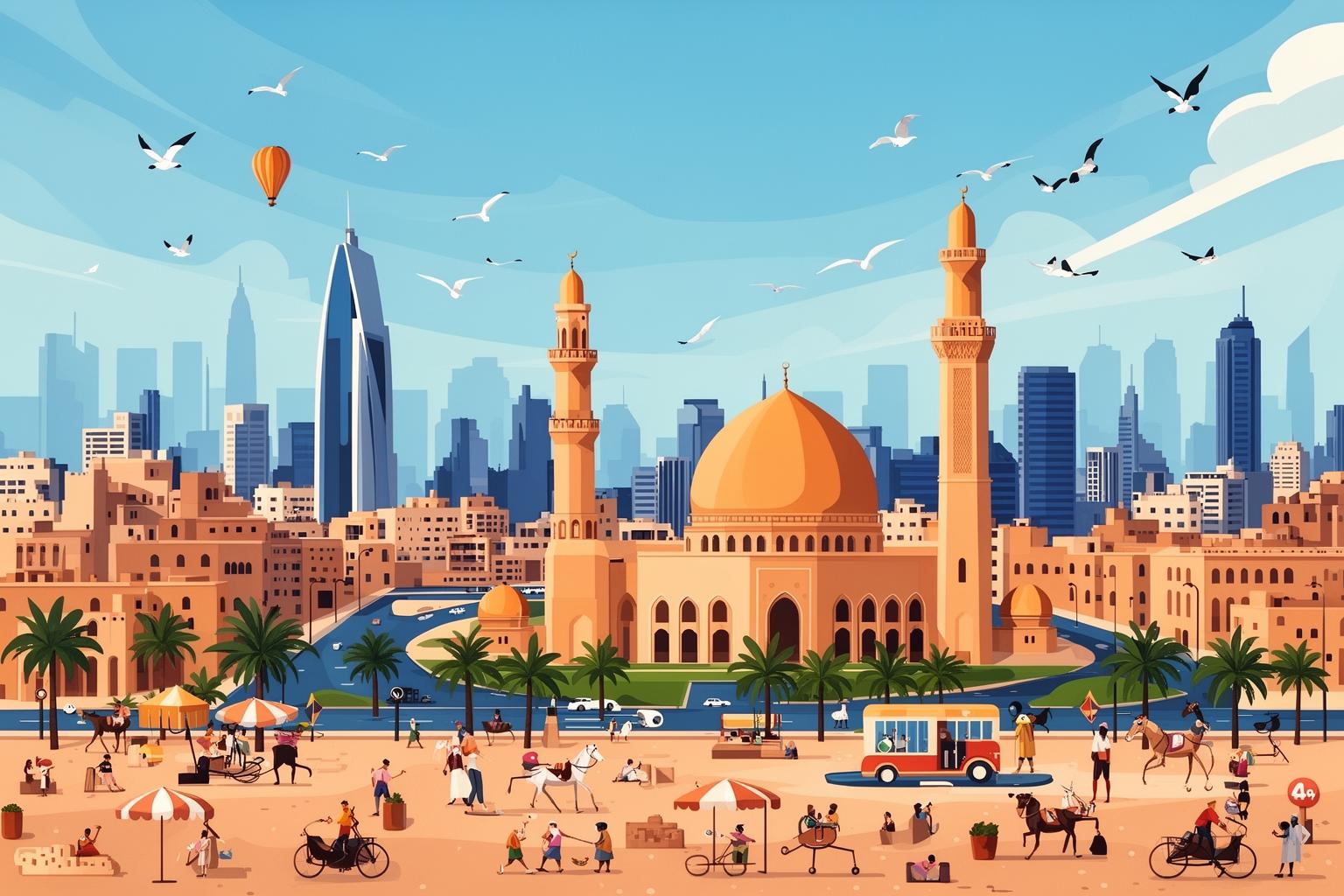
Mahfouz’s genius lay in his ability to portray a city in transition. His work serves as a chronicle of Cairo’s transformation from a traditional, inward-looking society to a multifaceted modern metropolis, grappling with Western influence, political turmoil, and existential uncertainty. Therefore, a literary pilgrimage must also follow this progression, moving from the medieval core of the city to its contemporary thoroughfares.
El-Hussein and Al-Azhar: The Spiritual Heart
The district surrounding the Al-Hussein Mosque and the Al-Azhar Mosque and University is the undisputed spiritual heart of Old Cairo. Al-Azhar, one of the world’s oldest universities, has been a beacon of Islamic learning for over a thousand years. The grand square before Al-Hussein Mosque buzzes constantly with activity, serving as a space of deep devotion and lively commerce. This neighborhood symbolizes the enduring faith and tradition that shaped the moral foundation of Mahfouz’s characters, even as they wrestled with it. It is a world of piety, Ramadan nights, and religious festivals that united the community. This spiritual force is a strong undercurrent in his writing, especially evident in his more philosophical and allegorical novels, most notably Children of Gebelawi. This contentious masterpiece reimagines the stories of Adam and Eve, Cain and Abel, Moses, Jesus, and Muhammad within the setting of a Cairene alley. It is a profound exploration of humanity’s quest for God and social justice, deeply entrenched in the spiritual language of Al-Azhar’s world. Though serialized in a newspaper, the novel was banned in book form in Egypt for decades, highlighting the very conflict between religious tradition and artistic inquiry that Mahfouz bravely confronted. Standing in the shadow of Al-Azhar’s minarets, one can sense the weight of history and the courage required to pose such questions.
Downtown Cairo (Wust al-Balad): The Allure of the West
A short taxi ride from Gamaliya brings you to a different realm: Downtown Cairo, or Wust al-Balad. Constructed in the late 19th and early 20th centuries by Khedive Ismail, who dreamed of a “Paris on the Nile,” this district is a harmonious blend of grand boulevards, ornate Belle Époque buildings, and expansive squares like the well-known Talaat Harb Square. This was the Cairo of Mahfouz the civil servant. For much of his adult life, he worked in various government ministries housed in these stately buildings. This represented the world of the rising Egyptian middle class—characters who wore Western suits rather than gallabeyas, worked in offices instead of workshops, and whose aspirations were shaped by European films and ideas. Novels like Midaq Alley, though set in an old alley, skillfully depict the clash between these two worlds, as residents are both tempted and tormented by the glamour and perceived corruption of the modern city beyond their lane. Works such as The Beginning and the End chronicle the desperate efforts of a family struggling to maintain its social standing in this harsh new urban environment. Walking from Gamaliya to Wust al-Balad traces the central conflict in much of Mahfouz’s work: the challenge of forging a modern identity without losing one’s soul.
Groppi and the Lost Cosmopolitanism
Within Downtown, certain landmarks evoke a particular, nostalgic past. The legendary tearoom Groppi, though its prime has waned, remains a monument to a more cosmopolitan Cairo. At its height, it was a dazzling venue where Egyptian pashas, British officers, and European expatriates mingled over coffee and pastries. This was the Cairo of King Farouk, a city bustling with Italian, Greek, Jewish, and Armenian communities. Mahfouz often expressed deep nostalgia for this vanished era of multiculturalism, a time before the mid-20th century revolutions and wars altered the city’s demographics profoundly. Visiting places like Groppi, or merely admiring the European architecture Downtown, offers a connection to the powerful sense of saudade permeating many of his novels—a longing for a more innocent, or perhaps more complex, version of his beloved city.
The Nile’s Embrace: Reflections on Life and the City
The Nile is Egypt’s lifeblood, and for Mahfouz, it served as a constant, powerful symbol. It embodied the unending flow of time, the origin of life, and a place for quiet reflection away from the claustrophobic intensity of the alleys. No exploration of his world is complete without spending time along its banks.
A Walk Along the Corniche
Mahfouz was an enthusiastic walker, and one of his favorite habits was to take long strolls along the Nile Corniche, the wide roadway lining the river’s edge. This is where Cairo breathes freely. The city expands, the sky opens wide, and the gentle river breeze offers a break from the urban heat. Walking here, especially in the golden light of late afternoon, is a profoundly meditative experience. You can watch the feluccas, traditional wooden sailing boats, glide silently across the water, their white sails stark against the modern skyline. It’s a scene that feels timeless. For Mahfouz, the river was a setting for introspection. In his novel Adrift on the Nile, a group of disillusioned intellectuals gather on a houseboat, smoking hashish and engaging in philosophical debates as they drift aimlessly, cut off from the political and social realities of Nasser’s Egypt. The novel captures a sense of national malaise, and the Nile itself becomes a metaphor for their moral and spiritual drift. Walking along the Corniche allows you to connect with this reflective side of Mahfouz’s psyche, inviting contemplation of the larger questions of life, death, and meaning that he so skillfully explored.
The View from Zamalek and Garden City
The character of the Nile shifts according to the neighborhood from which you view it. From the elegant, leafy districts of Zamalek—an island in the Nile—and Garden City, the view is one of quiet luxury. These areas, with their embassies, art galleries, and upscale apartment buildings, embody the upper strata of Cairene society. They contrast sharply with the poverty and piety of Gamaliya. Mahfouz excelled at unpacking the Egyptian class system, and the stark differences between these neighborhoods vividly reflect the social divides he depicted. Watching the feluccas sail past the exclusive Gezira Sporting Club in Zamalek reveals the disparate worlds that coexist, often tensely, within the same city. Mahfouz gave voice to them all—the pashas and the beggars, the intellectuals and the artisans—and exploring the full geographic spread of his Cairo is crucial to grasping the expansive scope of his vision.
A Legacy in Stone and Spirit: The Naguib Mahfouz Museum
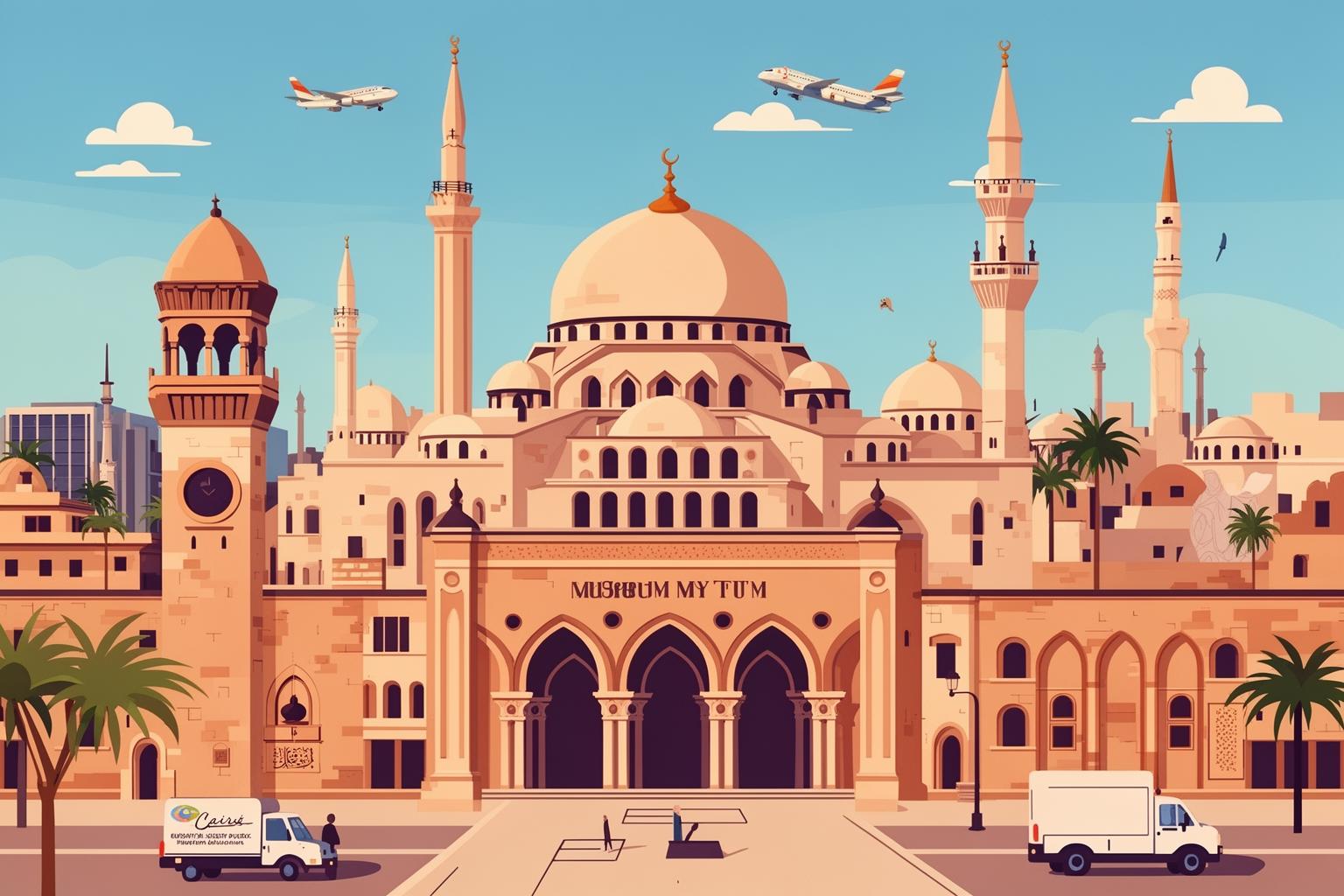
For any literary pilgrim, the journey reaches its peak at the Naguib Mahfouz Museum. Opened in 2019, this institution serves as a beautifully curated homage to the writer’s life and work, with a location as significant as its exhibits. Rather than being housed in a sterile modern structure, it occupies the historic Mohammed Bey Abu el-Dahab Tekkiye, an 18th-century Ottoman-era building in the Al-Azhar area, bringing Mahfouz’s legacy full circle—back to the heart of the old city that inspired him.
A Modern Tribute in a Historic Setting
The museum itself is a design masterpiece, honoring the historic building’s integrity while integrating sleek, contemporary displays. Visiting here is like journeying through Mahfouz’s entire life. You can view his personal belongings: his iconic large-lensed glasses, the desk where he painstakingly wrote his novels by hand, and shelves filled with his books in dozens of languages. The centerpiece is, of course, his Nobel Prize medal, symbolizing how this man, who seldom left his city, told a story so deeply local that it became universal. The exhibits track his literary evolution, from his early Pharaonic-themed novels to his realist masterpieces and later experimental and allegorical works. Interactive displays and well-crafted explanations provide context, making his complex world accessible even to those unfamiliar with his entire body of work.
More Than Just a Museum
What makes the museum remarkable is that it is not merely a static collection of artifacts but a living cultural center. It includes a library with his complete works and critical studies, a lecture hall, and spaces for artistic events. This reflects Mahfouz’s own belief in literature as a dynamic, ongoing conversation. A visit here feels less like a solemn memorial and more like a celebration of a continuing legacy. After experiencing the chaos and energy of the Cairene streets, the museum offers a quiet, contemplative space to piece everything together. It is here one can truly appreciate the magnitude of his achievement and the profound love he had for the city that was his sole muse. Be sure to check the opening hours before you visit and plan to spend several hours to fully absorb the wealth of information and inspiration it holds.
A Traveler’s Guide to Mahfouz’s World
Navigating Cairo can be an intense yet rewarding experience. A few practical tips will help you make the most of your literary pilgrimage and connect more deeply with the city’s spirit.
Navigating the Alleys
When wandering through Old Cairo, forget any hope of walking in a straight line. The pleasure lies in getting lost. Wear your most comfortable shoes, as you’ll be walking extensively on uneven cobblestones. Don’t hesitate to slip into a narrow lane that catches your eye; it might lead to a hidden courtyard, a beautiful mosque, or an artisan’s workshop. While exploring alone is an adventure, consider hiring a local guide for at least half a day. A knowledgeable guide, especially one who appreciates Mahfouz, can highlight subtle details and share oral histories that bring the streets to life in ways a guidebook cannot. They translate the city’s heartbeat for you.
The Rhythm of the City
Cairo moves to its own unique rhythm. To truly experience it, explore at different times of the day. Visit Gamaliya early in the morning when shops are just opening and the air remains cool. The light is soft and beautiful, and you can observe the neighborhood waking up slowly. Evenings hold a different kind of magic. This is when the city truly comes alive. Cafes fill up, lanterns in Khan el-Khalili are lit, and the streets swell with families and friends socializing. If your visit takes place during Ramadan, you will encounter another side of Cairo altogether. The days are quiet and fasting, but after sunset, the city bursts into a joyous celebration that lasts through the night. This is the Cairo of the Trilogy, a city of profound faith and communal festivity.
Tasting the Stories
To grasp Mahfouz’s world, you must also taste it. His novels abound with references to the simple, hearty food of the people. Find a local eatery and try koshary, Egypt’s national dish—a surprising and delicious blend of rice, lentils, pasta, and chickpeas, topped with spicy tomato sauce and fried onions. Start your day with ful medames, a rich stew of fava beans that is a staple of Egyptian breakfast. And naturally, punctuate your explorations with stops for refreshments. Embrace the ritual of the ahwa. Order a strong, sweet coffee or a refreshing karkadeh (hibiscus tea). Engaging with the city’s culinary culture offers a direct, sensory way to connect with the everyday lives of the people Mahfouz depicted with such empathy and affection.
The Unending Story of Cairo
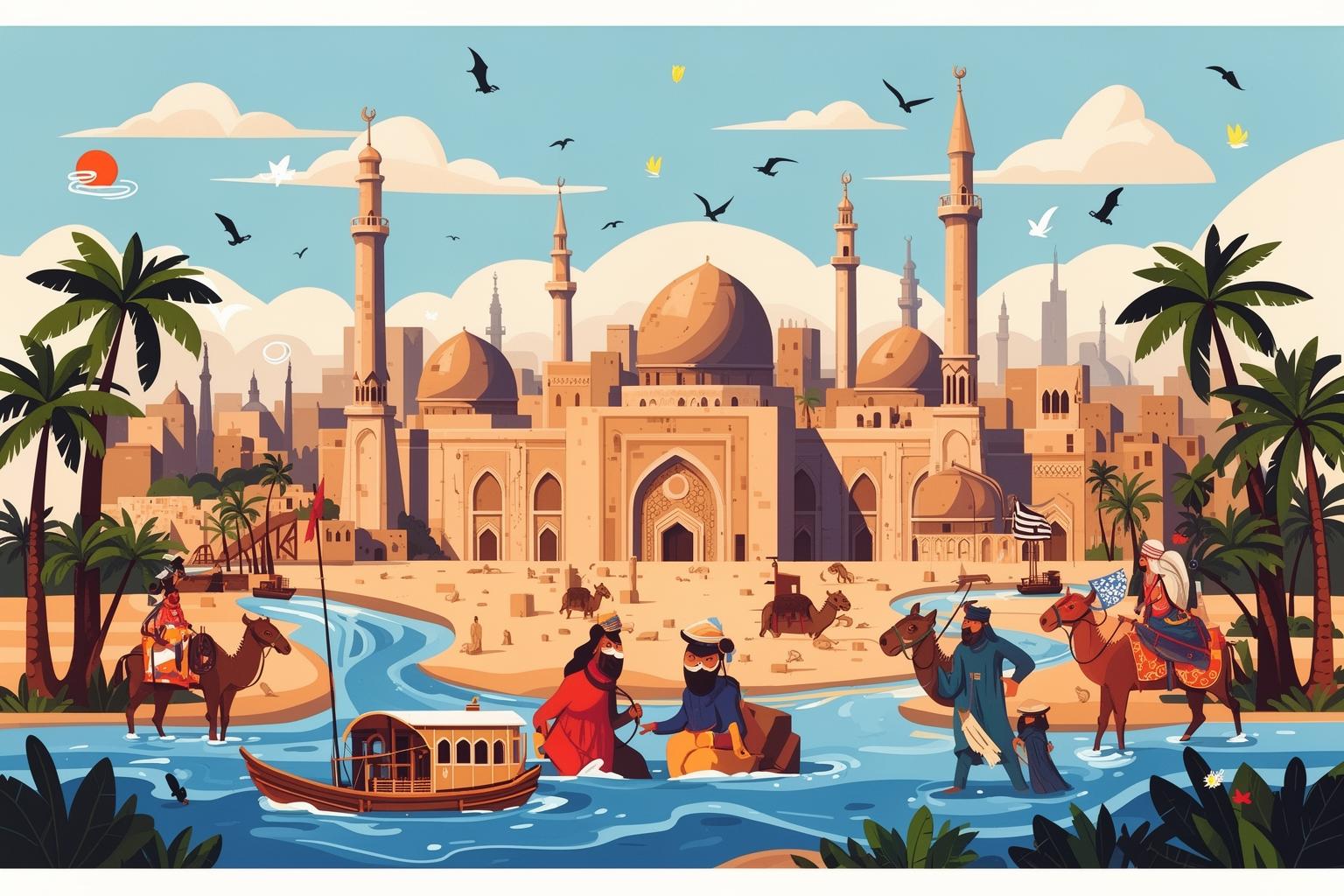
To leave Cairo after tracing the footsteps of Naguib Mahfouz is to depart with more than just memories of ancient monuments and lively markets. It is to carry away a sense of the city’s narrative soul. Mahfouz revealed to the world that Cairo is not merely a setting, but a protagonist in its own right— a character of boundless complexity, beauty, and resilience. He showed us that the grand sweep of history is discovered not only in the tombs of pharaohs but in the small dramas of an ordinary family tucked away in a forgotten alley. The city has transformed since he first put pen to paper, yet the essence of what he captured endures. The call to prayer still echoes over the rooftops, the debates still ignite in coffeehouses, and the timeless, chaotic, heartbreaking, and life-affirming story of Cairo continues to unfold each day on its streets. By walking through his world, you become a small part of that story, a reader who has stepped into the book and found that the narrative is, and always will be, alive.