To read Ivan Turgenev is to feel the vast, melancholic soul of 19th-century Russia. His words paint landscapes so vivid you can almost smell the damp earth after a spring rain, his characters so deeply human you feel you’ve met them in a dream. But Turgenev was more than a writer confined to his desk; he was a wanderer, a man whose life was a grand, sprawling journey across the heart of his homeland and the intellectual capitals of Europe. His story isn’t just written in ink on paper; it’s etched into the soil of his family estate, echoed in the grand salons of Paris, and whispered by the wind through the Black Forest of Germany. To trace his footsteps is to embark on a pilgrimage, not just to places on a map, but into the very heart of his creative genius. It’s a journey that collapses time, allowing you to stand where he stood, to see what he saw, and to feel the powerful currents of history, love, and art that shaped one of literature’s most enduring giants. This guide is your map and compass, an invitation to walk the paths that Turgenev trod, from the quiet birch groves of his youth to the bustling, revolutionary streets of his European exile, and to discover the man behind the immortal words.
For a different kind of literary pilgrimage, consider following the footsteps of José Saramago.
The Russian Soul: Spasskoye-Lutovinovo, the Ancestral Heart
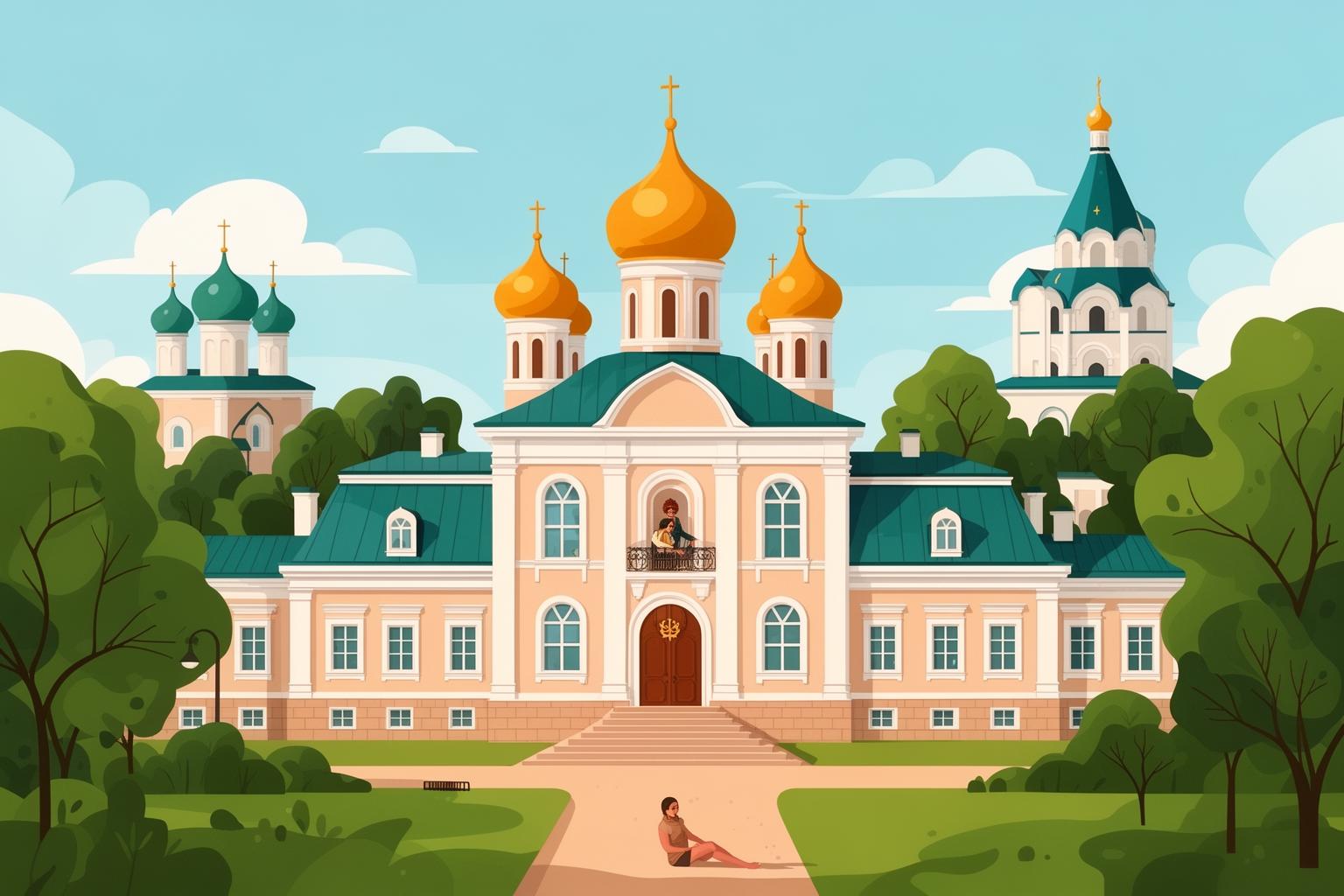
Every story has a beginning, a wellspring from which all rivers flow. For Ivan Sergeyevich Turgenev, that source is Spasskoye-Lutovinovo. This is not merely a place; it stands as the foundational narrative of his life and work. Nestled in the Oryol province, south of Moscow, this family estate serves as the spiritual core of the Turgenev universe. To arrive here is to step directly into the pages of A Sportsman’s Sketches. The atmosphere itself feels distinct—thicker, perfumed with linden blossoms in summer and the sharp, clean bite of snow in winter. It’s a landscape of gentle, rolling hills, dense birch groves with their peeling white bark, and a profound, almost overwhelming silence, broken only by cawing crows or the rustle of leaves.
Echoes in the Birch Grove
At the heart of the estate stands the main house, a modest, single-story wooden dacha painted a warm, inviting ochre with crisp white trim. It’s not a palace of extravagant wealth, but a home, lived in and cherished. Rebuilt after a fire, it still holds the echoes of Turgenev’s world. Inside, the rooms are preserved with near-sacred reverence. His writing desk is positioned to catch the morning light, with quill pens and inkwells waiting as if he had just stepped out for a walk. There is his hunting rifle, a tangible link to the long treks through the woods that inspired his most renowned early work. You can almost hear the murmurs of conversations, the laughter and arguments that once filled these spaces, and the quiet scratching of pen on paper that forever changed Russian literature.
Yet the true soul of Spasskoye lies beyond the house, in the expansive park that Turgenev himself helped design. It is a masterpiece of landscape art—a place where nature has been gently guided rather than restrained. Winding paths lead through alleys of ancient trees and past serene ponds reflecting the vast, open sky. As an avid walker, I found myself completely captivated. Each step felt like a conversation with the past. You could easily lose an entire day wandering through this labyrinth of greenery. The park’s most famous resident for many years was a gigantic oak tree planted by the young Turgenev. Though it fell in a storm, its legacy remains a powerful symbol of his deep roots in this soil. Standing where it once grew, you feel the connection between the man and the land as a tangible force.
The Landscape as Character
Here at Spasskoye, Turgenev refined his extraordinary power of observation. He didn’t just see a forest; he noticed how the light filtered through the leaves, the habits of a woodcock, and the distinct character of each peasant he met on hunting expeditions. The Russian countryside is not a mere backdrop in his stories; it is a living, breathing character. The melancholy beauty of the land, its vastness, and its deep-seated poverty and resilience are woven into the fabric of his prose. He learned the language of the land here and translated it for the world.
Visiting Spasskoye through the seasons reveals different emotional palettes. In late spring and early summer, it bursts with green and life, the air buzzing with insects and birdsong, perfectly mirroring the youthful energy and romanticism of some of his tales. Autumn transforms the landscape into a canvas of gold and crimson, a time of beautiful decay and reflection that echoes the themes of aging, loss, and memory prevalent in his later works. Winter blankets everything in stark, serene silence, a time for introspection when the birch trees stand like sentinels against a gray sky. This seasonal rhythm forms the heartbeat of rural Russia, and Turgenev captured it perfectly because he lived it so deeply.
Practical Pilgrim’s Notes
Reaching Spasskoye-Lutovinovo requires some planning, but the journey is integral to the experience. The nearest city is Mtsensk, accessible by train from Moscow’s Kursk Station. From Mtsensk, a local bus or taxi covers the short remaining journey to the estate. The entire trip from Moscow can be done in a very long day, but to truly absorb the atmosphere, I suggest staying overnight in nearby Oryol, a city rich in literary history. This allows for a more relaxed visit to the estate. Wear comfortable walking shoes, as you’ll want to explore every corner of the vast park. In summer, consider packing a small picnic to enjoy by one of the ponds. It’s a simple gesture, but it connects you to the timeless, pastoral quality of the place in a profoundly authentic way. The museum is well-maintained, with guides passionate about Turgenev’s legacy. Even without speaking Russian, the experience of being in his personal space transcends language barriers.
The Intellectual Arenas: Moscow and St. Petersburg
If Spasskoye was Turgenev’s heart, then the grand cities of Moscow and St. Petersburg served as his mind. It was within these bustling, contrasting urban environments that the thoughtful country squire transformed into a literary powerhouse and a pivotal voice in the era’s defining intellectual debates. These cities acted as his universities, battlegrounds, and stages, testing and refining his ideas about Russia’s future, art, and society.
Moscow’s Fiery Debates
Turgenev arrived in Moscow as a young man to study at Moscow State University. During the 1830s, the city was a vibrant, chaotic, and intellectually charged place. Unlike the rigid, Europeanized St. Petersburg, Moscow felt more authentically Russian—a sprawling, overgrown village of a city with a profound historical soul. It was here that Turgenev was first drawn into the great debate defining 19th-century Russian thought: the clash between the Westernizers and the Slavophiles.
The Westernizers, a camp to which Turgenev was firmly aligned, believed Russia’s salvation relied on embracing European rationalism, liberalism, and progress. Meanwhile, the Slavophiles, their intellectual opponents, argued that Russia had its own unique spiritual path rooted in Orthodox faith and peasant culture. These were not mere academic discussions; they were passionate, all-consuming arguments that erupted in student circles, literary salons, and smoky cafes. Strolling through the old Arbat district or near the university today, one can almost picture the young, tall, and imposing Turgenev engaged in heated debate with his peers, his voice rising with determination.
A City of Beginnings
This time in Moscow was formative. It was here that he immersed himself in German philosophy, devoured the works of Pushkin and Gogol, and began tentative explorations in poetry and drama. The city’s energy fueled his ambition. It was a place of firsts: first loves, first intellectual awakenings, and first publications. While few buildings from his student days remain unchanged, the spirit of that era endures in the city’s older quarters. Visiting the university’s historic campus on Mokhovaya Street offers a strong sense of connection to this foundational phase of his life. Moscow taught him to think critically, argue passionately, and see himself as part of a broader national dialogue.
St. Petersburg’s Imperial Gaze
Relocating to St. Petersburg was akin to entering a different world. If Moscow was Russia’s heart, St. Petersburg was its imposing, imperial head. Founded by Peter the Great as a “window to the West,” it was a city of classical facades, grand Nevsky Prospekt, and a network of canals that earned it the nickname “Venice of the North.” The atmosphere was colder, more formal, and deeply intertwined with the machinery of the state. After studying abroad, Turgenev briefly worked here as a minor civil servant, an experience that gave him firsthand insight into the stifling bureaucracy he later satirized in his works.
Yet St. Petersburg was also the undisputed center of Russian literary life. It was here he joined the circle around the influential journal Sovremennik (The Contemporary), edited by the poet Nekrasov. His publication of A Sportsman’s Sketches brought him immense acclaim, making him a celebrated literary figure almost overnight. He mingled with luminaries like Dostoevsky and Tolstoy, forming friendships and rivalries that would shape the golden age of Russian literature. Walking along the Fontanka or Moyka river embankments, one can easily imagine him on his way to a literary gathering, his mind alive with ideas for a new story as the city’s damp, misty air swirled around him.
The Shadow of the State
However, the city’s imperial power also had a dark side. The state’s watchful eye was ever-present, rendering freedom of expression a dangerous venture. Turgenev’s life took a dramatic turn when he wrote a heartfelt obituary for Nikolai Gogol in 1852. The authorities, suspicious of any public independent thought, saw it as an act of defiance. Turgenev was arrested, imprisoned for a month, and then exiled to his estate at Spasskoye for two years. This incident was a harsh reminder that even a celebrated author was not immune to the Tsar’s displeasure. His imprisonment in the Main Guardhouse on Sennaya Square marks a tangible point of tension between the artist and the autocratic state. Standing near that site today, one can feel the chilling power of the regime that Turgenev and his contemporaries had to contend with.
Tracing Turgenev’s Steps Today
For modern visitors, exploring Turgenev’s life across these two cities offers a study in contrasts. In Moscow, focus on the university district and old literary haunts. In St. Petersburg, a stroll down Nevsky Prospekt is essential. Visit the Literary Cafe, a historic venue where writers of the era gathered. Though the interior has changed, the location remains iconic. The Dostoevsky and Pushkin apartment museums also provide rich insights into the literary atmosphere of the time. The most poignant site, however, is his final resting place, which we will discuss later. For now, recognize that these cities were the crucibles where his talent was forged—the places where he learned to wield his pen both as an artist’s brush and a social critic’s scalpel.
The European Sojourn: A Life in Self-Imposed Exile

Although Turgenev’s soul was irrevocably Russian, much of his adult life was spent abroad. This was no mere tourist’s journey, but a prolonged, self-imposed exile propelled by a complex blend of intellectual curiosity, political disappointment with his homeland, and, most powerfully, his lifelong, unreciprocated love for the Spanish-born opera singer Pauline Viardot. This European sojourn transformed him into a distinctive cultural bridge—a man who could interpret Russia to the West and the West to Russia. His travels through Germany and France constitute the third major chapter of his life, a time marked by extraordinary productivity and deep personal yearning.
Germany’s Gentle Embrace: Berlin and Baden-Baden
Germany was Turgenev’s first and most formative European destination. It symbolized an intellectual ideal—a realm of philosophy and order sharply contrasting with Russia’s chaotic realities. His time there was essential in developing the sophisticated, psychologically refined style that became his signature.
Berlin: The Philosopher’s Path
In the late 1830s, as a young man, Turgenev enrolled at the University of Berlin to study philosophy, history, and classical philology. At the heart of Hegelian thought, the rigorous German academic world captivated him. He immersed himself in the works of Hegel, Goethe, and Schiller, embracing the ideals of German Romanticism and Idealism. This was more than academic pursuit; it provided a fresh perspective on the world, history, and the human soul. The intricate inner lives of his characters, their philosophical debates, and ideological struggles all trace back to the ideas planted during his Berlin lectures. Strolling through the historic university district near the grand avenue of Unter den Linden evokes the youthful excitement of a brilliant mind discovering an entirely new intellectual universe.
Baden-Baden: A Russian Roulette of the Heart
If Berlin nourished his mind, the elegant spa town of Baden-Baden nurtured his heart. Nestled in the Black Forest foothills, it was the glittering summer retreat for 19th-century European high society. Russians, in particular, gathered there, creating a “little Russia” abroad. Turgenev spent much of the 1860s in Baden-Baden, drawn mainly by Pauline Viardot and her husband Louis, who had settled there. His life in this town was a curious blend of idyllic tranquility and emotional unrest.
The town’s atmosphere is perfectly captured in his novel Smoke. Baden-Baden was a place of refined leisure—walks along the Lichtentaler Allee, concerts at the Kurhaus, and high-stakes gambling at the opulent casino. Turgenev observed his compatriots with a sharp, often satirical gaze, noting their affectations, endless political debates, and romantic entanglements. The casino, in particular, epitomized the risks and passions that defined their lives—a place where fortunes and futures hinged on the spin of the wheel. Visiting the casino today, still among the most exquisite in the world, feels like stepping into a scene from his novel.
The Villa and the Viardots
Turgenev built a handsome villa in Baden-Baden, just a short walk from the Viardot residence. His life revolved around them. He was a constant, devoted presence—a family friend deeply in love with the lady of the house. His villa became a literary salon, attracting visitors from across Europe. He spent his mornings writing, his afternoons walking in the magnificent surrounding forests, and his evenings in the Viardots’ company. As a hiker, I find this part of his life especially captivating. The Black Forest, with its towering pines and well-marked trails, is a walker’s paradise. It’s easy to picture Turgenev striding these paths, pine scents in the air, reflecting on a new novel’s plot or wrestling with his personal complexities. The forest offered him peace and a connection to nature, likely reminding him of his beloved Spasskoye.
Visiting Baden-Baden Today
Baden-Baden still retains much of its 19th-century charm. You can visit the street where Turgenev’s villa stands and see Pauline Viardot’s home nearby. The Museum for Art and Technology on the Lichtentaler Allee includes exhibits about the town’s famous Russian visitors. Walking the same paths along the Oos River, enjoying the thermal baths, or hiking to Merkur mountain are all ways to connect with the world Turgenev once knew. The town remains a living museum of that elegant, bygone era.
The French Connection: Paris and Bougival
France—especially Paris—was the final and longest phase of Turgenev’s European life. Here, he solidified his international acclaim and spent his last years surrounded by friends yet forever dreaming of his homeland.
Parisian Salons and Literary Lions
After leaving Baden-Baden at the outbreak of the Franco-Prussian War, Turgenev settled in Paris with the Viardots. By then, he was a literary celebrity, hailed in France as the greatest living Russian writer. He was embraced by the most exclusive literary circles, becoming close friends with Gustave Flaubert, Émile Zola, Edmond de Goncourt, and a young Guy de Maupassant. Their famous “Dinner of the Five Hissed Authors” gathered these masters of realism for evenings of food, wine, and intense literary debate. Turgenev served as the bridge who introduced his French friends to Tolstoy and Dostoevsky and, in return, promoted French realism back in Russia. A true man of letters, fluent in multiple languages, he lived and breathed literature. Wandering the Saint-Germain-des-Prés quarter—Paris’s historic intellectual heart—you tread the same streets where Turgenev met his friends in cafes like the Procope.
The Final Chapter in Bougival
In his later years, Turgenev and the Viardots moved to the tranquil suburb of Bougival, along the Seine west of Paris. On a shared property, he built a Swiss-style dacha named “Les Frênes” (The Ash Trees). This was his final home—a place of serene greenery where, from his study’s top floor, he enjoyed a beautiful view of the landscape. Here he wrote some of his most lyrical and poignant late works, including Poems in Prose. The setting was idyllic, though his health was deteriorating, and his nostalgia for Russia grew stronger each year. His letters overflowed with longing for Spasskoye, the scent of Russian birches, and the sound of his native tongue.
A Place of Farewell
The Bougival dacha was where he endured a slow, painful decline from spinal cancer. He bore his suffering with remarkable bravery, continuing to dictate stories and letters until near the end. He died at Les Frênes in September 1883, surrounded by the Viardot family. His passing marked the close of an era. The house where he spent his final moments is now the Musée Européen Ivan Tourguéniev, a small but deeply moving museum lovingly preserved by devoted enthusiasts. Visiting it is an essential part of any Turgenev pilgrimage.
A Modern Pilgrimage to Bougival
Reaching Bougival from central Paris is an easy trip on the RER train. The museum is a treasure: you can stand in his study, see his personal effects, and sense the powerful presence of his final days. The atmosphere is one of peaceful remembrance. From the garden, you look out over the Seine, just as he once did. It is a place both profoundly poignant and inspiring—a testament to a life lived fully, devoted to art and love until the very end. This is the last stop on his European journey, a quiet corner of France forever touched by Russia.
The Return: A Final Journey Home
In life, Turgenev was a wanderer, a man who belonged as much to Europe as to Russia. Yet in death, there was never any doubt about where he belonged. His final wish was to be buried on his native soil, among the writers and thinkers who had shaped his world. His last journey was not one of exile but a homecoming—a spectacular and moving procession that affirmed his status as a national treasure and a beloved son of Russia.
The Last Voyage
News of Turgenev’s death in Bougival sent waves of grief throughout Russia. The transport of his body from Paris to St. Petersburg became a massive public event. A memorial service at the Gare du Nord in Paris was attended by France’s literary elite. From there, the coffin traveled by train across Europe. At the Russian border, official delegations and mourning crowds awaited. As the train progressed to the capital, people gathered at every station to pay respects, laying flowers and observing moments of quiet reflection. This public outpouring of affection was a powerful testament. It showed that despite his many years abroad and his often critical stance toward the Russian government, Turgenev was viewed by the people as a true patriot, a writer who had captured the nation’s soul.
The Volkovo Cemetery
Turgenev’s funeral in St. Petersburg was among the largest the city had ever witnessed. Tens of thousands, especially students who regarded him as a champion of progress and enlightenment, escorted the procession to Volkovo Cemetery. This was no ordinary burial ground; it was the final resting place of the nation’s intellectual and artistic giants. He was laid to rest in the section known as Literatorskie Mostki, or the “Writers’ Footbridges,” a veritable pantheon of Russian literature.
Visiting Volkovo Cemetery today is a deeply moving experience. It is a quiet, wooded, and atmospheric place where the gravestones read like a syllabus of Russian cultural history. To find Turgenev’s grave is to reach the final stop on this grand pilgrimage. His monument is a simple yet elegant bronze bust atop a granite pedestal. He gazes out with a calm, thoughtful expression, his magnificent beard flowing. Around him lie his peers: the critic Belinsky, who first recognized his talent; the satirist Saltykov-Shchedrin; the novelist Goncharov. It is a community of immortals, with Turgenev at its center.
A Legacy Etched in Stone
The mood at the Literatorskie Mostki is one of profound reverence. Visitors leave flowers, and many stand silently in contemplation. This is the culmination of the journey—the place where the man of the world finally comes home to rest. His grave is not merely a marker of his passing but a powerful symbol of his enduring bond to the Russia he loved, critiqued, and ultimately understood better than most. It signifies that despite his travels and years spent in Baden-Baden and Paris, his identity was forged in the black earth of Spasskoye, and his legacy belongs to the people of Russia. Standing at his grave, one feels the full circle of his life complete—a life of wandering that ended in a final, eternal homecoming.
The Unending Journey
To trace Ivan Turgenev’s life is to journey through the heart of the nineteenth century, witnessing the clash of empires, ideas, and passions that shaped the modern world. His life unfolded on a grand scale, a map of experiences spanning from the quiet Russian heartland to the dazzling capitals of Europe. Each place—Spasskoye, Moscow, Berlin, Baden-Baden, Paris—serves as more than a mere biographical detail; it is a key to deeper insight into his work. To wander the linden-lined paths of his estate is to sense the pastoral melancholy of A Sportsman’s Sketches. To picture his debates in Moscow is to understand the ideological fervor of Fathers and Sons. To stroll the promenades of a German spa town is to inhale the cosmopolitan spirit of Smoke.
This pilgrimage is not about simply ticking off locations. It is about connection. It is about standing in a room, knowing his hand once rested on that same windowsill, his eyes once gazed out at that same view. It is about feeling the continuity of human experience and the timeless power of art to transcend borders and generations. Turgenev was a master at capturing the subtleties of the human heart—its longings, its sorrows, its hopes. By visiting the places that shaped his own heart, we draw closer to the source of that genius.
Whether you choose the rustic calm of Spasskoye or the literary vibrancy of Paris, you are not merely a tourist. You are a reader stepping into the world behind the words. You are a traveler on the path laid by a literary giant, and you will discover that his journey, in many ways, is endless—continuing to inspire and move all who follow it.