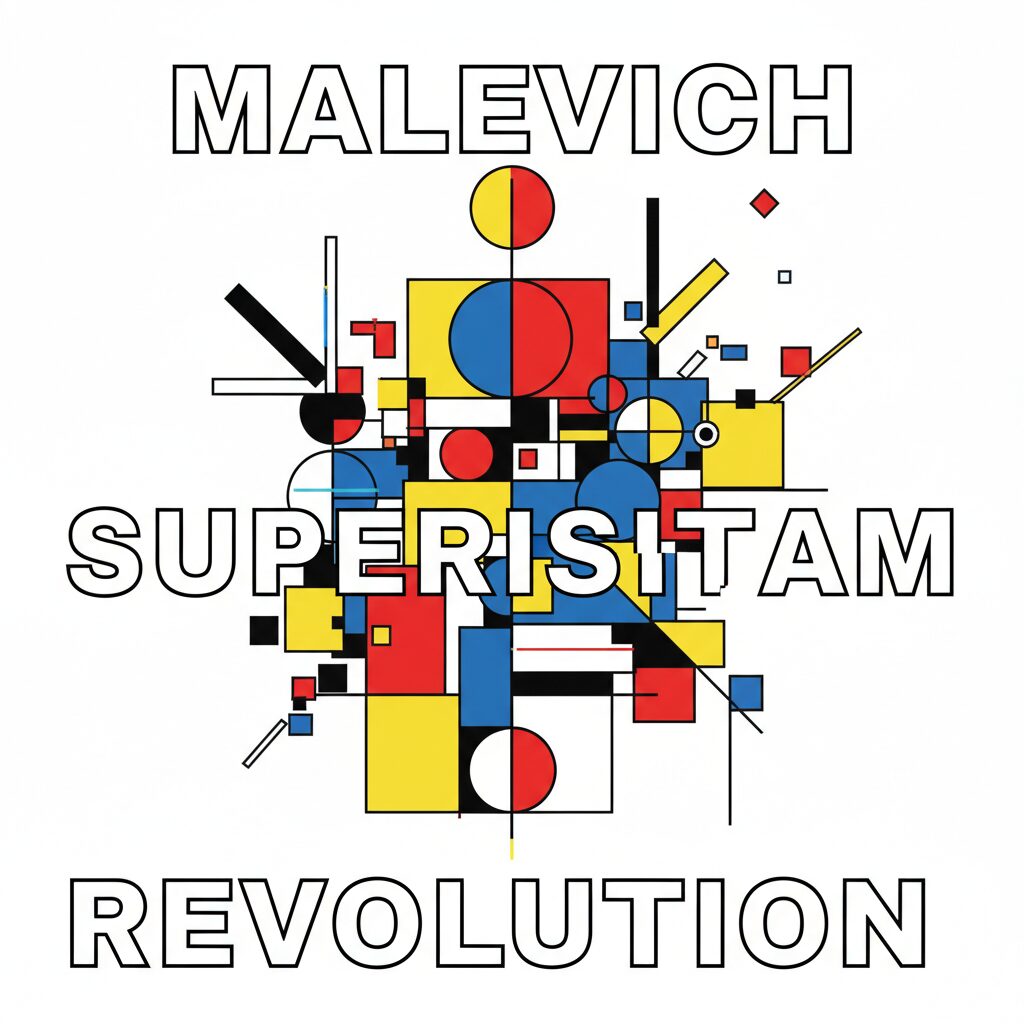
To trace the life of Kazimir Malevich is to embark on a pilgrimage not to hallowed ground, but into the very heart of an idea. It’s a journey that cuts across the vast, windswept plains of Ukraine, dives into the revolutionary crucible of Moscow, ascends to the utopian heights of a small Belarusian town, and finally confronts the monolithic power of the state in the imperial corridors of St. Petersburg. This is not a path marked by simple monuments. It is a quest to understand a man who sought to liberate art from the burden of objects, to chase the ghost of pure feeling, and to present the world with an icon for a new age: a black square on a white field. Malevich was more than a painter; he was a mystic, a philosopher, a prophet of an art that looked beyond the material world and into the cosmic void. He named his creation Suprematism, the supremacy of pure artistic feeling over the depiction of things. Following his footsteps means learning to see the world as he did—as a dynamic interplay of color, form, and infinite space. It is a journey that rewires your perception, forcing you to find the sublime in the absolute, the universe in zero. We begin our pilgrimage in the cities and landscapes that forged this singular vision, a path that leads to the genesis of modern art itself, a ground zero from which everything that came after was born.
For a different perspective on how an artist’s environment shapes their vision, consider the vibrant journey of David Hockney.
The Ukrainian Dawn: Kyiv and the Genesis of an Artist

The story of Kazimir Severinovich Malevich begins not in a major artistic capital, but in the lively, multicultural city of Kyiv. Born in 1879 to Polish parents within the Russian Empire, his identity was complex from the outset. He was a Pole in Ukraine, a Catholic in an Orthodox land, a boy whose artistic sensibilities were shaped not by academies and salons, but by the raw, unfiltered culture of the earth. His father worked as a manager in the extensive sugar beet industry, a role that kept the family on the move, shifting from one factory town to another across Ukraine’s fertile heartland. This itinerant childhood, far removed from the centers of high culture, formed the foundation of his artistic awareness. It was here, amid the rhythmic cycles of planting and harvest, that the future prophet of non-objectivity first learned the language of color and form.
Village Vistas and Folk Inspirations
Picture a young Malevich wandering through a Ukrainian village. The houses were not dull, plain structures; they were vibrant with color, their whitewashed walls adorned with lively floral patterns and symbolic motifs. He observed women in intricately embroidered blouses, their threads telling stories of protection and prosperity. He watched them paint pysanky—Easter eggs transformed into miniature universes of geometric and zoomorphic designs, each line and color carrying ancient meaning. This was his initial art school. In his autobiography, he wrote with deep affection about his fascination with peasant artists who painted roosters and horses on the walls of their homes and stoves. He was drawn to their intuitive sense of composition and their bold, uninhibited use of primary colors. He felt a profound connection to this art, which was not concerned with realistic depiction but with expressing a vital, inner energy. The deep reds, brilliant blues, stark whites, and blacks became the palette that seeped into his soul. The endless, flat horizon of the steppe, the vast white canvas of winter snow under a boundless sky—these were the primordial landscapes that would later resonate in the infinite white backgrounds of his Suprematist paintings. The essence of this place was one of profound, earthy creativity. To understand Malevich, one must first grasp the visual richness of Ukrainian folk culture, a world where art was not confined to a frame but lived as an integral part of everyday life.
The Kyiv Art School and First Steps
As a young man, Malevich eventually made his way to a formal education at the Kyiv Art School. Yet the city remained a place of contrasts for him. It was a center of learning, but he often felt like an outsider—a provincial boy struggling to comprehend academic traditions that felt rigid and lifeless compared to the vibrant folk art he loved. Kyiv in the early 20th century was a city alive with new ideas, yet deeply rooted in its own history. Today, walking its streets, one can still sense this blend of ancient and modern. While the exact building where he studied may have changed, the city’s spirit as a cultural crossroads endures. Visiting the National Art Museum of Ukraine, one can see the context from which he emerged—the works of his contemporaries and perhaps even some of his earliest, Impressionist-influenced paintings. These early pieces are captivating, revealing a young artist exploring light and shadow, trying to capture fleeting moments. But even then, there is a yearning for something beyond, a desire to dismantle forms and uncover a deeper structure beneath reality’s surface. His time in Kyiv was one of both absorption and frustration, a necessary apprenticeship before he could ignite his own artistic revolution.
The Moscow Crucible: Forging a Revolution in Art
If Kyiv was the cradle of Malevich’s artistic soul, Moscow was the forge where it was shaped into a weapon. Arriving in the city in the early 1900s, he was immersed in a whirlwind of creative and political energy. This was Moscow on the edge of upheaval, a city alive with poets, painters, and provocateurs determined to dismantle the old order and build a new world from its ruins. The air buzzed with manifestos, debates in smoky cafes, and an unyielding drive toward the future. For an ambitious artist like Malevich, it was everything. He shed his provincial Impressionist identity and plunged into the core of the Russian avant-garde, absorbing and mastering every fresh artistic language with fierce intensity.
From Cubo-Futurism to Alogism
Malevich didn’t merely join the avant-garde; he rose to become one of its foremost leaders. He aligned himself with radical groups led by artists such as Mikhail Larionov and Natalia Goncharova, taking part in scandalous exhibitions bearing provocatively titled shows like “Donkey’s Tail” and “Target.” The atmosphere was one of outright rebellion. It was a moment to shock the bourgeoisie and reject the stale refinement of the art establishment. Malevich’s work from this era stands as a testament to his extraordinary artistic appetite. He absorbed French Cubism and Italian Futurism, internalizing their principles and transforming them into a uniquely Russian style known as Cubo-Futurism. Paintings like “The Woodcutter” (1912) embody this fusion. The figure is fragmented into geometric, metallic shapes yet charged with a dynamic, rhythmic energy that feels unmistakably Russian, celebrating the raw power of the peasant laborer. He then ventured further into a style he termed “Alogical,” deliberately pairing objects in irrational combinations—a cow and a violin, for instance—to disrupt the viewer’s dependence on logic and reason. He was methodically dismantling the tools of traditional art, clearing the way for something entirely new. Walking through the halls of Moscow’s Tretyakov Gallery today to see these works is to witness an artist waging war on convention, battling his way, canvas by canvas, toward a new realm of perception.
The Birth of a New World: Victory Over the Sun
The year 1913 marks a seismic moment in art history, with Malevich at its center. He was commissioned to design sets and costumes for the Futurist opera Victory Over the Sun. The opera itself was an assault on reason, featuring a nonsensical libretto written in a newly invented language called “Zaum” (meaning “trans-rational”) and jagged dissonant music. Malevich’s contribution was equally radical. He created costumes that transformed actors into walking geometric sculptures, their bodies enveloped in cones, pyramids, and squares of cardboard and fabric. The stage sets were even more revolutionary. The stage was plunged into darkness, pierced by stark searchlights that highlighted abstract shapes and forms. On one backdrop, depicting the capture of the sun, he painted a simple, stark square, half black, half white. It was the first embryonic vision of his future. Victory Over the Sun was a total work of art, designed to obliterate the old, sunlit, rational world and usher in a new, futuristic reality. The performance was a riot, greeted with boos and cheers from a bewildered audience. But for Malevich, it was a profound revelation. Through designing the opera, he realized that the abstract shapes he created held a powerful drama all their own, independent of any object they were intended to represent.
The Last Futurist Exhibition 0.10 and the Unveiling of Suprematism
Two years later, in the winter of 1915, the art world was transformed forever. The venue was Petrograd (now St. Petersburg), but the revolution had its roots in Moscow. At a show defiantly titled “The Last Futurist Exhibition 0.10,” Malevich finally revealed his secret. After months of work in isolation, he presented 39 paintings that belonged to no known artistic movement. He called his new approach Suprematism. The works were astonishingly simple: colored rectangles, circles, and crosses floating against a white background. These compositions had no reference to the outside world. They were not images of anything; they were pure artistic events in themselves. And at the center was the masterpiece that would become his legacy, his icon, and his burden.
The Black Square in the Red Corner
In an act of breathtaking boldness, Malevich chose not to hang his painting “Black Square” flat on the wall. Instead, he positioned it high in the corner of the room, straddling two walls. This was the krasny ugol, the “red” or “beautiful” corner—the sacred spot in a traditional Russian Orthodox home where the family’s religious icons were displayed. The significance was profound. Malevich was declaring the death of the old gods and the old art. He was presenting “Black Square” as a new icon, a secular spiritual image for the modern era. It was not a window onto the world like a Renaissance painting. It was both an ending and a beginning. It was the “zero of form,” the point beyond which painting could not proceed. Imagine the shock of visitors entering that room. They faced what appeared to be a black void, an eradication of everything they understood as art, yet it was presented as a sacred object. “Black Square” was not an empty canvas. For Malevich, it was filled with feeling—the experience of pure non-objectivity. Alongside it hung “Black Cross” and “Black Circle,” the other primary elements of his new universe. With this single, revolutionary act of curation, Malevich had not only created a new style; he had redefined the very purpose and potential of art.
Vitebsk’s Utopian Dream: The UNOVIS Years
After the Bolshevik Revolution of 1917, the avant-garde was briefly and thrillingly embraced by the new state. Artists were regarded as the engineers of a new society, and Malevich’s vision of a new world founded on novel forms appeared perfectly aligned with the political agenda. His path then led him from the bustling metropolis of Moscow to the provincial city of Vitebsk, in what is now Belarus. In 1919, Marc Chagall invited him to teach at the newly established People’s Art School. What started as a teaching position soon evolved into one of the most radical educational experiments in art history.
The Suprematist Academy
The dynamic between the two artistic titans, Chagall and Malevich, was bound to be explosive. Chagall, the romantic dreamer whose work featured floating fiddlers and nostalgic depictions of Jewish shtetl life, found himself face-to-face with Malevich, the austere philosopher of the square. It was a clash of artistic worlds, and Malevich’s powerful, systematic vision quickly captivated the students. In a short time, Malevich and his followers effectively overtook the school, turning it into a Suprematist workshop. They renamed it UNOVIS, an acronym meaning “Champions of the New Art.” Vitebsk became their canvas. This was not art for museums; this was art for life. Under Malevich’s guidance, the students designed Suprematist propaganda posters for the government, created textile patterns, and planned utopian architectural projects. They painted their abstract motifs on building walls and trams, transforming the entire city into a living exhibition. The atmosphere in Vitebsk must have been electric—a blend of revolutionary zeal and artistic innovation. It was a moment when it seemed possible to reshape the whole world according to the universal principles of Suprematism, creating a harmonious environment for the new Soviet man.
The Philosophy of the White Canvas
It was in Vitebsk, surrounded by his dedicated students, that Malevich advanced his Suprematist theory to its logical and ultimate conclusion. He began to strip color from his canvases, moving toward his renowned “White on White” series. A work such as “Suprematist Composition: White on White” (1918) depicts a white square, tilted at an angle, set against a slightly different shade of white background. For many, this appeared to be the final stage, a nihilistic gesture. Yet for Malevich, it was the culmination of his spiritual journey. The white represented the infinite, the cosmos, and the realm of pure feeling. The faint outline of the square was the last vestige of form before it completely dissolved into boundless space. He sought to convey the sensation of flight, dematerialization, and entry into a higher, non-objective reality. These paintings are not empty; they call for quiet contemplation and meditative engagement from the viewer. They are icons of silence and infinity. Visiting Vitebsk today requires some imagination. While the city celebrates its association with Marc Chagall, the physical remnants of the UNOVIS period are more discreet. Still, standing in the city and gazing up at the vast sky, feeling the space and the light, allows one to connect with the very environment that inspired Malevich’s final, sublime phase of pure white abstraction.
The Leningrad Return: A Dialogue with the Past and the State
The utopian dream of Vitebsk was not to endure. By the early 1920s, political tides in the Soviet Union were shifting. Official tolerance for radical artistic experimentation diminished, replaced by a growing demand for art that was easily accessible and served the state’s direct propaganda purposes. Malevich left Vitebsk and moved to Leningrad, the former imperial capital, a city of grand classical architecture that sharply contrasted with his non-objective ideals. His final years unfolded as a complex and often painful negotiation between his steadfast artistic vision and the tightening control of an authoritarian regime.
GINKhUK and the Theoretical Legacy
In Leningrad, Malevich was appointed director of the prestigious State Institute of Artistic Culture (GINKhUK). This opportunity allowed him to move beyond painting and systematize his theories. Working with a team of researchers, he produced intricate charts and diagrams analyzing the formal and psychological qualities of color and form. He developed a “Theory of the Additional Element,” aimed at identifying the fundamental visual element defining every major artistic style—from Cézanne’s curves to his own Suprematist straight line. This was an attempt to create a scientific grammar of art. The period was intellectually rich but also fraught with peril. His esoteric, formalist research came under increasing suspicion by authorities, who labeled it bourgeois, individualistic, and disconnected from proletarian needs. In 1926, the institute was closed, and Malevich was dismissed, accused of being a “mystic” and a “formalist”—grave charges in Stalinist Russia.
A Return to the Figure
Deprived of his official post and with Suprematism effectively banned, Malevich shocked many followers by returning to figurative painting. In his last decade, he created a series of powerful, enigmatic portraits and scenes of peasant life. Works like “Peasants” and “Red Cavalry” initially appear as complete rejections of his abstract principles. Yet a closer examination reveals a far more intricate story. This was not capitulation but a strategic reinvention.
The Suprematist Lens on Reality
Malevich was now applying Suprematist lessons to the visible world. His peasant figures are not realistic portraits but geometric archetypes, their bodies composed of cylinders and cones, their faces often blank, transforming them into universal human symbols. The landscapes they occupy are not naturalistic but flattened planes of pure, vibrant color, composed with the same rigor as his abstract works. Horizons are elevated, fields striped with bands of red, black, and white—the core Suprematist palette. He painted the world through a Suprematist lens, unveiling the abstract geometric structure beneath reality’s surface. In a final, quiet act of defiance, he began signing these later works not with his name but with a small black square. This secret signature was a coded message: even in this figurative realm, Suprematism remained the true subject, the hidden foundation.
The Final Exhibition and a Suprematist Farewell
In 1930, Malevich was arrested and interrogated by the NKVD, the secret police. Though eventually released, the ordeal left him profoundly shaken. He fell ill with cancer, and his final years were marked by hardship and isolation. Still, he continued to create, his art a testament to his unbreakable spirit. His death in 1935 was as much an artistic act as his life had been. He designed his own Suprematist coffin—a white box adorned with a black square and a black circle. His students and friends carried it in procession through Leningrad’s streets. He was cremated, and his ashes were buried, as he had requested, in a field near Nemchinovka, outside Moscow. A simple wooden cube painted with a black square marked his grave. The monument was destroyed during World War II, and the exact resting place of his ashes is now unknown. The ultimate non-objective artist dissolved back into the landscape. For the modern pilgrim, the primary destination in St. Petersburg is the State Russian Museum. It is there the journey culminates. Standing in the rooms dedicated to his work, coming face-to-face with the original “Black Square,” “Red Square,” and the sublime “White on White” is an experience of profound intensity. The air is heavy with the power of his vision. One witnesses his entire life’s arc laid out—from the folk-inspired figures to the cosmic voids—and understands it was all part of a single, unwavering pursuit of the absolute.
The Global Legacy: Malevich Beyond Borders

While Malevich himself remained confined within the Soviet Union during the final years of his life, his ideas managed to break free. A crucial moment occurred in 1927 when he was allowed to travel to the West for the first time to showcase his work in Warsaw and Berlin. This journey proved monumental for his international legacy. He was celebrated across Europe, delivering lectures and meeting artists such as Jean Arp and Le Corbusier. Although he had intended to embark on a longer tour, he was suddenly recalled to the USSR. Recognizing the fragility of his situation, he made a critical choice: he left a substantial portion of his paintings and theoretical charts behind in Berlin, entrusting them to the care of a German architect.
The Stedelijk’s Sanctuary
This collection undertook its own dramatic voyage. It was concealed during the rise of the Nazis, who would have undoubtedly destroyed it as “degenerate art.” After the war, the works were ultimately acquired by the Stedelijk Museum in Amsterdam. This single acquisition established the Stedelijk as the most important center for Malevich’s work outside Russia. For decades during the Cold War, when his art was censored and hidden in the Soviet Union, the Stedelijk was the primary place where the world could experience the power of Suprematism. A visit to Amsterdam is thus essential to fully appreciate Malevich’s enduring legacy. The collection is extensive and comprehensive, allowing visitors to trace his entire artistic evolution. Viewing his work in this clean, modernist environment offers a fresh perspective, emphasizing his influence on Western movements such as De Stijl and the Bauhaus, and solidifying his role as a foundational figure in international modern art.
MoMA and the American Encounter
Malevich’s introduction to America is largely credited to Alfred H. Barr Jr., the visionary first director of the Museum of Modern Art in New York. Barr discovered Malevich’s work in Germany in the 1920s and immediately recognized its groundbreaking significance. He successfully acquired key Suprematist pieces for MoMA’s collection, including the sublime “White on White.” His landmark 1936 exhibition, “Cubism and Abstract Art,” famously positioned Malevich as a central figure in the history of abstraction. This exhibition was a revelation for American artists and audiences, presenting a radical vision forged in the upheaval of the Russian Revolution. Today, standing before “White on White” in MoMA’s vibrant galleries offers a unique experience. Amid the energy of New York City, the painting’s profound stillness and silence feels even more powerful. It serves as a gateway to another realm, demonstrating that Malevich’s ideas transcended their national origins to become a universal language of modernism.
A Pilgrim’s Reflection: In the Footsteps of Zero
To follow the path of Kazimir Malevich is to witness the birth of an idea and to trace it through triumph, exile, and defiance. The journey begins in the soil of Ukraine, where the language of pure color was etched into his young mind. It bursts forth in the intellectual ferment of pre-revolutionary Moscow, where the black square first appeared as a symbol of a new world. It reaches toward a utopian reality in the streets of Vitebsk, where art and life were meant to merge into a unified Suprematist whole. Finally, it finds its somber and heroic voice in the vast, unforgiving city of Leningrad, where a return to the figure became a coded act of artistic resistance. This is more than a geographical tour; it is a spiritual and intellectual excavation. Malevich’s quest was to find the “zero point,” to strip art of all worldly baggage and uncover its essential core. To stand before his Black Square is to stand at that zero point. It acts as a mirror reflecting not the external world, but the universe of feeling within. It invites you to release your expectations of art and open yourself to the possibility of pure sensation. The pilgrimage does not end at his lost grave; it continues in every museum where his work hangs, in every design employing pure geometric form, and in every artist who dares to believe art can create new realities. Malevich cast a stone into the calm lake of representation, and its ripples keep expanding, challenging and inspiring us, urging us to look beyond the object and into the infinite horizon of pure feeling.