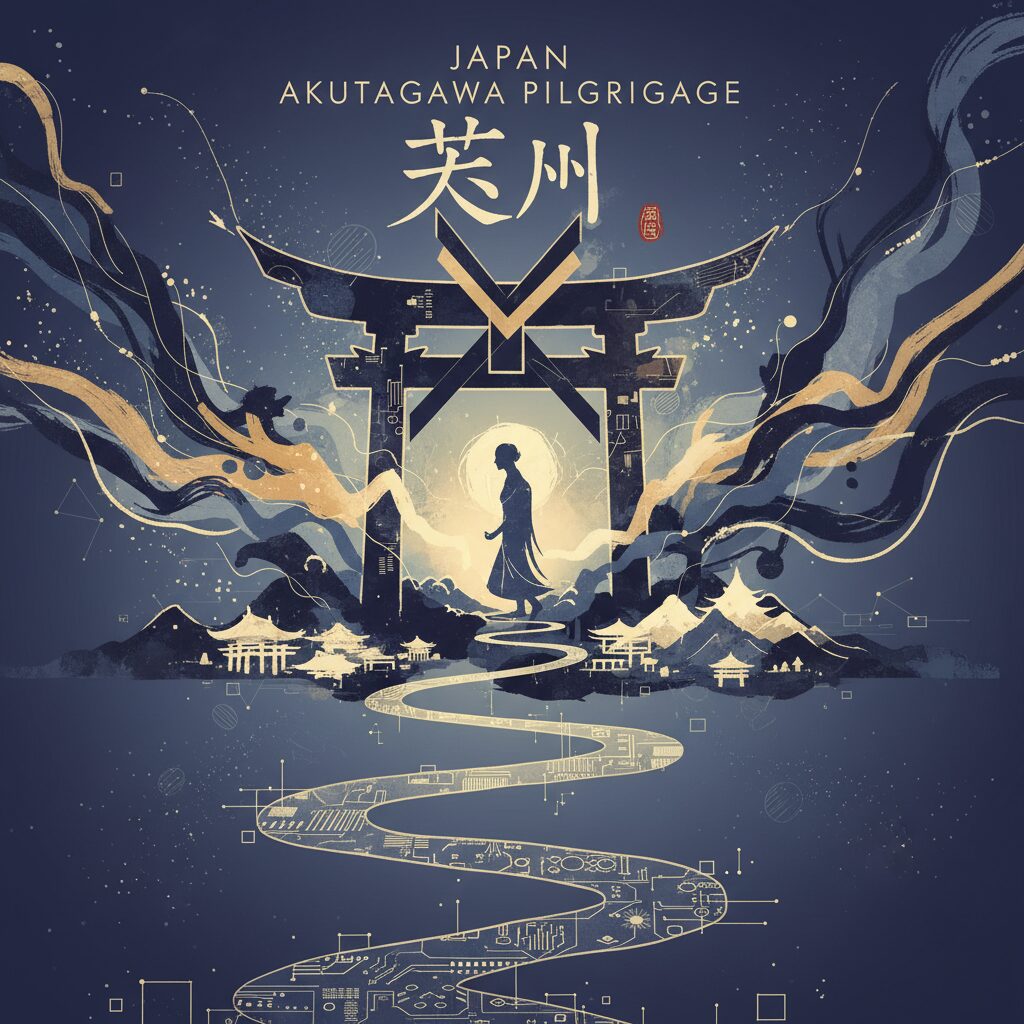
To walk through modern Japan is to traverse a landscape of dazzling contradictions—a place where shimmering towers of glass and steel rise beside quiet wooden temples, where the frenetic energy of the future hums in harmony with the deep, resonant silence of the past. For the literary pilgrim, this journey takes on another dimension, a quest to find the spectral traces of the artists who shaped the nation’s soul. There are few figures whose phantom presence is as potent, as intellectually sharp, and as tragically profound as Ryunosuke Akutagawa. A giant of the Taisho era (1912-1926), Akutagawa was a master of the short story, a writer whose piercing psychological insights and brilliant reinterpretations of historical tales defined an age of cultural transition. His works, from the moral ambiguity of “Rashomon” and “In a Grove” to the haunting self-portrait of “Spinning Gears,” are not just stories; they are intricate keys to understanding the anxieties and aspirations of a Japan grappling with modernity. To seek out the places where he lived, wrote, and drew inspiration is to do more than simply visit historical sites. It is an attempt to connect with the very air he breathed, to stand in the quiet corners where his genius took flight, and to feel the lingering echoes of a voice that, a century later, still speaks with unnerving clarity about the complexities of the human heart. This is a journey into the world of Akutagawa, a path that winds through the bustling heart of Tokyo, the serene shores of Kamakura, and the ancient lanes of Kyoto, seeking the man behind the immortal words.
For a different kind of literary journey that explores the intersection of place and narrative, consider a pilgrimage through the world of Carlos Fuentes.
The Genesis: Akutagawa’s Tokyo Origins
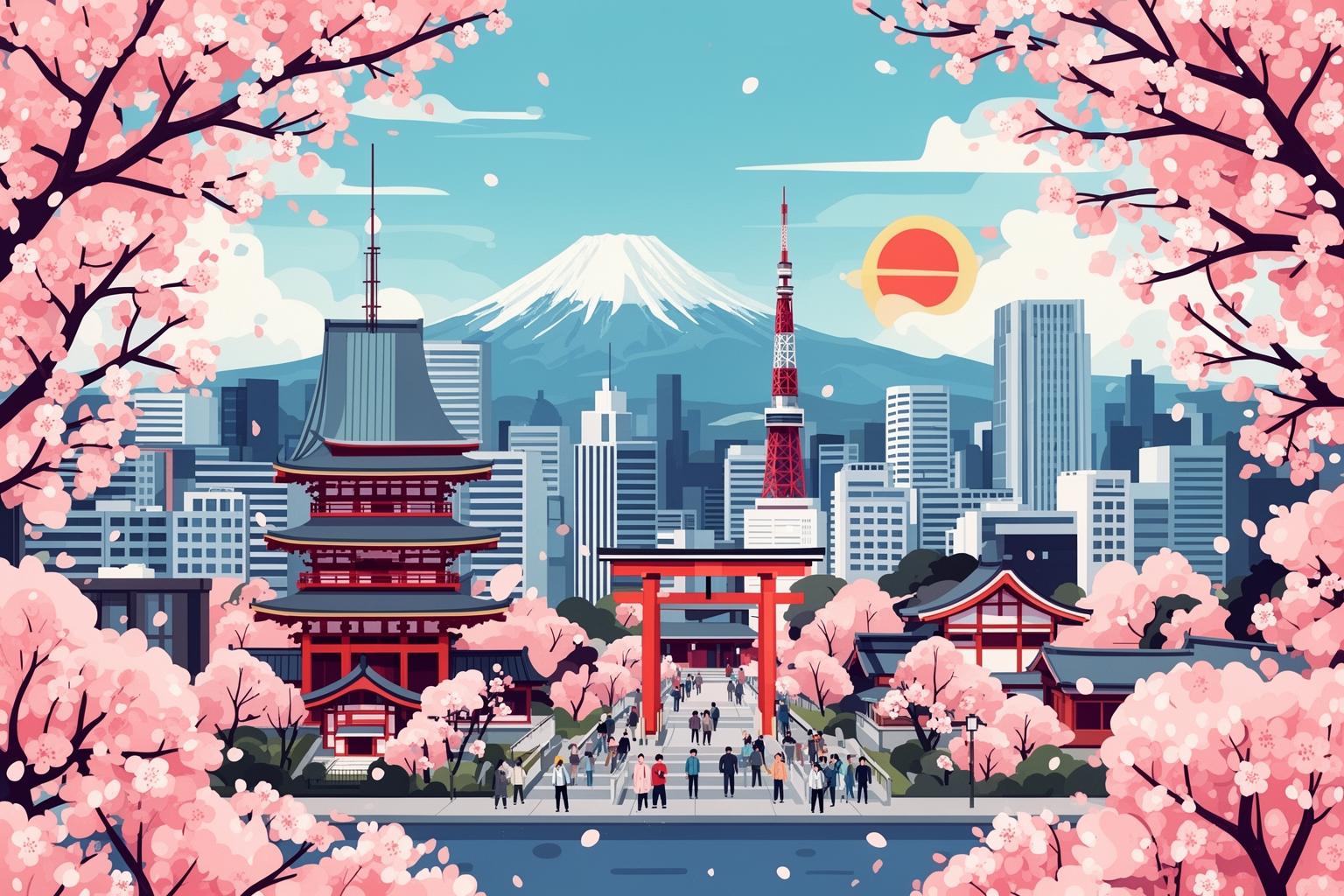
Every story has a beginning, and Akutagawa’s begins not in a serene literary salon, but in the bustling mercantile heart of Meiji-era Tokyo. He was born in 1892 in Irifunecho, a neighborhood within the Kyobashi district, now part of modern Chuo Ward. This was a city undergoing a radical transformation, shedding its feudal past to emerge as a modern, industrial capital. The Tokyo of Akutagawa’s birth was filled with clattering streetcars, gas lamps casting a hazy glow on newly paved streets, and a populace alive with a dynamic mix of Western ideas and Japanese tradition. To understand this environment is to take the first step toward understanding the man, for the city’s restless energy and its constant balancing between old and new would become central themes in his life and work.
Kyobashi and Irifunecho: Traces of a Meiji Birthplace
Today, finding the exact spot of Akutagawa’s birth requires a leap of historical imagination. The district where he was born has been consumed by the relentless redevelopment that characterizes central Tokyo. Where his family’s milk farm once stood, there are now office buildings, sleek storefronts, and a continuous flow of traffic. Yet the search is not without its rewards. A modest plaque, often overlooked by hurried passersby, marks the approximate location. Standing before it calls for a deliberate pause, an intentional effort to peel back the layers of the present. Close your eyes, and you can almost hear the echoes of the past: the calls of street vendors, the clip-clop of horses’ hooves, the scent of coal smoke blending with the sea breeze from nearby Tokyo Bay. This sensory world first greeted Ryunosuke. He was born a Dragon—in the month, day, and hour of the dragon; hence his name, Ryunosuke, which includes the character for the mythical beast. Yet his early life was shadowed by tragedy. His mother, Fuku, suffered from mental illness shortly after his birth, a shadow that would hang over Akutagawa throughout his life, fueling a profound fear of inheriting her condition.
The Modern Landscape: Discovering the Past in the Present
A visitor to Chuo Ward today should not expect a preserved historical district. Instead, the pilgrimage here is one of atmosphere and context. Walk from the upscale elegance of Ginza toward the more business-oriented Kyobashi district. Notice the architectural blend—the pre-war stone facades of department stores standing alongside post-modern skyscrapers. This visual dialogue between eras is deeply Akutagawa. He was a product of this very fusion: a man passionate about English literature, yet one who chose to set his most famous stories in Japan’s feudal past. To truly appreciate this area, visit on a weekend morning when the commercial rush quiets down. The calmer streets allow you to focus on details: a small, tucked-away shrine nestled between buildings, an old shop selling traditional paper goods, the elegant arch of the Nihonbashi bridge not far off. These are remnants of the old Tokyo Akutagawa would have known. Although the specific landmarks of his infancy have vanished, the spirit of the place—a crossroads of commerce, culture, and continual change—remains a powerful prelude to his life’s story.
The Forge of Intellect: Tokyo Imperial University
If his birth shaped his anxieties, it was his education that equipped him with his tools. Akutagawa’s intellect was razor-sharp, refined to perfection at the nation’s most prestigious institution: Tokyo Imperial University, now known as the University of Tokyo. Enrolling in its English Literature department in 1913, he entered the core of Japan’s intellectual life. This was more than just a place of learning; it was a battleground of ideas where Western literary canons were analyzed, debated, and ultimately used to forge a new Japanese literature for the modern era. The campus, situated in the Hongo district of Bunkyo Ward, remains a haven of academic tranquility amid the city’s bustle, and walking its grounds feels like stepping back into the ambitious, intellectually vibrant world of the Taisho period.
Walking the Hallowed Grounds of Hongo
The Hongo campus is an architectural gem. Begin your pilgrimage at the renowned Akamon, the “Red Gate.” This vivid vermilion gate, a registered Important Cultural Property, once served as the entrance to the Maeda clan’s feudal estate during the Edo period. Passing through it, you leave behind the city’s noise and enter a realm of tree-lined paths, stately brick buildings, and an almost tangible sense of history. The atmosphere is one of deep seriousness and quiet determination. Students on bicycles pass silently, their faces focused, reflecting the generations of scholars who preceded them. Seek out the iconic Yasuda Auditorium with its distinctive clock tower. Although built after Akutagawa’s time, it has become the university’s symbol and embodies the grand ambition that filled the campus. The most evocative experience, however, is to simply wander through the older parts of the university. Locate the General Library, a magnificent neo-gothic edifice, and envision a young Akutagawa inside, immersing himself in works by Baudelaire, Strindberg, and Anatole France—writers who profoundly influenced his style and worldview.
The Atmosphere of a Taisho Intellectual
During Akutagawa’s years here, he was not a solitary scholar but part of a lively literary circle. Alongside fellow students like Kan Kikuchi and Masao Kume, he revived the literary magazine Shinshicho (“New Currents of Thought”). It was in these pages that his early masterpieces, including “Rashomon,” first appeared, drawing the attention of the literary giant Natsume Soseki. To capture this atmosphere, find a quiet bench near Sanshiro Pond, a serene oasis at the heart of the campus named after Soseki’s famous novel. As you watch the shimmering reflections of trees on the water, you can imagine the intense discussions that must have taken place here. These young men, brimming with talent and ambition, knew they were at the forefront of a new literary movement. They debated aesthetics, critiqued one another’s work, and dreamed of literary immortality. Visiting the University of Tokyo is about more than sightseeing; it’s about feeling the intellectual passion that launched one of Japan’s greatest literary careers. For first-time visitors, a good tip is to pair the campus visit with a stroll through the nearby Yanaka district, one of the few areas in Tokyo to survive wartime bombings, offering a glimpse of the older, slower-paced city that Akutagawa once knew.
The Seaside Interlude: Kamakura’s Literary Salon
After graduating, Akutagawa briefly accepted a teaching position in Yokosuka, a naval port city. The strict, militaristic environment clashed with his artistic temperament. Seeking a more agreeable setting, he, like many writers and artists of his era, was drawn to the coastal town of Kamakura. Just an hour south of Tokyo, Kamakura presented a dramatic shift in scenery and pace. With its rolling hills, ancient temples, and the vast Pacific Ocean, it was a place for contemplation and creativity. It became a refuge for the bunjin, the literary figures who formed a close-knit community away from the pressures of the capital. For Akutagawa, his time in Kamakura was a period of growing confidence and connection, a crucial interlude before he entered his final, most intense phase of writing.
A Breath of Salty Air
The atmosphere of Kamakura is one of refined rustic charm. The air is imbued with the scent of sea salt and incense from the many temples. The transition from Tokyo’s dense urban sprawl is immediate and striking. Begin your journey at Kamakura Station and stroll toward the sea along the main street, Wakamiya Oji. This broad avenue, lined with cherry trees and traditional shops, leads directly to Tsurugaoka Hachimangu, the city’s most significant shrine. The scale is grand, yet the mood is relaxed. From there, continue to the iconic Great Buddha (Daibutsu) at Kotoku-in Temple. The colossal bronze statue, seated in serene contemplation beneath the open sky, powerfully symbolizes the city’s spiritual heritage. It is this blend of natural beauty and profound history that captivated the Taisho-era writers. Imagine Akutagawa, a man grappling with deep existential questions, finding a measure of peace while gazing upon this image of unwavering calm. The beaches of Yuigahama and Zaimokuza offer another dimension. A walk along the shore, especially in the quiet hours of a weekday morning, allows you to experience the same rhythmic crashing of waves and the vast open horizon that offered him respite from the claustrophobia of his own mind.
Tracing the Bunjin Community
Akutagawa’s time in Kamakura was shaped by his interactions with fellow writers. He was a frequent visitor to the homes of Saisei Muroo and Horiguchi Daigaku. While their exact residences may now be private homes or no longer exist, the spirit of this literary community endures. The Kamakura Museum of Literature, housed in a splendid former villa of the Maeda family, is a must-visit. Its elegant Western-style architecture, beautiful rose garden, and commanding sea view make it one of Japan’s most beautiful museums. Inside, exhibits celebrate the many writers associated with the city, including Akutagawa and Yasunari Kawabata. The museum offers crucial context, outlining the relationships and intellectual currents that flowed through this seaside salon. To fully appreciate the area, consider renting a bicycle. It allows you to explore quieter residential streets where these writers lived and to discover hidden temples and cafés tucked away from the main tourist routes. Kamakura offers a slower, more contemplative pilgrimage—a chance to connect with Akutagawa not through the intensity of his work, but through the restorative power of the landscape that briefly became his home.
The Heart of the Labyrinth: Tabata, the Artist’s Village
Of all the places connected to Ryunosuke Akutagawa, none holds more significance or is more infused with his presence than Tabata. This quiet, modest neighborhood in northern Tokyo was where he spent the final decade of his life, from 1916 until his death in 1927. It was here, in a simple house he named Gakujuso, that he created much of his monumental body of work. Yet Tabata was more than just a residence; it was a creative ecosystem. Known as the Tabata Bunshimura (Tabata Writers’ and Artists’ Village), it housed an extraordinary concentration of painters, poets, and writers who formed a lively, supportive, and occasionally fractious community. Exploring Tabata today means embarking on the most intimate part of the Akutagawa pilgrimage, to walk the very streets where his daily life unfolded, where his literary brilliance shone brightest—and ultimately faded.
Tabata Bunshimura: A Hub of Creativity
What attracted artists to Tabata? In the early 20th century, it was a semi-rural suburb. The area offered more affordable land, cleaner air, and a peaceful atmosphere while remaining well-connected to central Tokyo by the newly established Yamanote railway line. It was an ideal place to work without distractions yet still easily meet publishers and colleagues in the city. The nearby Tokyo School of Fine Arts (now Tokyo University of the Arts) in Ueno also contributed significantly, drawing a generation of painters who became the village’s first residents. Writers like Akutagawa followed. The mood was one of bohemian camaraderie, with informal gatherings in local homes, sake-fueled debates on art and literature lasting late into the night, and a constant exchange of ideas between painters and writers. This fertile environment nurtured Akutagawa’s mature works. He was a central figure in the community, admired for his intellect and talent, a sun around which many other stars revolved.
The Tabata Memorial Museum of Writers and Artists: A Revered Space
The Tabata Memorial Museum of Writers and Artists should be your first and most important stop in Tabata. This modern, thoughtfully curated museum preserves the spirit of the Bunshimura. While not large, its collection is rich and profoundly moving. The exhibits skillfully recreate the world of Akutagawa and his contemporaries. You can view facsimiles of his manuscripts, his delicate handwriting covering the pages with an almost feverish intensity. Photographs of him with family, friends, and his beloved dog offer insight into the private man behind the public intellectual. One of the most striking exhibits is a detailed model of Tabata as it was in the 1920s, allowing visitors to visualize the village and the close proximity of the artists’ homes. The museum excels not only in highlighting Akutagawa but also in contextualizing him within his community. You learn about painter Seiki Kuroda, poet Saisei Muroo, and many others who made Tabata a cultural hub. The museum provides maps for walking tours, making it the perfect starting point for exploration. The staff are knowledgeable and passionate, and the museum feels less like a sterile institution and more like a heartfelt tribute.
The Site of “Gakujuso”: A Place for Quiet Reflection
After soaking up the history at the museum, take a walk to the site where Akutagawa’s house, Gakujuso, once stood. The original home no longer exists, lost to time and urban development. In its place lies a quiet residential street. However, a prominent signpost with photographs and explanations marks the spot, ensuring this sacred site is not forgotten. Standing here is a profoundly moving experience. This is where Akutagawa wrote “The Hell Screen,” “Kappa,” and “Spinning Gears.” It is where he played with his three sons, hosted friends, and where, in the early hours of July 24, 1927, he ended his own life at age 35. The atmosphere feels distinct; the noise of Tokyo recedes, replaced by a contemplative silence. You find yourself observing the surrounding houses, small gardens, and overhead power lines, trying to imagine the modest wooden home that once stood here. This site is the heart of the pilgrimage—a place for quiet reflection on the immense creativity and deep suffering that coexisted within one man. It reminds us that genius often dwells in the most ordinary of settings.
A Practical Guide to Exploring Tabata
Tabata is easily reached via the JR Yamanote or Keihin-Tohoku lines to Tabata Station. Upon exiting, follow signs pointing to the museum and literary walking trails. The neighborhood is hilly, with narrow, winding streets, so comfortable walking shoes are recommended. The best way to experience Tabata is by wandering without a rigid itinerary. Follow the small plaques and signposts scattered around, marking the former homes of various artists. You’ll pass the site of Saisei Muroo’s house and that of proletarian writer Takiji Kobayashi. These markers create a kind of literary scavenger hunt, revealing the remarkable density of talent that once thrived in these quiet lanes. Make sure to climb the Dogo-zaka slope, a path Akutagawa took daily. At the top, you gain a sense of the area’s terrain. As you walk, notice the small details: well-kept plants outside a home, the distant sound of a passing train, and the way light filters through the leaves of a persimmon tree. These timeless, everyday sensations formed the backdrop of Akutagawa’s life. Visiting Tabata is a slow, meditative journey offering the deepest connection to the author’s world.
Journeys of Inspiration: Beyond the Capital
Although Akutagawa was fundamentally a Tokyo writer, his imagination was not limited to the capital. His journeys, though not extensive, were essential in providing the settings and atmospheres for some of his most enduring stories. He had the eye of a historian and the sensitivity of a poet, enabling him to absorb the essence of a place and transform it into literature. Following him to the ancient capitals of Kyoto and Nara, or to the port city of Nagasaki, offers insight into the raw materials from which he crafted his fictional worlds. These travels reveal a writer who, while wrestling with the modern psyche, was deeply connected to Japan’s broad cultural and historical landscape.
Kyoto and the Gates of Perception
No story is more closely linked to a place than “Rashomon” is to Kyoto. The narrative of moral collapse and subjective truth unfolds beneath the dilapidated Rashōmon gate, the southern entrance to the Heian-kyo capital during a time of severe famine and decline. Akutagawa’s tale is a masterpiece of atmosphere, depicting a world where civilization has worn thin. A visitor to contemporary Kyoto looking for the Rashōmon gate will find the original structure vanished centuries ago. Its former site lies in an unremarkable area near the junction of Kujō Street and Senbon Street, marked only by a stone monument in a small park. Yet, as with Akutagawa’s birthplace, the journey is not about viewing the object itself but about grasping its historical significance. Standing there places one at the southern threshold of what was once among the world’s great planned cities. From there, the grand Suzaku Avenue stretched northward to the Imperial Palace. Akutagawa used the gate’s historical ruin as a potent symbol of the erosion of moral certainty.
Seeking the Shadow of Rashomon
To truly experience Akutagawa’s Kyoto, one must explore the city’s darker, more atmospheric corners. While the golden splendor of Kinkaku-ji or the vibrant hues of Fushimi Inari are splendid, the spirit of “Rashomon” or the eerie artistry of “The Hell Screen” is better sensed elsewhere. Visit the extensive temple complexes of Daitoku-ji or Myōshin-ji on a quiet afternoon, wandering among their sub-temples adorned with mossy gardens and shadowy wooden corridors. Stroll through Adashino Nenbutsu-ji in Arashiyama, with its thousands of stone statues mourning lost souls. In these places of deep stillness and history, one can feel the weight of the centuries that captivated Akutagawa. He was a master of historical storytelling, not as a mere academic pursuit, but as a means to explore eternal human dilemmas. His Kyoto is not the city of cherry blossoms and geishas, but a realm of shadows, ghosts, and profound moral questions—a landscape where the veneer of civilization is fragile and the darkness of the human heart is always close at hand.
Nagasaki’s Exotic Influence
In 1921, Akutagawa traveled to Nagasaki as a correspondent for the Osaka Mainichi Shimbun. This trip had a lasting impact on him. Nagasaki was, and remains, a city unlike any other in Japan. For centuries, its port served as the nation’s primary gateway to the outside world, a hub of trade with the Dutch and Chinese, and the historical center of Christianity in Japan. This unique, cosmopolitan environment sparked Akutagawa’s imagination. He was intrigued by the city’s history of Christian martyrs, its mix of Japanese, Chinese, and European cultures, and its vibrant, exotic atmosphere. This experience directly influenced stories such as “The Cogwheels” (part of “Spinning Gears”) and other works featuring Christian themes or a more international viewpoint. Visitors to Nagasaki can follow his footsteps through the city’s historic districts. Wander the cobblestone slopes of Dutch Slope (Oranda-zaka), where Western traders once resided. Visit Ōura Church, the oldest standing church in Japan, and nearby Glover Garden, with its well-preserved 19th-century Western-style mansions overlooking the harbor. Explore the city’s Chinatown, Shinchi, and the tranquil Sofukuji Temple, known for its magnificent Ming Dynasty architecture. In Nagasaki, one senses a different side of Akutagawa—open to the world, curious about diverse faiths and cultures, and able to weave these varied threads into his distinctively Japanese literary fabric.
The Final Chapter: A Grave Amongst the Camellias
A literary pilgrimage often concludes with a visit to the author’s final resting place. This moment serves as a quiet tribute, a last act of connection with the spirit that has guided the journey. Ryunosuke Akutagawa is interred in the cemetery of Jiko-in Temple in Sugamo, a district within Tokyo’s Toshima Ward. Unlike the grand, monumental tombs of some historical figures, his grave is modest and personal, reflecting the man himself. Visiting here is the final, vital step in understanding a life that, though tragically brief, left an enduring impact on the world.
Jiko-in Temple in Sugamo
Sugamo is a neighborhood with a distinctive character, known for the Jizo-dori shopping street, often dubbed the “Harajuku for grandmothers,” boasting a charming, old-fashioned vibe. Jiko-in Temple is just a short walk from this lively street, yet it feels like a world apart. It is a small, quiet urban temple, offering a peaceful sanctuary amid the bustling city. The cemetery lies within the temple grounds. Japanese cemeteries possess a unique and serene beauty. Rather than a morbid gloom, there is a sense of tranquil order and reverence. Stone monuments stand in neat rows, often decorated with fresh flowers and offerings from visiting family members. The air is still, broken only by the cawing of a crow or the distant toll of a temple bell. Locating Akutagawa’s grave involves a bit of searching, which is part of the experience. It is a simple stone pillar, inscribed with the characters of his family name and his posthumous Buddhist name, shared with his wife, Fumi, and other relatives.
The Etiquette of Remembrance
Visiting a grave in Japan is an expression of respect, accompanied by simple customs to follow. It is customary to bring flowers and sometimes a small offering of something the deceased enjoyed—in Akutagawa’s case, perhaps a book or a small bottle of sake might be appropriate, though flowers alone are most common. At the cemetery entrance, there is a place to draw water. Using the provided ladles, you gently pour water over the gravestone as a symbolic act of cleansing and respect. Afterward, place your flowers in the vase. Most importantly, take a moment for quiet reflection. Stand before the stone and consider the journey you have made—from his birthplace in Kyobashi, through the halls of his university, to his creative sanctuary in Tabata. Reflect on the stories that moved you, the characters that lingered in your mind, and the brilliant, troubled intellect that created them all. This final stop is not about an ending but about gratitude. It is a silent thank you to the master for the world he bequeathed. A visit here is a powerful and humbling conclusion to the pilgrimage, linking the monumental legacy of his work with the simple reality of his peaceful final rest.
A Traveler’s Epilogue: Embracing Akutagawa’s World
To follow in the footsteps of Ryunosuke Akutagawa is to embark on a journey through the heart of Japan’s turbulent yet brilliant transition into the modern era. His life reflected the Taisho period’s dazzling promise alongside its profound anxieties. The places he lived are more than mere locations; they serve as vessels of memory, filled with the intellectual vigor, creative passion, and deep sorrow that marked his existence. From the commercial energy of his birthplace to the academic discipline of his university, from the bohemian fellowship of Tabata to the tranquil finality of his grave in Sugamo, each setting reveals a distinct aspect of his complex character.
This pilgrimage shows that Akutagawa’s world has not completely disappeared. While Tokyo has rapidly transformed, the spirit of the city he once knew endures in its quiet corners, hidden temples, and resilient neighborhoods. The intellectual curiosity he cultivated at the University of Tokyo still resonates on its campus, and the artistic soul of Tabata Bunshimura is carefully preserved in its memorial museum. By walking these paths, the modern visitor does more than merely learn about a long-gone author; they engage in a conversation with the past, allowing the places themselves to share their stories. You come to realize that today’s Japan was built upon the foundations of Akutagawa’s era, and that the questions he grappled with—the nature of truth, individual isolation, and the conflict between tradition and modernity—remain as relevant now as they were a century ago. So, when you visit Japan, venture beyond the well-known landmarks. Seek out these quieter, more evocative places. Let the spirit of this literary master guide you, and you will uncover a Japan rich in depth, subtlety, and enduring human drama.