The air in Japan often feels charged with a certain kind of magic, a quiet energy that hums just beneath the surface of the everyday. It’s in the mist that clings to ancient forests, the steam that rises from volcanic hot springs, and the soft glow of a paper lantern swaying in a narrow alley. It’s a feeling Hayao Miyazaki captured with breathtaking perfection in his masterpiece, Spirited Away. For years, the film has served as a gateway for countless dreamers, a portal into a world of gods, spirits, and fantastical bathhouses. But what if you could step through that portal, even for a moment? While Studio Ghibli has famously stated that no single place served as the direct model for the film, the spirit world it depicts is not entirely a fantasy. Its soul is woven from the threads of real places scattered across the Japanese archipelago—places you can touch, see, and feel. This is a journey into those landscapes, a pilgrimage to the soul of Spirited Away. It’s a photographer’s quest to capture the echoes of Chihiro’s adventure, following the whispers of spirits through ancient bathhouses, across iconic red bridges, and into the forgotten corners of a city’s past. We’ll wander through the tangible inspirations that fueled a global phenomenon, finding pieces of the Aburaya bathhouse and its bustling, mysterious town hidden in plain sight. Prepare to cross the threshold, because the spirits are waiting.
For travelers captivated by the delicate interplay of myth and reality, delving into real-world locations that inspired another celebrated tale can add depth to the journey.
The Grand Echo: Dogo Onsen and the Soul of the Aburaya
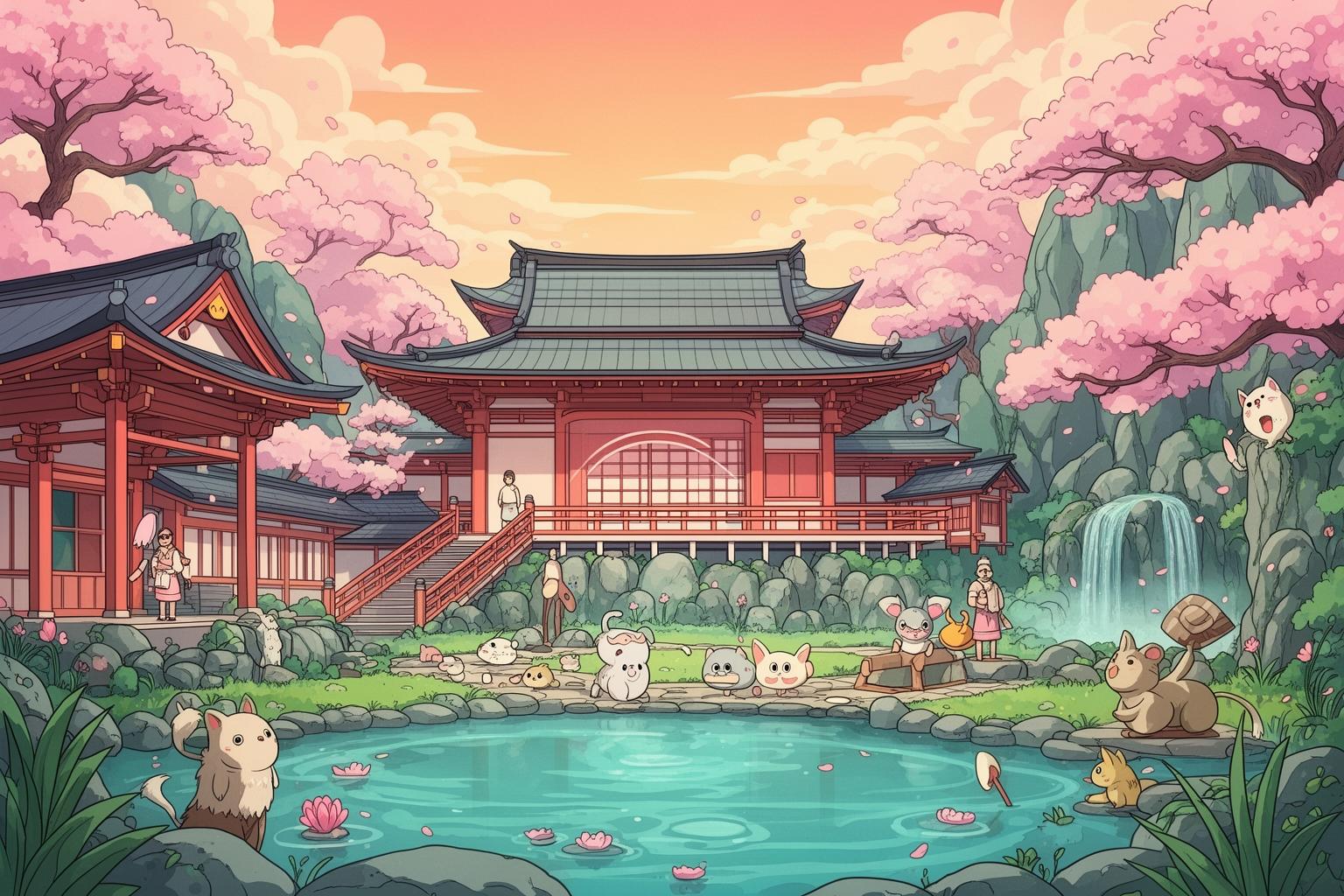
Our first destination leads us south to Shikoku Island, where the city of Matsuyama holds a treasure of legendary significance. Here stands the Dogo Onsen Honkan, a Meiji-era bathhouse rising from the streets like a wooden fortress. At first sight, the connection is electric. Its intricate, multi-layered rooflines, maze of balconies and windows, and ornate wooden carvings all evoke the Aburaya, the grand bathhouse at the heart of Spirited Away. This is more than a building; it is a living, breathing piece of history that has welcomed bathers for over a century, its waters famed for healing ancient gods. As you approach, the scent of sulfur and steam fills the air, mingling with the gentle clacking of wooden geta sandals on stone. The structure itself seems to observe you, its central watchtower, the Shinrokaku, topped by a majestic white heron symbolizing the onsen’s legendary origins. Inside, the atmosphere transforms. Light filters through stained glass, casting colorful patterns on dark, polished wood smoothed by time and countless visitors. The corridors form a labyrinth of staircases and passageways, each turn unveiling a new room, a new detail. You can almost hear the bustling frog-like attendants and Yubaba’s commanding voice echoing through the halls. The main bathing areas, Kami no Yu (Bath of the Gods) and Tama no Yu (Bath of the Spirits), resonate with the sounds of flowing water and quiet, contented sighs. The stone tubs and soaring ceilings evoke grandeur and timelessness. Sitting in these restorative waters, you feel connected to generations of travelers, pilgrims, and even royalty who have sought solace here. A special experience awaits at the Yushinden, a private bathing area built exclusively for the Imperial Family in 1899. Though bathing there is not permitted, a tour offers a glimpse into a world of unparalleled craftsmanship, with gilded screens and exquisitely decorated rooms. It speaks to the profound cultural significance of this place, a significance Miyazaki undoubtedly sensed and infused into the Aburaya’s hierarchical design. A practical tip for visitors: arrive in the late afternoon. Enjoy the bathhouse, then as dusk falls, explore the surrounding covered shopping arcade, Dogo Haikara Dori. The streets come alive with people dressed in yukata provided by their ryokans, and the entire area glows with a warm, nostalgic light. It is in these moments, seeing the Dogo Onsen Honkan illuminated against the twilight sky, that the illusion is complete. You are no longer simply a tourist; you are a visitor to the spirit world.
The Crimson Bridge to Another World: Shima Onsen’s Sekizenkan
Deep in the mountains of Gunma Prefecture, tucked away in a serene valley, lies a scene so perfectly reminiscent of the film that it feels like walking onto a movie set. This is Shima Onsen, a classic hot spring town, whose crown jewel is the Sekizenkan ryokan. What makes this place truly iconic is the vibrant red bridge that arches elegantly over the Shima River, leading directly to the inn’s entrance. It is an exact replica of the bridge Chihiro must cross, holding her breath, to enter the spirit world. Standing before it, you can almost sense the gentle pressure of Haku’s hand, guiding you across the threshold between the human and the ethereal. The Sekizenkan itself is a cascade of wooden buildings clinging to the hillside—a chaotic yet beautiful tangle of architecture spanning different eras. The oldest part, the Main Building, is a designated Important Cultural Property and is reputed to be the oldest wooden hot spring hotel in Japan. Its dimly lit wooden corridors and traditional tatami rooms feel as if frozen in time. Staying here offers an immersive experience: you don a yukata, shuffle through winding hallways, and descend into the historic Roman-style bath, a stunning, arched hall filled with steam and the gentle sound of flowing water. The inn is connected by a mysterious, long, and slightly eerie tunnel burrowing through the hillside, linking the older sections to the newer ones. Walking through it, you half-expect to find yourself in the boiler room with Kamaji, the six-armed boiler man. The atmosphere of Shima Onsen town powerfully enhances the illusion. It is a quiet place, free from the bustle of major tourist areas. Narrow streets are lined with traditional inns and small shops, accompanied by the gentle murmur of the river. In the evening, when the lanterns of the Sekizenkan flicker to life and cast a warm glow on the red bridge, the enchantment is undeniable. For photographers, it’s a dream: the contrast of the crimson bridge against the lush green mountains in summer or the stark white snow in winter is breathtaking. A word of advice for visitors making the pilgrimage: take your time. Don’t just snap a photo of the bridge and leave. Spend a night at the Sekizenkan or another local ryokan. Soak in the town’s four public baths, each with its distinct character. Stroll along the river after dark. It is in these quiet, unhurried moments that the spirit of the place reveals itself, and you understand why this tranquil corner of Japan could inspire such a fantastical tale.
A Glimpse into the Past: The Edo-Tokyo Open Air Architectural Museum
While towering bathhouses and red bridges provide the grand, sweeping visuals of Spirited Away, the film’s charm also lies in its smaller, more intimate details: the cluttered interiors, the weathered storefronts, and the charmingly old-fashioned mechanics of the spirit world. For these, Hayao Miyazaki turned to a site much closer to his Tokyo studio: the Edo-Tokyo Open Air Architectural Museum. Located within Koganei Park, this magnificent museum is a village of rescued and reconstructed buildings from Japan’s recent past. It’s a place where you can stroll through the streets of the Meiji, Taisho, and early Showa periods, and it was a favorite haunt of Miyazaki’s while developing the film. He would wander these streets, absorbing the atmosphere and sketching details that would later populate his animated world. The strongest connection is found inside the “Kodera-yu,” a public bathhouse (sento) relocated here from Adachi Ward. Upon entering, you’re greeted by a grand mural of Mount Fuji overlooking the bathing areas—a classic sento feature. But it’s the tall wooden lockers for clothing and the ornate details of the changing rooms that feel so familiar. It’s easy to imagine Lin showing Chihiro the ropes here. Even more evocative is the Takei Sanshodo, a former stationery shop from the Kanda district. With walls lined by countless wooden drawers from floor to ceiling, it is the unmistakable inspiration for Kamaji’s boiler room. You can almost see the soot sprites scurrying about, carrying coal in their tiny arms. Standing in this room, surrounded by the scent of old paper and wood, you feel a direct, tangible link to Miyazaki’s creative process. However, the museum is not just about these two buildings. The entire western section, with its collection of Showa-era shops and homes, feels like the abandoned town Chihiro and her parents discover at the beginning of the film. You can peer into an old flower shop, a soy sauce store, and a traditional Japanese inn, each a perfectly preserved time capsule. For anyone visiting Tokyo with a love for Ghibli, this museum is an essential pilgrimage site. It offers a different kind of magic—not the grand, ethereal fantasy of Dogo Onsen, but the quiet, nostalgic magic of a world just out of reach, a world of beautiful everyday history that formed the very bones of Spirited Away.
An Honorable Mention Across the Sea
No discussion of Spirited Away’s inspirations would be complete without mentioning a persistent and popular theory that points not to Japan, but to the mist-shrouded hills of Taiwan. The town of Jiufen, a former gold mining boomtown near Taipei, is famous for its narrow, winding alleyways, steep stone staircases, and the cascade of red lanterns illuminating its teahouses as night falls. The resemblance to the film’s spirit town is so striking that for years, it has been widely cited as a primary model. The experience of wandering through Jiufen—especially along Shuqi Road—is truly magical. As you navigate the crowded steps, flanked on both sides by food stalls and souvenir shops, the glow of the lanterns creates an otherworldly atmosphere. The A-Mei Tea House, in particular, with its multi-storied wooden structure and glowing facade, is often singled out as a real-world Aburaya. While Miyazaki himself has clarified in interviews that Jiufen was not a direct model, the shared aesthetic and mood are undeniable. It taps into a collective imagination of what a mythical, bustling Asian town should feel like. It’s possible the film and the town both draw from a similar well of cultural and architectural inspiration. So, while it may not be an official pilgrimage site, Jiufen remains a spiritual cousin to the world of Spirited Away. For fans visiting Taiwan, it is an unmissable stop. It serves as a beautiful reminder that the magic of the film isn’t confined to a single blueprint but is part of a wider, shared landscape of wonder that spans cultures and borders. It proves that the feeling of stepping into another world is universal, whether found in a Japanese onsen or a Taiwanese mountain town.
Finding Your Own Spirit World

Pursuing the ghost of a film is a peculiar kind of journey. It’s a search for something inherently intangible. Yet, within the grand halls of Dogo Onsen, on the crimson bridge of Shima Onsen, and among the preserved storefronts of the Edo-Tokyo museum, the world of Spirited Away feels surprisingly vivid. These locations are not mere replicas; they are the foundational elements, the cultural DNA from which Miyazaki shaped his vision. They embody the history, the aesthetics, and the spirit that make the film resonate so strongly. The true pilgrimage, I’ve discovered, isn’t about finding an exact one-to-one match of a scene. It’s about sensing the heartbeat of the world that inspired it. It’s about soaking in waters that have healed people for a millennium, wandering through corridors that echo with history, and watching lantern light flicker on aged wood. The magic of Spirited Away is the magic of Japan itself—a land where the past is ever-present, where gods and spirits seem just a breath away, and where even the most ordinary tunnel might be a gateway to a realm of wonders. So go, seek out these places. But more importantly, keep your eyes open. You might just discover your own corner of the spirit world when you least expect it.