There’s a certain kind of magic that lives within the pages of an Alexandre Dumas novel. It’s a whirlwind of swashbuckling adventure, high-stakes political intrigue, passionate romance, and the unshakeable bonds of friendship. From the rallying cry of “All for one, and one for all!” to the chilling, patient revenge of Edmond Dantès, Dumas didn’t just write stories; he crafted entire worlds that have captivated readers for nearly two centuries. But what if I told you that those worlds aren’t entirely confined to paper and ink? They are woven into the very fabric of France, in the stones of its castles, the cobblestones of its capital, and the sun-drenched shores of its coast. This isn’t just a trip; it’s a pilgrimage. It’s a chance to walk the same paths as d’Artagnan, to feel the phantom chill of the Château d’If, and to stand in the very rooms where a literary giant dreamed it all into existence. We’re about to embark on a journey through the life and landscapes of Alexandre Dumas, a man whose own story was as grand and dramatic as any of his fictional creations. From his humble beginnings to his extravagant dream home, and finally to his hallowed resting place among France’s immortals, this is a tour through the heart of a legend.
The Roots of a Legend: Villers-Cotterêts

Every great story has its beginning, and for Alexandre Dumas, that beginning lies in a quiet town nestled within the lush forests of the Aisne department, about an hour’s drive northeast of Paris: Villers-Cotterêts. The name itself carries a gentle, flowing quality, a stark contrast to the explosive and dramatic life of its most famous son. To truly understand Dumas, one must start here, where the roots of his remarkable imagination first took hold.
Born in 1802, Dumas was the son of Thomas-Alexandre Dumas, a general in Napoleon’s army whose life was, remarkably, even more adventurous than his son’s literary heroes. The general was the offspring of a French marquis and Marie-Cessette Dumas, a Black slave from Haiti. This mixed-race background placed the Dumas family in a distinctive and often precarious position within French society. Young Alexandre grew up listening to tales of his father’s extraordinary exploits—a man of legendary strength and courage, dubbed the “Black Devil” by his foes. These stories of heroism, prejudice, betrayal, and honor became the foundation for the novels that would later bring him fame. Walking through Villers-Cotterêts, one can almost sense the presence of those formative years. The town is not a bustling city but a place of quiet reflection. Nearby lies the Forest of Retz, a vast and ancient woodland that served as Dumas’s childhood playground. It’s easy to imagine him wandering beneath the dense canopy of oaks and beeches, his mind already filled with tales of romantic duels and daring escapes, the forest serving as the backdrop for the adventures of Athos, Porthos, and Aramis.
The town’s centerpiece, and a must-see for any Dumas pilgrimage, is the Château de Villers-Cotterêts. This royal castle, an exquisite example of Renaissance architecture, has recently undergone a massive transformation. It now houses the Cité internationale de la langue française, a cultural center dedicated to the French language—a profoundly fitting tribute in Dumas’s hometown. After all, he was a master of the French language, a wordsmith who molded it to his will to create some of the most enduring stories ever told. Visiting the Cité is not solely about Dumas; it offers incredible context, helping you appreciate the tool he wielded with such brilliance. The exhibitions are interactive and captivating, celebrating the richness and global influence of the language he so passionately championed. For first-time visitors, a practical tip is to plan your trip as a day excursion from Paris. The train ride is scenic, and arriving in this small town feels like stepping back in time. Allow yourself a full day to explore the Cité at a relaxed pace and then stroll through the town itself. Locate the statue of Dumas, a striking and dignified monument, and pay your respects. This is the place where the force of nature that was Alexandre Dumas was born, and you can feel the quiet power of his origin story in the very air.
The Parisian Stage: Where a Writer Became a Star
If Villers-Cotterêts was the prologue, Paris was the grand, sprawling narrative of Dumas’s life. He arrived in the city as a young man with little money but a mind aflame with ambition. It was here that he would conquer the stage, revolutionize the novel, earn and squander multiple fortunes, and secure his place as a literary superstar. Paris was not just his home; it was his muse, his battlefield, and the primary setting for his most cherished works. Following his footsteps here is like peeling back the layers of the 19th-century city that still pulses beneath the surface of the modern metropolis.
The Roar of the Crowd: Dumas’s Theatrical Triumphs
Before he became a novelist, Dumas was a dramatist. He took Paris’s theater scene by storm with his historical dramas, brimming with the same passion and high emotion that would later define his books. A key landmark in this chapter of his life is the area around the Grands Boulevards, especially the Théâtre de la Porte Saint-Martin. It was here in 1829 that his play Henri III et sa cour (Henry III and His Court) debuted. It was a smash hit, a turning point for French Romantic theater and for Dumas personally. Though the original building has been altered over time, standing outside today, one can still imagine the electric atmosphere of that opening night—the flickering gaslights, the clattering carriages on cobblestones, and a young provincial writer suddenly the city’s talk. Another significant venue is the legendary Comédie-Française, the esteemed state theater. While more traditional, it too staged Dumas’s work, signifying his acceptance into the highest circles of French literary society. Exploring this district, still known as the “theater district,” offers a tangible sense of his early fame. It’s a vibrant, energetic part of Paris, where it’s easy to picture Dumas—a large, charismatic figure—holding court in a nearby café after a triumphant performance, his booming laughter ringing through the streets.
A Writer’s Haunts: Living and Breathing Paris
Dumas lived in many apartments across Paris, frequently moving to suit his shifting financial fortunes. He was deeply embedded in the city’s intellectual and bohemian quarters. The neighborhood of Saint-Germain-des-Prés, with iconic cafés like Les Deux Magots and Café de Flore, was the beating heart of the literary world. Although these particular cafés rose to fame slightly after Dumas’s prime, the district’s spirit is timeless. This was where writers, artists, and thinkers gathered to debate, create, and be seen. Wandering its winding streets means walking the same stones as Dumas and his contemporaries such as Victor Hugo and Honoré de Balzac. Known as a bon vivant, Dumas loved fine food and even finer company. He hosted legendary parties, and his appetite for life was as insatiable as his literary output. To soak in this atmosphere, simply sit at a café terrace with a coffee or a glass of wine, watch the world go by, and imagine the conversations that unfolded on that very spot. For a glimpse of his social life, explore the area around Place Saint-Georges in the 9th arrondissement, known as “New Athens” in his day. It was a trendy, artistic hub where he once lived, surrounded by actors, painters, and fellow writers. Less touristy than Saint-Germain, it offers a more authentic view of the Paris Dumas would have known.
Walking Through the Novels: Paris as a Character
For many fans, the ultimate Parisian pilgrimage is visiting the real-life settings of his novels. Dumas transformed Paris into a vast, epic character, and the city serves as a treasure map for his readers. You cannot walk far without encountering a location from The Three Musketeers. Begin near the Louvre, once a royal palace. Picture the young d’Artagnan arriving from Gascony, marveling at its grandeur, or the Musketeers striding through its courtyards on their way to meet King Louis XIII. From the Louvre, take a short walk to the church of Saint-Germain-l’Auxerrois. Here, the Musketeers often worshipped, a key meeting spot in the novel. The church is a gothic masterpiece, and stepping inside feels like entering their world. Next, visit the Place des Vosges in the Marais district. This exquisitely preserved 17th-century square was at the height of aristocratic fashion in the Musketeers’ era. Milady de Winter lived at number 6, and it was here that d’Artagnan had one of his fateful encounters with her. The arcades now house art galleries and stylish cafés, but the elegant architecture and peaceful central park remain unchanged. For a deeper dive, seek out the former site of the Bastille, the notorious prison central to The Man in the Iron Mask. Though the fortress was demolished during the Revolution, its outline is marked on the pavement of Place de la Bastille, where the imposing July Column stands as a monument to liberty—a theme Dumas surely cherished. A practical tip for this literary tour: wear your most comfortable shoes. Paris is a city made for walking, and the joy is in the discovery—turning a corner and suddenly recognizing a street name or building from a scene you’ve read countless times. Let the books be your guide, and allow the city to tell its stories.
A Dream in Stone: The Château de Monte-Cristo

After attaining phenomenal success and wealth through the serial publication of The Count of Monte Cristo and The Three Musketeers, Alexandre Dumas decided to create his own earthly paradise. He discovered a hillside plot in Le Port-Marly, a village west of Paris overlooking the Seine, and set out to build a home as fantastical and romantic as his novels. He named it the Château de Monte-Cristo. It was to serve as his sanctuary, a place to write and entertain, and a monument to his extraordinary life story. Visiting it today offers perhaps the most personal and poignant experience for any Dumas enthusiast. It provides a direct, tangible link to the man himself—a house constructed not just of stone and mortar, but of dreams.
The Palace of Imagination
The main château is a Renaissance jewel box, an architectural dream. Dumas engaged the architect Hippolyte Durand but was deeply involved in every design detail. The facade is a stunning gallery of sculptures, adorned with intricate carvings of floral motifs, angels, musical instruments, and, most notably, portraits of great literary figures throughout history, from Homer and Dante to Shakespeare and Schiller. At the very top, above the main entrance, are Dumas’s own coat of arms and his personal motto: “J’aime qui m’aime” (I love those who love me). The house quite literally wears its heart on its sleeve. Inside, each room narrates a story. The salon Mauresque, or Moorish Salon, stands out as the undeniable highlight. Meticulously transported piece by piece from a Tunisian bey’s palace, it is an intoxicating space filled with intricate stucco, vibrant tiles, and stained glass, designed for Dumas to entertain guests in exotic grandeur. One can almost hear the murmur of conversation and smell the sweet pipe smoke. As you explore the dining rooms, bedrooms, and studies, you sense not only the grandeur of the life lived here but also its fragility. This dream home was extraordinarily costly to build and maintain. Dumas, renowned for his generosity and poor money management, hosted lavish parties and kept his doors open to an endless flow of friends, artists, and hangers-on. The dream was magnificent but ultimately unsustainable.
The Fortress of Solitude: The Château d’If
Across the lush, English-style garden from the main house stands a smaller, neo-Gothic marvel: a miniature castle complete with a moat, affectionately named the Château d’If by Dumas. This was his personal writing studio, his sanctuary. While the main house was for socializing, this was where the creative magic unfolded. The exterior is etched with the titles of his numerous works, serving as a permanent bibliography carved in stone. Above the door, a carved dog guards the entrance, symbolizing the loyalty he cherished deeply. Inside, it is a simple, rustic space—a writer’s den. Standing in this small room, gazing out at the gardens and the main château beyond, is a moving experience. This is the place where he sat, pen in hand, producing thousands upon thousands of pages and spinning the tales that immortalized him. It was here he continued the adventures of the Musketeers and composed countless other novels and plays. The space feels sacred, a tiny fortress designed to keep the world at bay and let imagination run free.
Practical Pilgrim’s Guide
The Château de Monte-Cristo is situated in Le Port-Marly, easily reachable from central Paris. The simplest way to get there is by taking the RER A train to Saint-Germain-en-Laye, followed by a short bus ride (line 10) that stops close to the château. The journey itself enhances the experience, leaving behind the dense urban environment of Paris for the greener, quieter suburbs along the Seine. The château is usually open from April to early November, but it’s essential to consult the official website for precise dates, times, and any special events or closures. Weekdays tend to be less crowded than weekends, providing a more intimate visit. Allow yourself at least half a day—rushing through would be a disservice. Take time to admire the intricate facade details, stroll the winding garden paths, sit by the grottoes, and fully immerse yourself in both the main house and the writing studio. A small café on-site offers light snacks and coffee, but bringing a picnic to enjoy in the gardens is a delightful option on a sunny day. This is not merely a museum; it is the physical embodiment of a writer’s soul, telling a story of remarkable success, boundless creativity, and ultimately, the tragic folly of a man whose dreams were always just a little too grand for the real world. After only two years, Dumas’s debts compelled him to sell his beloved paradise for a fraction of its value. He never truly recovered from the loss.
The Count’s Domain: Marseille and the Château d’If
To truly grasp the power of Dumas’s most iconic novel, The Count of Monte Cristo, you must leave behind the elegant boulevards of Paris and the lush greenery of its suburbs. You need to travel south, to the vibrant, chaotic, sun-soaked port of Marseille and the windswept island fortress looming just offshore. This is where Edmond Dantès’s story begins—in the depths of despair—and where the seeds of his epic revenge are sown. It’s a journey into a different France—a world of sea salt, suspicion, and survival.
The Sun-Kissed Port of Marseille
Marseille is a city with a soul unlike any other in France. It’s ancient, gritty, multicultural, and fiercely independent. Arriving at the Vieux-Port (Old Port), the city’s heart, means stepping directly into the world of the novel’s opening chapters. The air is thick with the scent of the sea and diesel, mingled with the aroma of bouillabaisse from the waterfront restaurants. The sound of boat masts clinking in the wind and the cacophony of vendors at the morning fish market form the city’s constant soundtrack. This port is where the young, hopeful sailor Edmond Dantès arrived aboard the ship Pharaon, his future bright. You can stand on the quay, look out to the mouth of the harbor, and imagine his excitement, his love for Mercédès, and his total ignorance of the betrayal about to unfold. To get a true sense of Dantès’s neighborhood, explore the historic Le Panier district. With its narrow, winding streets, steep staircases, and pastel-colored buildings adorned with fluttering laundry, it is Marseille’s oldest quarter. Though it has become trendier in recent years with artisan shops and cafés, it retains an authentic, village-like atmosphere. Here, you can best envision the lives of the sailors, merchants, and conspirators who populate Dumas’s tale. A tip for visitors: the best way to view the Vieux-Port is from above. Climb the steps to the Basilique Notre-Dame de la Garde, the city’s golden-crowned guardian. From this lofty vantage, you get a breathtaking panoramic view of the entire city, the port, and, most importantly, the menacing silhouette of the Château d’If resting in the bay.
Island of Despair and Hope: Visiting the Real Château d’If
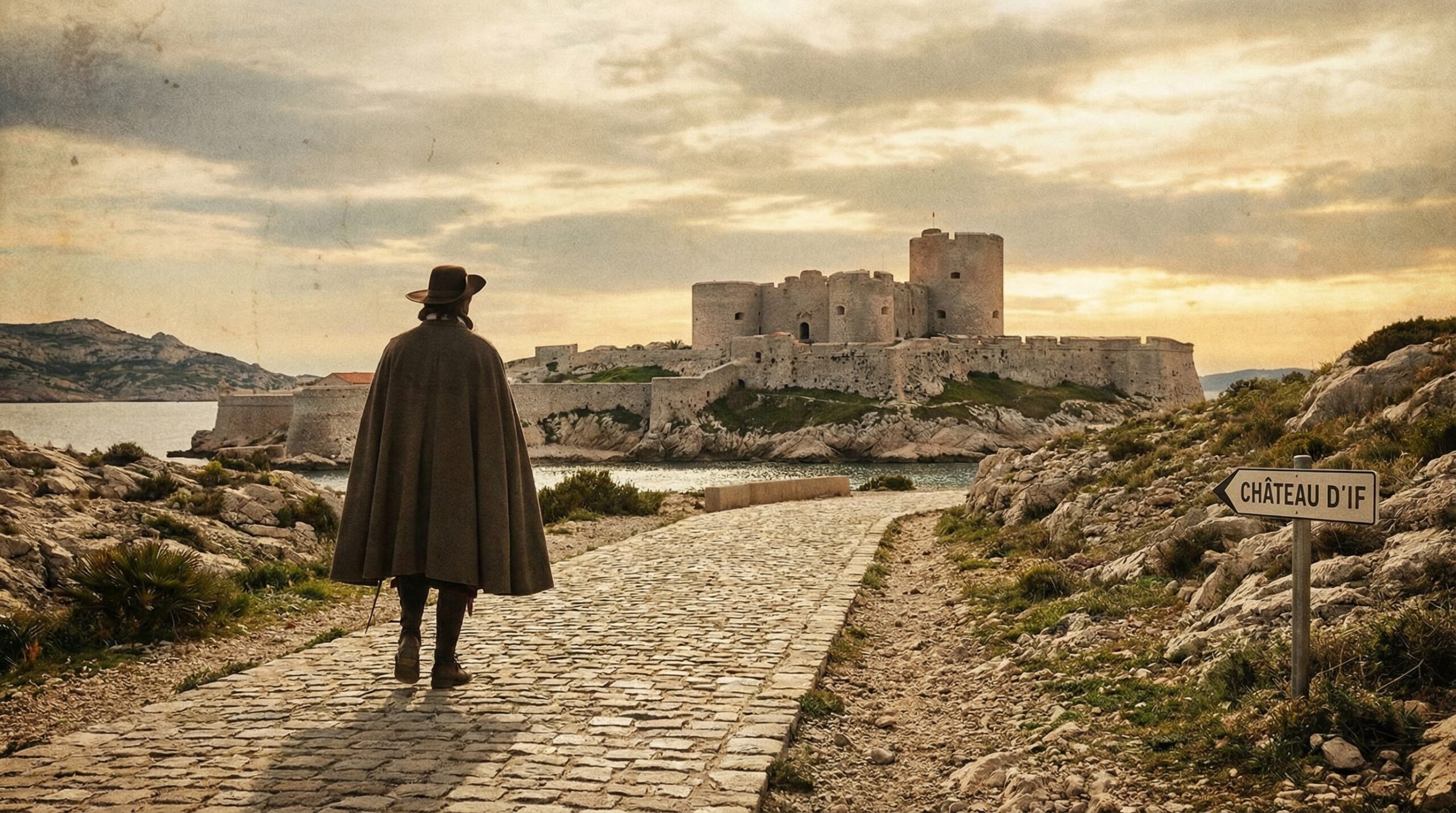
From the Vieux-Port, regular ferries make the short but dramatic crossing to the island of If. As the boat pulls away from the bustling harbor and into the open blue of the Mediterranean, the city shrinks behind you and the fortress grows larger and more imposing. The feeling is tangible; you are leaving the world of the living and approaching a place of isolation and legend. The Château d’If was a genuine 16th-century fortress, later converted into a state prison for political and religious dissenters. It had a fearsome reputation. No one was ever known to escape. Stepping off the ferry onto the rocky island is an unforgettable experience. The wind whips around the stone walls, and the cries of seagulls echo through the air. The castle itself is stark and intimidating. You can explore the grim, windowless cells, see the crude graffiti left by real prisoners, and feel the chilling reality of incarceration here. The prison authorities have fully embraced the Dumas connection. You can visit the cell attributed to Edmond Dantès, complete with a hole scraped through the wall connecting it to the cell of his mentor, the Abbé Faria. Of course, this is a bit of historical theater—Dantès and Faria are fictional—but it hardly matters. The story’s power is so immense that standing in that dark, damp space, you can’t help but feel the weight of Dantès’s fourteen years of wrongful imprisonment. The atmosphere is a potent blend of history and fiction. You climb the ramparts and look back at Marseille, so close yet impossibly far, and you understand Dantès’s despair. But you also gaze out at the vast, open sea, the path to his eventual miraculous escape, and feel the surge of hope that is the novel’s enduring message. Practical advice: the boat ride can be rough, so be prepared if you are prone to seasickness. The island is rugged and exposed, so wear sturdy shoes and bring a hat, sunscreen, and water, especially in summer. The island offers no other services besides the castle itself. Allow a few hours for the round trip and exploration. It is an essential, visceral experience for any Dumas enthusiast—a chance to stand in the very place where one of literature’s greatest tales of suffering and rebirth unfolds.
An Immortal Legacy: The Panthéon

After a life filled with whirlwind activity, soaring triumphs, and crushing setbacks, Alexandre Dumas died in 1870, spending his final days at his son’s home in Puys, near Dieppe. For more than a century, he was laid to rest in the local cemetery of his birthplace, Villers-Cotterêts—a modest resting place for a man whose characters were beloved worldwide. However, in 2002, France chose to bestow upon its great storyteller the honor he had long deserved. In a grand and poignant ceremony, his remains were exhumed and reinterred in the Panthéon in Paris, the secular mausoleum reserved for the nation’s most esteemed citizens.
A Hero’s Welcome Home
The ceremony, organized by then-President Jacques Chirac, was quintessentially Dumasian theater. On a chilly November night, Dumas’s coffin, draped in a blue velvet cloth embroidered with the Musketeers’ motto, was carried through the streets of Paris. Accompanying it was a procession of actors on horseback dressed as d’Artagnan, Athos, Porthos, Aramis, and the Count of Monte Cristo. The spectacle was worthy of the man himself—a final, triumphant parade through the city he had truly made his own. The procession concluded at the Panthéon, where the coffin was borne past the tombs of his literary contemporary and rival, Victor Hugo, and fellow writer Émile Zola. In his address, President Chirac acknowledged the racism Dumas endured due to his Haitian heritage, declaring that this reinterment served as a correction of a longstanding injustice. With this ceremony, the son of a former slave was formally recognized as one of France’s national heroes, marking the final, victorious chapter of a life story more remarkable than any fiction.
Among the Immortals
Visiting the Panthéon today is a profoundly moving experience. The building itself is a masterpiece of Neoclassical architecture—vast, solemn, and awe-inspiring. Its imposing dome is a prominent feature of the Parisian skyline, and its famous inscription reads, “Aux grands hommes, la patrie reconnaissante” (To its great men, the grateful homeland). To reach Dumas’s tomb, one descends into the crypt, a maze of stone corridors and burial chambers where the atmosphere is quiet and reverent. Standing beside the resting places of luminaries such as Voltaire, Rousseau, Marie Curie, and Victor Hugo feels like the fitting conclusion to his journey. He is right where he belongs. His tomb is simple, inscribed with his name and dates. Before it, one contemplates the vast impact of his work—the joy, adventure, and romance he has given to millions over generations. It is a moment to appreciate the profound power of storytelling—the capacity of a single imagination to create worlds that endure beyond their creator and continue to inspire. The Panthéon is easily included in a tour of the Latin Quarter, situated atop the Montagne Sainte-Geneviève, near the Sorbonne and Luxembourg Gardens. A small suggestion: take the time not only to see Dumas’s tomb but to explore the entire crypt. Recognizing the company he keeps—the scientists, philosophers, writers, and resistance heroes—adds weight to the tremendous honor of his inclusion. It is the ultimate recognition of his genius and his lasting place in the heart of French culture.
This journey through France following the footsteps of Alexandre Dumas is more than a literary tour; it is an adventure in itself. It is about connecting with the spirit of a man who lived life on a grand scale and whose work continues to remind us of the power of courage, the value of loyalty, and the gratifying taste of justice. Whether standing in the quiet forests of his childhood, the bustling streets of Paris, the fantastical halls of his dream home, or the sun-washed walls of his most famous prison, one walks through the pages of his story. And perhaps the call to adventure, so vivid and resonant in his novels, begins to echo in one’s own heart. All for one, and one for all. The journey awaits.