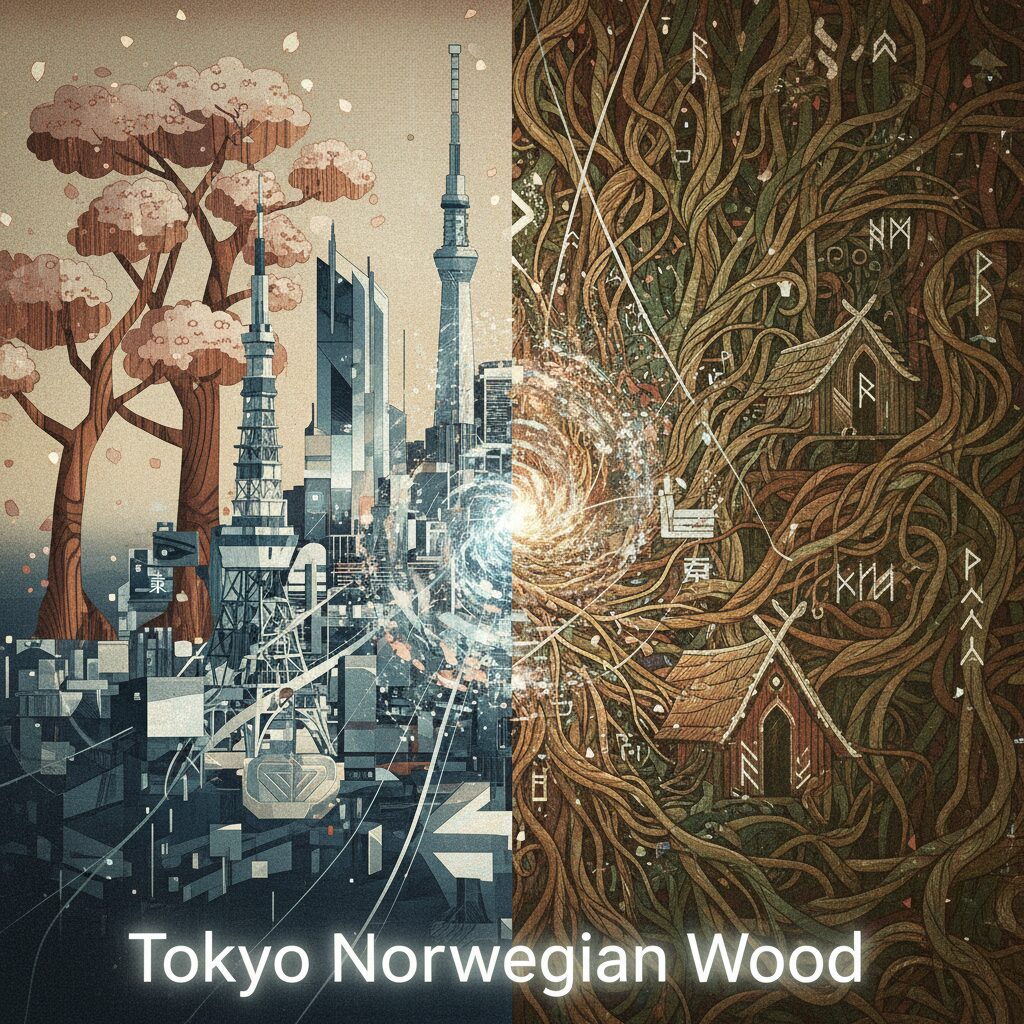
Some stories don’t just live on paper. They seep into the real world, staining the streets and parks of a city with their own particular shade of memory. They give you a new map, one drawn not with roads and landmarks, but with feelings, conversations, and the ghosts of characters who feel more real than some people you know. Haruki Murakami’s Norwegian Wood is one of those stories. For millions around the world, this novel wasn’t just a book; it was an entry point into a world of quiet melancholy, profound love, and the bittersweet ache of growing up. It painted a picture of Tokyo in the late 1960s so vivid, so tangible, that you can still walk its paths today. The city has changed, of course. Towers of glass and steel have risen, and the fiery student protests of that era have faded into history. But the soul of the Tokyo that Toru Watanabe, Naoko, and Midori inhabited still lingers. It’s there in the rumble of an old streetcar, in the hushed reverence of a basement jazz bar, and in the quiet rustle of leaves in a park on a Sunday afternoon. This is not just a tour. This is a pilgrimage. It’s a journey to find the emotional landscape of a beloved novel, to walk in the footsteps of its characters and feel, just for a moment, the world as they saw it. It’s a chance to overlay the Tokyo of your imagination onto the Tokyo of today, and to see where the lines blur. Prepare to walk, to listen, and to remember. The story is waiting for you.
The vivid depiction of Tokyo in Murakami’s work finds a resonant echo in the mystical allure of Japan’s ancient landscapes, inviting you to explore the forest gods that quietly weave myth into reality.
The Heart of the Narrative: Waseda and the Echoes of Student Life
Every story requires a starting point, a grounding in reality from which the fiction can drift away. For Norwegian Wood, that grounding is found in the Waseda neighborhood. This is Toru Watanabe’s world, the setting for his days filled with lectures, part-time jobs, and the quiet solitude that defines him. To truly grasp the novel, you first need to understand the rhythm of Waseda. It exists in a unique temporal space, eternally youthful due to the university at its center, yet steeped in a history that feels almost tangible as you stroll its streets. The atmosphere here differs from the frenetic energy of Shinjuku or Shibuya, carrying a calmer, more reflective presence.
The Waseda Campus: The Origin of It All
Waseda University’s campus is more than just a series of buildings; it’s a living repository of memories. Passing through the main gate, you find yourself beneath the shade of towering zelkova and ginkgo trees, which have seen generations of students come and go. The architecture blends dignified, ivy-clad halls with more contemporary structures, but the prevailing impression is one of tradition and intellectual aspiration. This is where Toru took drama classes, not out of passion but as part of the easy flow of his student life. You can easily picture him sitting on a bench near Okuma Auditorium, its iconic clock tower silhouetted against the sky, lost in a paperback copy of The Great Gatsby, grappling with the world and his place within it. The campus is most evocative on a quiet weekday afternoon when the buzz of academic life fades to a soft murmur and you can find a secluded spot to sit quietly and soak in the atmosphere. It feels like a space where grand ideas and deep solitude coexist, perfectly mirroring Toru’s inner world. The echoes of the late-60s student protests, a powerful undercurrent in the novel, linger here as well. Though peaceful now, it’s easy to imagine the fervent, turbulent energy of that time reverberating between the historic buildings.
Toden Arakawa Line: A Nostalgic Journey
Just a short stroll from campus lies a doorway to another era: the Toden Arakawa Line. This is Tokyo’s last remaining public streetcar, a single-car tram that rumbles through the city’s quieter northern neighborhoods. For Toru, this tram was part of his daily commute, a vehicle linking the different spheres of his life. Riding it today feels like a conscious step back from Tokyo’s hyper-efficient subway system. The tram travels at a human pace, stopping at small, charming stations, with a bell that dings a gentle, analogue tone. Through the windows, you don’t see gleaming skyscrapers but a patchwork of local life: small shops, homes with carefully tended gardens, and people going about their routines. The journey invites quiet observation. You can trace a route from Waseda toward Zoshigaya or Oji, neighborhoods preserved with a Showa-era charm. This ride is more than mere transport; it’s a chance to slow down, to experience the city on the same wavelength as the novel’s characters. It provides the perfect transition from the academic calm of Waseda to the more tumultuous, emotionally charged environments of central Tokyo.
Shinjuku’s Labyrinth: Encounters and Solitude
If Waseda represents the novel’s quiet, reflective core, then Shinjuku is its loud, chaotic, and often overwhelming spirit. It’s a hub of massive human traffic, a concrete and neon jungle where lives intersect, diverge, and sometimes vanish altogether. Shinjuku is where Toru works, meets with friends, and often wanders alone, feeling like a solitary, anonymous drop in an endless sea of people. The station itself is a world—a vast underground maze that handles more passengers than any other train station on Earth. For the characters, it serves as a constant point of departure and arrival, symbolizing the physical and emotional journeys they all undertake.
Kinokuniya Bookstore and the Jazz Kissa
Amid the sensory overload of Shinjuku, Toru finds solace in two particular settings: bookstores and jazz cafes. The Shinjuku branch of Kinokuniya Bookstore stands as a landmark, a multi-level refuge for lovers of literature. It’s easy to imagine Toru spending hours there, browsing the shelves, the scent of paper and ink providing a soothing contrast to the city’s noise. He is a character deeply immersed in his own thoughts, with books as his steady companions. Visiting Kinokuniya gives you direct access to this facet of his world. After losing yourself in literature, the next step on a Murakami pilgrimage is to seek out a jazz kissa. These basement cafes, dedicated to the focused listening of jazz records, are a recurrent motif in all of Murakami’s work. They serve as sanctuaries of cool, dark solitude. While the specific bar Toru frequents in the novel is fictional, its spirit lives on in real spots like Dug, a legendary jazz venue tucked away in a Shinjuku basement, known to have been favored by Murakami himself. Descending the narrow stairs feels like entering another realm. Inside, the air is heavy with the scent of dark-roast coffee and lingering cigarette smoke, despite smoking now being prohibited. The music, played from a vast vinyl collection on a high-fidelity sound system, is the main focus. Conversation is scarce. It’s a place to listen, reflect, and absorb the distinctive melancholy that infuses the novel. Finding one of these cafés is key to understanding the texture of Toru’s solitary urban existence.
Shinjuku Station: A Universe of Transit
To fully appreciate Shinjuku’s significance in the novel, one must confront the station itself. It is less a building than a small city—a maze of platforms, tunnels, and department stores. The sheer volume of people flowing through it at any given time is staggering. It’s a place of constant motion, a perfect metaphor for the fleeting nature of the characters’ lives and relationships. This is where Toru boards the Chuo Line westward toward Naoko’s sanatorium, a journey into memory and loss. It’s where he weaves through crowds to meet Midori, a vibrant force of life in his otherwise muted world. For a first-time visitor, the station can be bewildering, which is exactly the point. The sense of being lost in Shinjuku Station mirrors Toru’s own feeling of drifting through life. A practical tip for navigating its vastness is to set aside the grand map and focus on mastering one exit. Learn the route from your train platform to the East Exit for bookstores and cafes, or the South Exit for a city view, and let that serve as your anchor. To truly experience it, pause for a moment in one of the main concourses and simply watch the flow of humanity around you. It’s in that instant of anonymous observation that you can grasp the true essence of Shinjuku as portrayed in Norwegian Wood.
West Tokyo’s Quietude: Kichijoji and the Inokashira Park
Leaving the dense urban core of Shinjuku behind and heading west on the Chuo Line, the energy of Tokyo begins to change. The buildings grow shorter, the streets widen, and the pace of life feels less frenetic. This is the world of West Tokyo, and for the pilgrim of Norwegian Wood, the destination is Kichijoji. This neighborhood is intimately connected to Naoko and the long, winding walks she takes with Toru. It embodies a different kind of space—where nature and urban life coexist, and where deep, difficult conversations unfold amid serene beauty.
Inokashira Park: A Sanctuary of Memory
Inokashira Park serves as the emotional heart of Toru and Naoko’s relationship. It’s here, during a Sunday walk, that their story begins to take shape. The park offers a lovely expanse of greenery centered around a large pond, where couples and families paddle swan-shaped boats. Strolling along the pond’s edge, beneath cherry and maple trees, you are literally retracing their steps. The novel details their walk: the circuit around the pond, the well where they pause, the quiet benches where they rest. The park’s atmosphere is one of peaceful melancholy, feeling timeless and perfect for reflection. The weight of their unspoken words seems to hang in the air. The park’s beauty shifts dramatically with the seasons, encouraging repeated visits. In spring, pale pink cherry blossoms symbolize fleeting beauty reflecting Naoko’s fragile state. In autumn, fiery maple leaves create a stunning, almost heartbreakingly beautiful scene. Visiting Inokashira Park is to enter the heart of the novel’s central tragedy and its most tender moments. Sit quietly on a bench, watch the water, and let the profound sadness and beauty of their story wash over you.
The Streets of Kichijoji: Midori’s World
While Inokashira Park represents Naoko’s realm, the town of Kichijoji itself feels much more like Midori’s world. In contrast to the park’s serene introspection, the streets radiating from Kichijoji Station buzz with life and a quirky, independent spirit. This neighborhood is known for its vintage clothing stores, tiny standing bars, unique雑貨 (zakka) shops selling miscellaneous goods, and a lively food scene. It exudes youthful, slightly bohemian energy, sharply contrasting with Naoko’s ethereal presence. Exploring Kichijoji is to explore another side of Toru’s emotional life—the side drawn toward vitality, life, and connection with the messy, complicated real world. A must-see is Harmonica Yokocho, a tight maze of narrow alleyways adjacent to the station. By day, it hosts small shops and fishmongers; by night, it transforms into a smoky, lantern-lit labyrinth of tiny bars and eateries. Squeezing into one of these spots for a drink and a bite offers a glimpse of the Showa-era atmosphere that still lingers in these parts of Tokyo. Wandering through Kichijoji, you sense the grounded, fiercely independent spirit that defines Midori, making her such a compelling and vital character in the story.
Further Afield: Tracing Faint Footprints
For the truly devoted pilgrim, the journey need not end at the well-known spots. Norwegian Wood is rich with smaller, more intimate moments set in the quieter, residential neighborhoods of Tokyo. Exploring these areas is a different kind of experience. It’s less about discovering a famous landmark and more about capturing a feeling—the subtle texture of a character’s everyday life. This part of the journey leads you away from tourist routes and into the city as it is genuinely lived by its inhabitants.
The Komagome and Sugamo Areas: Midori’s Home
The novel situates Midori’s family home and their modest bookstore, Kobayashi Books, in the Otsuka area near Komagome. This is an unassuming part of Tokyo, a neighborhood of residential streets, small shopping arcades (shotengai), and the quiet rhythm of daily life. Walking here, you won’t encounter monuments or plaques, but instead, the kind of environment that shaped Midori’s pragmatic and resilient nature. The fictional Kobayashi Books was a reflection of her reality—a small, struggling family business. Although you can’t visit the store itself, wandering through the local shotengai in Sugamo or Komagome lets you see the small, family-run shops that still persist. You might imagine her cycling down these streets, her presence a burst of bright color against a subdued backdrop. This is a pilgrimage of the imagination—an opportunity to connect with the source of Midori’s remarkable strength by immersing yourself in the atmosphere of her neighborhood. It’s a quiet, reflective experience that offers a deeper understanding of one of the novel’s most cherished characters.
Ueno Station: A Fleeting Moment
Ueno Station has a brief but meaningful role in the story. It’s a place Toru passes through, where he buys a book. Yet Ueno is more than just another station. Historically, it has served as Tokyo’s gateway to northern Japan. It carries a slightly grittier, more transient vibe compared to the polished hubs of Shinjuku or Tokyo Station. For decades, it was a point where newcomers arrived in the capital from rural areas, full of hope—or where others departed, defeated. This history imbues the station with a unique, poignant atmosphere. It’s a place of beginnings and farewells, echoing the novel’s themes. Visiting the station and its expansive park—home to some of Tokyo’s finest museums and a large, scenic pond—adds another dimension to the novel’s urban map. It underscores the idea of Tokyo as a mosaic of distinct villages, each with its own character and history, all linked by the complex network of railways.
Capturing the Murakami Vibe: Tips for the Modern Pilgrim
A pilgrimage honoring Norwegian Wood is as much about cultivating the right mindset as it is about the location itself. You are pursuing a feeling, an atmosphere that Murakami so expertly crafts. To genuinely connect with the essence of the novel, it helps to embrace some of the characters’ habits and sensibilities as you explore. This elevates a mere sightseeing trip into a richer, more immersive, and personal experience.
Discovering Your Own Jazz Kissa
While visiting iconic places like Dug is a wonderful experience, the real Murakami journey lies in finding your own special hideaway. As you stroll through neighborhoods like Shimokitazawa, Koenji, or the quieter backstreets of Shinjuku, stay alert for small, inconspicuous signs indicating a cafe or bar tucked away in a basement or on an upper floor. The best spots are often hidden in plain view. The aim is to find a place with an excellent sound system, a passionate owner who takes music seriously, and an atmosphere that fosters quiet reflection. Order a black coffee or a whiskey, open a book, and let the sounds of John Coltrane or Miles Davis carry you away. This kind of personal discovery is far more fulfilling than simply following a guidebook.
The Art of Walking
Murakami’s characters are relentless walkers. They walk to think, to talk, to escape, and to process their thoughts. Toru’s long, aimless strolls are central to his life. To follow in his footsteps, you need to carve out unstructured time in your schedule. Put your phone aside and just walk. Choose two neighborhoods on a map—such as Waseda and Iidabashi—and commit to walking between them. It’s during these unplanned journeys that you’ll uncover the true soul of the city—the tiny shrines, hidden cafes, and unexpected green spaces. Walking lets you sense the subtle shifts in atmosphere as you move from one district to another. It becomes a meditative practice that links you intimately to the city’s rhythm and the wandering spirit of the novel’s protagonist.
What to Read and Listen To
To fully immerse yourself, assemble a soundtrack and reading list for your trip. Create a playlist featuring not only The Beatles’ “Norwegian Wood,” but also the kind of jazz that would accompany Toru’s life—Bill Evans, Thelonious Monk, Miles Davis. Let this be the soundtrack to your walks. For reading, bring along a well-loved copy of the novel itself, or perhaps The Great Gatsby, F. Scott Fitzgerald’s classic that Toru reads and references. Reading a few pages while sitting in Inokashira Park or a quiet corner of a jazz cafe creates a powerful connection between the fictional world and your own experience, blurring the boundaries in the most enchanting way.
A Journey’s End in an Unknown Place
The pilgrimage through the world of Norwegian Wood does not end at a particular place. It doesn’t finish with a final snapshot or a checked-off itinerary. Rather, it reflects the novel’s own haunting and ambiguous conclusion. Toru stands at a telephone booth, confused, realizing he is somewhere unfamiliar, answering a call from Midori that draws him back toward the future. He exists between worlds—between memory and reality, between loss and the possibility of new life. Your own journey may leave you in a similar state of thoughtful reflection. The goal of this walk is not to locate the exact well in Inokashira Park or the actual Kobayashi Bookstore. Those are merely breadcrumbs. The true aim is to use the city as a catalyst for delving into the novel’s profound themes of memory, love, loss, and survival. You arrive in Tokyo to find the world of Norwegian Wood, but what you ultimately uncover is a reflection of its themes within yourself. The streets, parks, and cafés become a mirror. And as you stand on a busy street corner, with the city’s sounds swirling around you, you might feel, as Toru did, that you are nowhere in particular, yet somehow exactly where you need to be.