
There are stories that stay with you, not just as narratives you consumed, but as experiences you lived. They become part of your emotional landscape, their characters feeling like old friends and their settings like a hometown you’ve never visited. For a generation of anime fans, Clannad is that story. A heart-wrenching, beautiful tale of love, family, and the small miracles of everyday life, its emotional weight is intrinsically tied to the town of Hikarizaka, a place that feels as real and as vital as any character. The gentle slope of its iconic hill, the warm light filtering through the cherry blossoms, the quiet hum of its residential streets—these images are etched into our memories. But what if I told you that Hikarizaka isn’t just a masterful creation of animation? What if I told you that you could walk that same hill, feel that same gentle breeze, and stand in the very places where the story of Tomoya and Nagisa began? This journey is not just for anime fans; it’s for anyone who seeks to find the magic woven into the fabric of ordinary Japanese life. We are embarking on a pilgrimage to the heart of Clannad, to the quiet Tokyo suburb of Mizuho and beyond, to trace the footsteps of the characters we love and discover the tangible, breathtaking reality behind one of anime’s most cherished worlds.
If you’re captivated by the idea of visiting real-world anime locations, you might also enjoy exploring the inspirations behind other beloved series.
The Heart of Hikarizaka: Discovering Mizuho, Tokyo

When you think of Tokyo, images of the neon-lit chaos at Shibuya Crossing or the towering skyscrapers of Shinjuku probably come to mind. Mizuho, located in the far western part of Tokyo Metropolis, stands in stark contrast to that bustling vision. It is worlds away from the city’s hectic energy, a place where life beats to a calm, steady rhythm. This town is characterized by quiet residential streets, small neighborhood parks filled with the sound of children’s laughter in the afternoon, and a strong sense of community that feels both nostalgic and warmly comforting. In many ways, it serves as the perfect backdrop for a story like Clannad.
Kyoto Animation, the studio behind the anime, is well-known for rooting their fantastical and emotional narratives in carefully researched real-world settings. This approach lends their work a deep sense of authenticity and relatability. For Clannad, they found inspiration in Mizuho. The moment you step off the train at Hakonegasaki Station on the JR Hachiko Line, you start to sense it. The air feels different here—cleaner and quieter. The dense urban landscape gives way to a more open sky. This isn’t a tourist destination; it’s a lived-in community, and that genuine atmosphere is precisely what makes it special. A pilgrimage here isn’t about ticking off landmarks on a list but about immersing yourself—breathing in the same air the creators did and seeing the world through their carefully crafted lens. It’s about appreciating how the tranquil, unassuming nature of this town—the calm, its ties to nature, and its unhurried pace—became a silent yet foundational character that supports the entire saga of Clannad and its unforgettable After Story.
The Iconic Hill: The Meeting Place of Fate
The heart of any Clannad pilgrimage lies on one stretch of pavement: the long, straight hill, or sakamichi, where Tomoya Okazaki first encounters Nagisa Furukawa. This moment sparks it all, frozen in time beneath a shower of cherry blossom petals. Finding this hill is the main goal for most visitors, and standing there is nothing less than transcendent. Situated a short walk north of Hakonegasaki Station, near the lush Rokudoyama Park, the approach itself builds anticipation, much like a cinematic reveal. You’ll pass through peaceful neighborhoods where carefully tended gardens grace modest homes, and the only sounds are the occasional hum of a delivery scooter or birdsong.
Then, it appears. The road slopes upward, stretching straight ahead, lined on both sides by the cherry trees that frame the anime’s most touching moments. The visual accuracy is astonishing. The perspective, the gentle curve of the land, the way the trees form a natural canopy—it’s all exactly as depicted. Climbing this hill is a deeply meditative experience. With every step, you can almost hear the soft-spoken exchanges, Nagisa’s tentative whispers and Tomoya’s weary replies. You feel the significance of their first meeting, a chance encounter that would shape their futures. Practically speaking, wearing comfortable yet stylish walking shoes is advisable. The ascent is steady but lengthy, and you’ll want to savor the moment without discomfort. Safety-wise, the area is very peaceful, but since it is a residential street, visiting during daylight hours allows for full appreciation of the scenery and shows respect for the locals who live here.
Reaching the summit rewards you with a serene, understated view looking back down the hill. It’s a place to pause and reflect on the story’s themes of perseverance and life’s journey, which, like this hill, has its own trials and rewards. The impact of the seasons here cannot be overstated. Visiting in late March or early April, when the sakura are in full bloom, offers the ultimate Clannad experience. The air is heavy with the sweet, delicate scent of blossoms, and petals drift down like pink snow, faithfully recreating the anime’s opening scenes. However, other seasons also hold charm. In summer, the trees form a rich, verdant tunnel. Autumn dyes the leaves in golds and crimsons, lending a wistful beauty to the landscape. In winter, the bare branches create stark, graphic silhouettes against a crisp sky, evoking the anime’s more somber moments in After Story. Each season brings a unique emotional tone, providing fresh ways to connect with the spirit of this place.
Echoes in the Schoolyard: The Search for Hikarizaka High
Hikarizaka High School is far more than just a backdrop in Clannad; it serves as the crucible where friendships are built, comedic chaos unfolds, and the foundations of family are established. It is the setting for the drama club, Sunohara’s antics, and the sisterly dynamics between Kyou and Ryou. While the town of Hikarizaka is firmly set in Mizuho, the school itself is an amalgamation—an idealized representation of a Japanese high school inspired by several real locations. This approach is common in anime production, allowing creators to design a perfect, emotionally resonant place not limited to a single physical site.
One of the most frequently mentioned models for the school’s exterior, especially its gate and general layout, is Tokyo Metropolitan Komae High School, situated in Komae—a different area of Tokyo from Mizuho. It is vital to treat this part of the pilgrimage with respect and sensitivity. This is not a tourist attraction but an active school where thousands of students attend classes daily. Under no circumstances should visitors attempt to enter the grounds, disturb lessons, or photograph students. The essence of a true pilgrimage lies in quiet appreciation from a respectful distance. You can view the school’s facade from the public street, noting architectural elements that may have inspired the anime’s artists. Observing the familiar gate design, window shapes, or the schoolyard layout can evoke a powerful sense of recognition—as if witnessing a memory brought to life. The aim is not trespassing but simply standing outside and imagining the lively school life depicted in the animation. This respectful observation connects you to the story without intruding on reality, embodying the core principle of responsible anime tourism.
Walking the Town: Finding Dango and Familiar Street Corners
Beyond the major landmarks of the hill and school, the true charm of the Mizuho pilgrimage lies in wandering its streets. The animators at Kyoto Animation captured more than just locations; they captured an atmosphere, a mood. As you explore the residential neighborhoods, you’ll experience a persistent sense of déjà vu. Whether it’s a specific style of fence, the design of a crosswalk, or a small playground nestled between houses, countless ordinary details will feel surprisingly familiar. It’s as though you’ve stepped right into one of the anime’s background paintings. This is where Clannad’s world truly comes to life.
This journey is best enjoyed on foot, with a fully charged smartphone for navigation and a willingness to get pleasantly lost. Let yourself wander down side streets, follow intriguing paths, and soak in the quiet rhythm of suburban Japanese life. And of course, no Clannad pilgrimage would be complete without honoring the “Dango Daikazoku” (The Big Dango Family), the whimsical song and symbol that become Nagisa’s spiritual cornerstone. Although there isn’t a specific dango shop in Mizuho modeled directly from the anime, the town offers an ideal chance to connect with this cultural icon. Look for a local wagashi-ya, a traditional Japanese confectionery shop. Visiting one of these quaint, often family-run stores is a delight in itself. Buy some mitarashi dango—skewered rice dumplings grilled and glazed with a sweet soy sauce. Find a quiet park bench, maybe overlooking a small stream or a well-kept public garden, and enjoy them. As you savor the chewy texture and sweet-savory flavor, you’ll forge a tangible link to Nagisa’s cherished song—a small, personal moment that enriches the entire experience.
Beyond the Main Town: Tracing Clannad’s Wider Inspirations
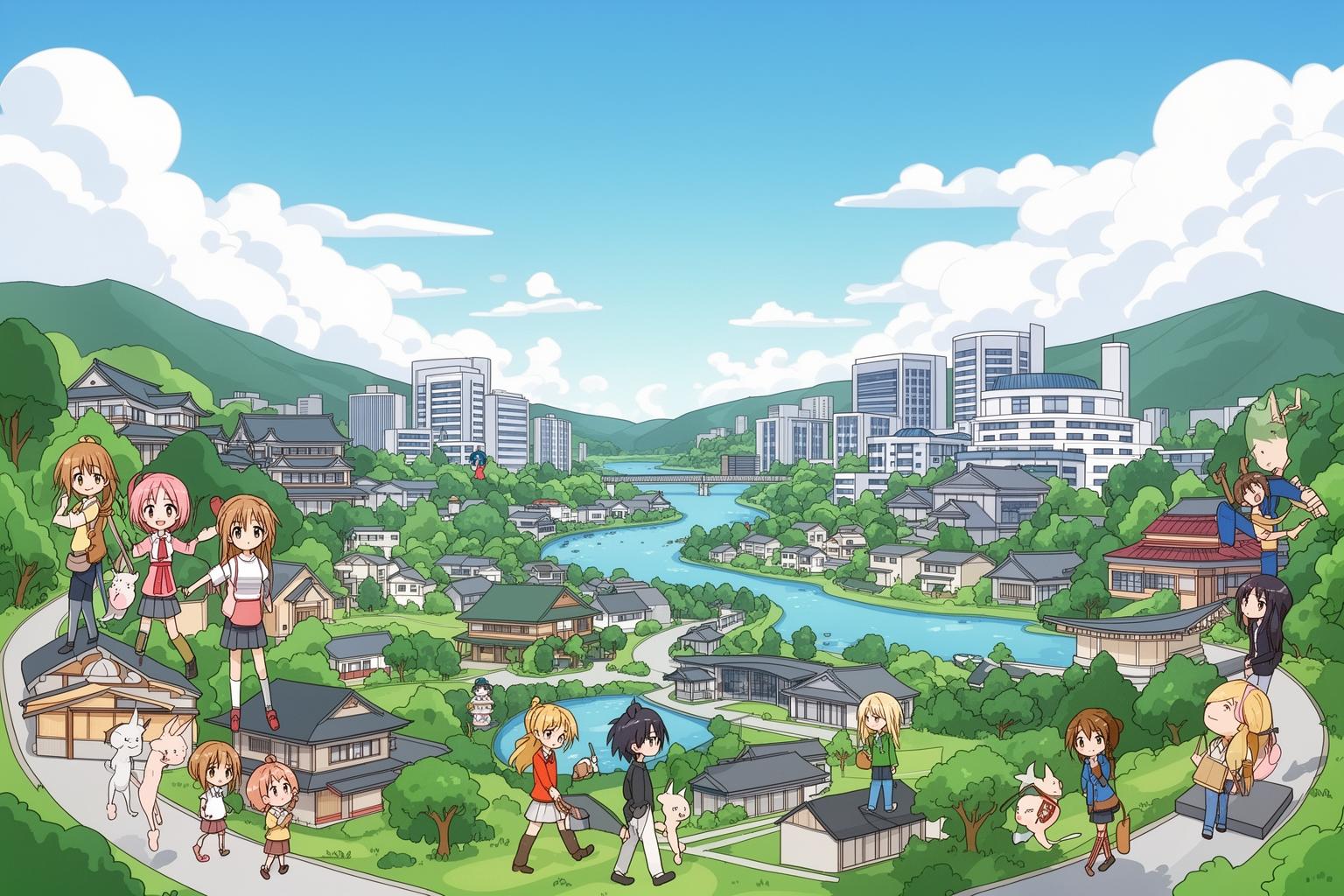
While Mizuho undeniably serves as the heart of Hikarizaka, the universe of Clannad extends far beyond, drawing its visual language from a broader spectrum of Japanese scenery. For the truly committed pilgrim, the journey need not conclude in west Tokyo. The story’s rich visual fabric is woven with threads from other equally evocative locations, each contributing unique texture and meaning to the narrative. Exploring these secondary sites enhances one’s appreciation of the remarkable artistry and meticulous detail invested in creating the anime’s world, demonstrating how diverse environments were fused to tell a story that spans from adolescence to the complexities of adulthood.
Urban Dreams in Yokohama
As Clannad shifts into After Story, its narrative breadth widens. Tomoya graduates and joins the workforce, and the setting occasionally moves away from the intimate confines of Hikarizaka to a larger, more modern cityscape. Many of these urban scenes, including the hospital where Nagisa gives birth to Ushio and some backdrops from Tomoya’s professional life, are said to be inspired by the Minato Mirai 21 district in Yokohama. Just a short train ride south of Tokyo, Yokohama offers a striking contrast to Mizuho’s tranquil suburbia. It is a sleek, contemporary port city, celebrated for its stunning waterfront, futuristic architecture, and vibrant cosmopolitan vibe. A day trip here naturally extends the pilgrimage, reflecting Tomoya’s own passage into adulthood.
Strolling along Minato Mirai’s waterfront, one can recognize the visual elements that likely influenced the anime’s creators. The clean architectural lines, expansive open areas, the iconic Cosmo Clock 21 Ferris wheel, and the towering Landmark Tower all contribute to an aesthetic that is both hopeful and somewhat impersonal—a fitting setting for Tomoya’s struggles and victories as a young man building a life with his new family. Visiting Yokohama offers another layer to the Clannad experience, allowing fans to trace the story’s full arc from the cherry-blossom-lined hills of youth to the gleaming cityscapes of adult responsibility.
The Sunflower Fields of Memory: A Journey to Aomori
This next destination is reserved for the most devoted pilgrims—a trek to the far north of Honshu, Japan’s main island. It explores one of the series’ most enigmatic and symbolic visual motifs: the vast golden fields of the Illusionary World. While these are often depicted as sunflower fields in the anime, their real-world inspiration is believed to be the spectacular rapeseed (nanohana) fields of Yokohama Town in Aomori Prefecture. (Yes, another Yokohama, adding a delightful layer of coincidence to the pilgrimage!) Every May, this region bursts into a breathtaking sea of radiant yellow flowers extending as far as the eye can see. The resemblance to the anime’s otherworldly landscapes is striking.
Visiting Aomori demands careful planning—it involves a lengthy journey by Shinkansen bullet train and local lines—but the payoff is an experience of profound beauty and symbolic depth. Standing amid these vibrant yellow fields beneath a vast sky feels like stepping into a dream. It connects you to the deepest, most metaphorical layers of Clannad’s story, touching on themes of memory, loss, and renewal. This journey is not merely about visiting a location; it is about experiencing the powerful, elemental emotions that the Illusionary World embodies. It stands as a testament to how even the series’ most fantastical elements are deeply anchored in the stunning reality of Japan’s natural landscape.
A Practical Guide for Your Hikarizaka Pilgrimage
Embarking on a journey into the world of Clannad is an exceptionally rewarding experience, though a bit of preparation can greatly enhance the smoothness and enjoyment of your trip. The locations are not concentrated tourist destinations but are embedded within everyday life, requiring a thoughtful and well-planned approach.
Getting to Mizuho
The main pilgrimage site, Mizuho, is easily reachable from central Tokyo. The simplest route is to take the JR Chuo Line Rapid service from major stations such as Shinjuku or Tokyo Station to Tachikawa Station. From Tachikawa, transfer to the JR Hachiko Line heading toward Hachioji via Hakonegasaki, and disembark at Hakonegasaki Station. The entire trip usually takes about an hour to an hour and a half, depending on your starting point and connection times. Using a prepaid IC card like Suica or Pasmo is highly recommended for smooth travel on Tokyo’s extensive train network. From Hakonegasaki Station, most key pilgrimage sites, including the famous hill, can be reached on foot, so be ready for a pleasant walk.
Navigating the Town
Mizuho is best explored at a relaxed pace. The main spots are somewhat spread out, so comfortable shoes are essential. Before setting out, it’s wise to save important locations on a digital map app like Google Maps on your smartphone. Japan has excellent mobile connectivity, but bringing a portable battery pack is a smart idea to ensure your device doesn’t run out of power while on the move. While walking offers the most immersive experience, local buses run from Hakonegasaki Station and can take you closer to the Rokudoyama Park area if you want to save time or energy. Taxis are also available at the station, though they are a pricier option.
When to Go: A Seasonal Calendar
The time of your visit can greatly influence your experience, as each season brings its own distinct charm to Clannad’s landscapes.
- Spring (Late March – Early April): Undoubtedly the peak season for a Clannad pilgrimage, the cherry blossoms transform the town and iconic hill into a picture-perfect scene straight from the anime. Expect more visitors at this time, but the breathtaking scenery makes it worthwhile.
- Summer (June – August): The town flourishes with vibrant, lush greenery. The days are long yet can be very hot and humid, so staying hydrated and seeking shade during the midday sun is important. The verdant views offer a different but equally captivating perspective on Hikarizaka.
- Autumn (October – November): With crisp, comfortable weather and colorful foliage, autumn is another excellent time to visit. The warm reds, oranges, and yellows create a beautifully nostalgic and melancholic atmosphere, perfectly aligning with the themes of After Story.
- Winter (December – February): The quietest season, winter offers stark and serene beauty. Bare cherry tree branches form dramatic silhouettes, and the cold, clear air makes for pleasant walking weather if you dress warmly. It’s a season for reflection and quiet contemplation.
Pilgrim’s Etiquette and a Woman’s Perspective on Safety
When visiting these locations, remember you are a guest in a living community and it is important to be respectful. Keep your voice low, do not litter, and never trespass on private property, as you will be walking through residential neighborhoods and past active schools. The pilgrimage’s charm lies in its subtlety and respectfulness. From a solo female traveler’s viewpoint, Mizuho and similar suburban areas in Japan are very safe, though general travel common sense still applies. It’s best to explore during daylight hours for easier navigation and to fully appreciate the surroundings. Inform a friend or family member of your plans. Convenience stores, abundant even in suburban areas, provide clean restrooms, affordable snacks and drinks, and are always well-lit and secure.
The Enduring Magic: Why Clannad’s World Still Resonates

A journey to the real-life sites of Clannad is more than simply a trip for location scouting. It is a deeply moving and meaningful experience that connects fiction with reality. To walk the same streets as the characters, to witness the sunlight filtering through the same trees, is to let the story’s powerful emotions embed themselves in your memory in a vivid, lasting way. The quiet, unchanging nature of Mizuho beautifully mirrors the anime’s central themes of enduring love, the strength of family bonds, and the gentle, steady flow of time. The town itself feels like a constant, a warm and inviting place that holds these stories within its very streets.
Standing atop that long hill, gazing down the path where it all began, you begin to understand why this story has touched so many hearts. It’s because its world, Hikarizaka, feels real—because, in an authentic sense, it truly is. This pilgrimage reinforces that connection, turning abstract emotions into tangible experiences: the warmth of the sun on your skin, the sound of the wind rustling through cherry blossoms, the taste of dango from a local shop. It is an invitation to slow down, appreciate the small details, and discover the profound beauty hidden in the ordinary. So, if Clannad holds a special place in your heart, consider making the journey. Walk the path of light, and you may find your own small miracle waiting for you in the gentle, unforgettable town of Hikarizaka.