
Step into a world shrouded in mist, where ancient trees whisper tales older than memory and the forest floor is a velvet tapestry of a thousand shades of green. This is not just a fantasy. This is the world that breathed life into Hayao Miyazaki’s cinematic masterpiece, Princess Mononoke. For those of us whose souls were stirred by the epic struggle between humanity and nature, between the fierce San and the resolute Lady Eboshi, the film’s landscapes feel like a half-remembered dream. But that dream is a real place, a tangible piece of Earth you can walk, touch, and breathe. The primordial forests, the moss-covered stones, and the deep, untamed wilderness that served as the canvas for Studio Ghibli’s epic are rooted in the sacred grounds of Japan. This journey is more than a simple sightseeing trip; it’s a pilgrimage to the very heart of what makes Princess Mononoke timeless. We’ll venture deep into the islands and mountains that Miyazaki himself explored, seeking the spirit of the wolf gods and the silent, watchful Kodama. We will walk the paths that lead to the soul of an ancient Japan, a world where gods still wander among the trees, and the air itself feels charged with a quiet, powerful magic. Prepare to leave the modern world behind and follow the faint, mossy trail into the real-life Irontown, the Great Forest Spirit’s domain, and the heart of Princess Mononoke’s world.
If you’re drawn to pilgrimages that explore the profound connections between place and story, you might also find meaning in a pilgrim’s journey through the world of Tokyo Magnitude 8.0.
The Heart of the Forest: Yakushima Island

This is it. If there is a single place on Earth that perfectly captures the spirit, soul, and visual grandeur of Princess Mononoke’s forest, it is Yakushima. This subtropical island, drifting south of Kyushu, is a UNESCO World Heritage site renowned for its astounding natural beauty. The Japanese often say its climate brings rain for “35 days a month.” This nearly constant moisture sustains the island, cloaking every surface—from ancient cedar bark to neglected stone lanterns—in a lush, emerald moss. It’s a realm that feels timeless, where nature reigns supreme and unchallenged. Whether arriving at the small island airport or by ferry, you immediately notice a change. The air grows heavier, wetter, and intensely green. The mountains, known locally as the “Alps of the Ocean,” rise steeply from the sea, their summits perpetually shrouded in clouds. This is the territory of the Shishigami, the Forest Spirit—a place where the line between the physical and mystical seems impossibly thin.
A Living World: The Essence of Yakushima
To truly grasp Yakushima is to appreciate the deep Japanese reverence for nature, a fundamental principle of Shinto belief. The island is more than just a forest; it is a living being. Its most honored residents are the Yakusugi, ancient Japanese cedars some thousands of years old. Standing before one humbles you. Their massive trunks and twisted bark, etched by millennia, make you feel momentarily small. These silent giants are the forest’s deities, inspiring the immense trees that form Mononoke’s canopy. The island’s wildlife also feels authentic. It’s rare to hike long without spotting Yakushika deer or Yakuzaru monkeys, who move confidently through the forest, indifferent to human presence. Observing a gentle deer tiptoeing through a mossy clearing or a monkey caring for its young overhead directly echoes the film’s portrayal of a harmonious yet wild ecosystem. Here, animals are not mere creatures but forest citizens infused with its spirit. The atmosphere is one of vast age and quiet patience. This forest operates on a different timescale, inviting you to slow down, to listen, and observe the tiniest details—the way water beads on ferns, moss patterns on stones, or the distant sound of waterfalls. This profound sense of a living, breathing world is precisely what Miyazaki captured so brilliantly.
The Pilgrimage to Mononoke’s Forest: Shiratani Unsuikyo Ravine
While the whole island serves as the film’s backdrop, Shiratani Unsuikyo Ravine is its definitive pilgrimage site. This is where Miyazaki and his artists spent days drawing inspiration that shaped the film’s iconic visuals. Hiking trails weave through this stunning gorge, and one area is famously known as Kokemusu-no-Mori—the “Moss-Covered Forest.” Without exaggeration, this is Princess Mononoke’s forest come alive. As soon as you step onto the trail, the outside world fades away. You are enveloped in a lush, vibrant green. The air is cool with the scent of damp earth and decomposing wood, life and death intertwined. Every rock, fallen log, and tree root is blanketed in soft, thick moss of countless varieties. It’s a surreal, almost psychedelic scene. Shafts of light pierce the dense canopy, illuminating patches of the forest floor and making the mist glow mysteriously. You half expect to glimpse the tiny white Kodama with their rattling heads peeking shyly from behind a tree. This is a place that demands silence and reverence.
The Journey Begins: Yayoi Sugi and the Lower Trails
Exploring Shiratani Unsuikyo typically starts at a well-marked trailhead reachable by car or bus. Several routes vary in difficulty, catering to all fitness levels. The shortest, easiest route—the Yayoi Sugi Course—is an ideal introduction. This gentle one-hour walk leads you across a picturesque suspension bridge to the impressive Yayoi Sugi, a cedar estimated to be around 3,000 years old. Even this shorter path offers a strong sense of place. Stone paths and wooden walkways protect the delicate moss, immediately immersing you in the environment. The trail provides a taste of the ravine’s beauty without the strain of a long hike, perfect for those short on time or preferring a slows paced experience. Along the way, ancient roots crisscross like natural staircases, as if crafted by a fantasy artist. The sounds around you form a natural symphony: the river’s soft murmur, distant birdcalls, and the enveloping silence of the woods.
Deeper into the Moss: Kokemusu-no-Mori
For dedicated visitors, the journey continues on the Bugyo Sugi Course, a three-to-four-hour trek into the ravine’s core. Here the path grows more rugged, demanding proper hiking boots to negotiate wet stones and twisted roots. This leads you into Kokemusu-no-Mori, the sacred ground for Mononoke fans. The scenery is otherworldly. Huge boulders, the size of cars, are entirely swathed in moss, their edges softened into gentle rounded shapes. Crystal-clear streams wind between moss-covered stones. The trees—ancient cedars mixed with native species—reach toward the sky, their trunks and limbs draped in soft green velvet. The chaotic yet perfect beauty of this scene appears almost crafted. This is the forest where Ashitaka first encounters San and the wolf clan, where the ground itself feels timeless and sacred. Sit quietly, absorb the scene. Watch shifting light, listen to dripping water, and feel the calming, profound presence of the forest. It’s a deeply meditative connection to the film’s spirit.
The Reward: Taiko Iwa Rock Viewpoint
Many hikers’ ultimate destination in Shiratani Unsuikyo is Taiko Iwa, or “Drum Rock.” Reaching this stunning viewpoint involves the longest route—a challenging five-to-six-hour round trip. The final climb is steep, sometimes requiring ropes anchored to rock faces for assistance, but the moment you emerge onto the massive sunlit granite boulder, all effort is forgotten. The panoramic view over Yakushima’s mountains unfolds before you, a vast green sea stretching to the island’s highest peaks piercing the sky. This spectacle recalls the sweeping shots in the film, showcasing the immense scale and wildness of the world the characters inhabit. It’s a moment of triumph and clarity. On clear days, you can discern the distinctive shape of the Miyanoura-dake mountains. This climax to the Shiratani Unsuikyo experience is a memory etched forever. This is where Moro, the wolf goddess, would stand to survey her realm.
In the Presence of the Gods: The Journey to Jomon Sugi
If Shiratani Unsuikyo reveals Mononoke’s forest’s enchanting face, the Jomon Sugi trail leads to its ancient, living heart. This is no casual hike but a full-day, ten- to twelve-hour pilgrimage deep into the island’s interior to behold one of the oldest living trees in the world. Jomon Sugi is a colossal Yakusugi cedar, its age estimated between 2,000 and over 7,200 years. Its existence defies comprehension—it was a sapling when the pyramids were built, already ancient during the rise and fall of the Roman Empire. Undertaking this trek demands physical and mental endurance, but the spiritual reward is immeasurable.
The Anbo Forest Railway: Entry into the Past
The hike starts well before dawn, with most taking a pre-sunrise bus to the Arakawa trailhead. The longest segment begins with a seemingly endless walk along the abandoned narrow-gauge Anbo Forest Railway. While occasionally used for maintenance, this old logging line primarily serves as a hiker’s path. For about eight kilometers, you tread wooden planks between rails, winding through dark forest as the sun rises. The route is mostly flat but hypnotic. Moss-covered bridges span deep ravines; tunnels cut through rock faces. This stretch feels like a passage, leading you from the modern world into ancient wilderness. It invites quiet reflection, the rhythm of your boots on the planks the only intrusion amid the awakening forest. You can easily envision Irontown workers transporting iron along this line—a narrow scar of industry amid untamed nature.
Wilson’s Stump and the Forest’s Core
After the railway ends, the mountain trail beckons with steep stairs and muddy, root-filled climbs. Along the way, you pass other monumental Yakusugi cedars, such as the Meoto Sugi (Husband-and-Wife Cedars) and the Dai-o Sugi (Great King Cedar). The most famous stop before the final goal is Wilson’s Stump—a massive hollowed cedar felled centuries ago. You can walk inside this cavernous stump, and from a certain spot looking upward, see a perfect heart-shaped opening framing the sky. This magical, unexpected moment is a favorite for rest and photographs. It also serves as a solemn reminder of the logging that once threatened these woods—a parallel to the central conflict in Princess Mononoke. A spring within the stump’s heart continues to flow, symbolizing life persisting after death.
Meeting the Ancient Being: Jomon Sugi
The final ascent to Jomon Sugi is the most grueling part of the journey—legs burn and lungs strain. Yet, the tree reveals itself gradually as you round a bend. Jomon Sugi is not graceful or elegant; it is a mighty, primordial force. Its trunk is a gnarled, massive wood mass, scarred by centuries of storms, lightning, and the sheer burden of its age. It seems more geological than botanical. For protection, visitors cannot approach closely or touch it; a viewing platform a respectful distance away prevents root damage from countless pilgrims. Even from afar, its presence is overwhelming, radiating immense silent power. This is the Forest Spirit in its purest form, embodying unfathomable age and resilience. Standing before it, weary and perspiring, is profoundly moving. It connects you with a timescale vast beyond human comprehension—a deep and wild nature San fought valiantly to protect.
Practical Magic: Planning Your Yakushima Journey
Visiting Yakushima demands careful preparation to appreciate its wonders and safely navigate its challenges. This is wild country that commands respect.
Reaching the Enchanted Island: Access and Transport
Yakushima is most conveniently reached from Kagoshima city at southern Kyushu. There are two main options: flying or sea travel. Flying is fastest, with multiple daily flights from Kagoshima, plus direct flights from larger cities like Fukuoka and Osaka. The flight offers stunning aerial views as you descend onto the island’s dramatic landscape. More common and budget-friendly is the sea route, with high-speed jetfoils taking two to three hours and slower car ferries about four hours sailing from Kagoshima port. Boats dock at Yakushima’s two main ports: Miyanoura in the north or Anbo in the east. On the island, transportation is the next challenge. Renting a car is the most convenient choice, granting freedom to explore and reach trailheads early before buses start. However, island roads are narrow and winding, and car rentals should be booked well ahead, especially during peak seasons. Alternatively, a public bus system operates reliably but infrequently on main routes, typically one or two buses per hour. Careful planning around bus schedules is necessary. For frequent use, a bus pass may offer savings.
Where to Stay: Accommodation on the Island
Lodging is mainly concentrated around Miyanoura and Anbo, the two port towns offering restaurants, supermarkets, and rental shops. Options range from luxury hotels with hot springs to cozy family-run minshuku inns and budget hostels. Staying in a minshuku offers an authentic local experience, with hosts serving home-cooked meals featuring island ingredients and providing valuable knowledge. Anbo is more convenient for the Jomon Sugi hike due to early morning bus departures nearby, while Miyanoura hosts more frequent ferry services. For those seeking deep immersion, some isolated accommodations dot the coastline. Regardless of preference, booking early is essential, as the island’s popularity—especially during Japanese holidays—means accommodations fill rapidly.
Essential Gear: Preparing for Your Forest Trek
Packing for Yakushima centers on one requirement: waterproof gear. Quality rain jackets and pants are indispensable. The weather is famously unpredictable; clear skies can give way to sudden torrential rains. Durable, waterproof hiking boots with strong grip are critical since trails are often wet, slippery, and muddy. Even seasoned hikers benefit from trekking poles, which ease pressure on knees during long descents, such as from Jomon Sugi. A headlamp is vital for pre-dawn starts on the longest hikes. Bring all food and water needed for day-long treks. A local custom is ordering a “bento” packed lunch from your lodging or shop the day before, designed to supply energy for demanding hikes. Above all, respect this fragile environment: carry out all trash, refrain from feeding wildlife, and stay on marked trails to protect delicate moss beds. You are a visitor in a sacred realm.
The Untouched Wilderness: Shirakami-Sanchi
While Yakushima is the most well-known inspiration, it is not the only one. Hayao Miyazaki also drew inspiration from the deep, wild forests of Shirakami-Sanchi, another UNESCO World Heritage site located in the far north of Japan’s main island, Honshu, straddling the border between Aomori and Akita prefectures. If Yakushima embodies the mystical, moss-covered heart of the forest, Shirakami-Sanchi represents its vast, untamed expanse. It hosts the last and largest remaining virgin beech forest that once stretched across much of northern Japan. This less-visited, more remote wilderness evokes the broader, more imposing landscapes found in Mononoke’s world.
A Different Kind of Green: The Primeval Beech Forest
The atmosphere in Shirakami-Sanchi contrasts with that of Yakushima. The forest here is dominated by towering beech trees (buna). In spring and summer, their leaves form a brilliant, uniform canopy of bright green that filters sunlight, casting dappled patterns on the forest floor. In autumn, this canopy shifts to a breathtaking sea of gold and orange. The forest floor is more open than in Yakushima, with less cluttered growth typical of subtropical forests, creating a sense of vast space and grandeur. Walking through the beech forest feels like wandering through a vast natural cathedral supported by countless pillars. This is the kind of sprawling, seemingly endless wilderness that Ashitaka traverses on his quest—a formidable, indifferent landscape that humbles human travelers. The core zone of Shirakami-Sanchi is strictly protected, requiring a permit to enter, but numerous hiking trails around its edges allow visitors to experience its profound beauty.
The Sapphire Eye: Aoike Pond and the Twelve Lakes
The most accessible and famous part of Shirakami-Sanchi is the Juniko area, meaning the “Twelve Lakes.” In reality, it comprises 33 small lakes and ponds, believed to have been formed by a landslide. A network of easy walking trails connects several of these jewel-like bodies of water. The highlight is Aoike, the “Blue Pond.” Its reputation is well-earned. The water of Aoike is an astonishing, almost impossibly vibrant cobalt blue, so intense it appears artificial, as if lit from beneath. Scientists attribute this phenomenon to the spring water’s incredible clarity and unique mineral composition, but standing before it, a more mystical explanation feels fitting. It resembles a gateway to another world, a place where a forest spirit might come to drink. Surrounded by dense beech forest, the brilliant blue of the pond is a stunning and unforgettable sight. Exploring other lakes in the Juniko chain, such as the tranquil Wakitsubo-no-ike, the source of Aoike’s water, provides a peaceful and rewarding way to spend the day.
Navigating the Northern Wilds: Access and Exploration
Shirakami-Sanchi’s remoteness adds to its appeal but also makes it more challenging to visit than Yakushima. The best way to explore the area is by rental car, which offers flexibility to reach different trailheads and access points. However, it is also accessible via public transport. The Resort Shirakami is a scenic tourist train that runs along the Gono Line, tracing the beautiful coast of the Sea of Japan. The journey itself is spectacular, featuring panoramic windows and live music performances onboard. The train stops at Juniko Station, from where a bus can take visitors up to the lakes area. Main visitor centers, such as the Shirakami-Sanchi Visitor Center near the town of Hirosaki, provide excellent resources including maps, trail conditions, and local ecosystem information. The best time to visit is from June to October, when the forests are lush and green in summer, and the autumn colors are magnificent. Many roads and trails become impassable during the heavy winter snowfall.
The Fire of Industry: The Real Irontown in Izumo
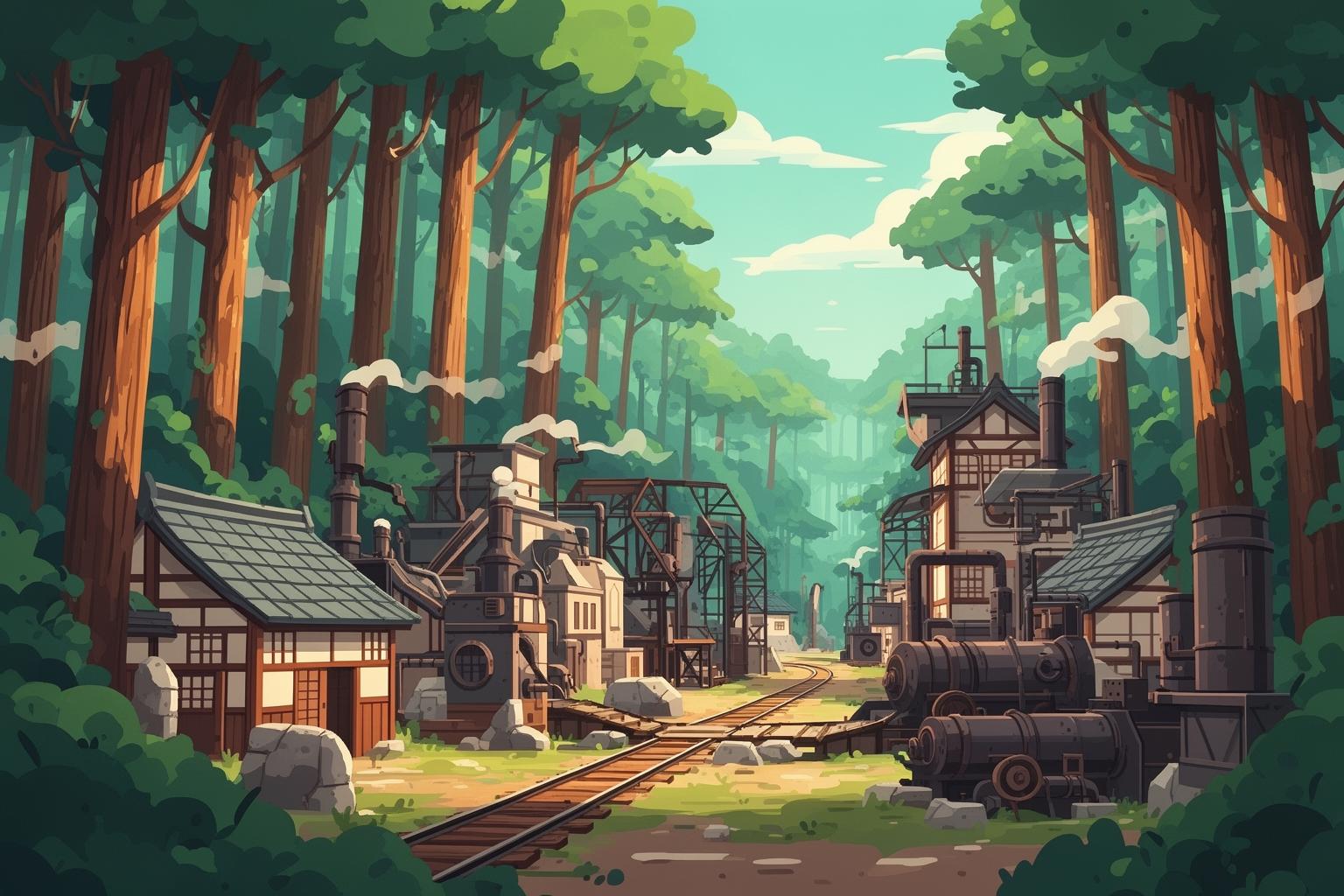
Princess Mononoke is not merely about the beauty of nature; it also explores the clash between that nature and the relentless advance of human industry. Lady Eboshi’s Irontown, the imposing fortress emitting smoke into the sky, is as unforgettable as the forest itself. This, too, draws heavily from real-world inspiration: the history of tatara iron-making in the Chugoku mountains of Shimane Prefecture, traditionally known as the Izumo region.
Forging a Nation: The History of Tatara Steel
For centuries, this mountainous part of Japan was the heart of a unique and essential industry. Tatara is the traditional Japanese technique of smelting iron sand to produce high-quality steel called tamahagane. This is the legendary steel used to craft samurai swords. The process was arduous and environmentally damaging. It consumed enormous amounts of charcoal, resulting in entire mountains being deforested to feed the demanding clay furnaces, which operated continuously for three days and nights before being dismantled to extract the steel bloom. This historical truth directly inspired Irontown. Lady Eboshi’s enterprise, which clears forests to fuel her forges and produce iron for firearms, closely mirrors the real-life tatara artisans and their environmental impact. The film’s conflict is far from mere fantasy; it dramatizes a genuine historical tension that unfolded in the mountains of Izumo.
Echoes of Irontown: Visiting the Tatara Sites Today
Though the traditional tatara industry has mostly disappeared, its heritage remains visible in the Okuizumo area of Shimane. This offers a journey into the historical and cultural origins of the film’s central conflict. A key destination is the Okuizumo Tatara and Sword Museum, where visitors can learn about the entire process—from gathering iron sand to forging steel—and view historical artifacts. The most striking site, however, is the Sugaya Tatara Sannai, Japan’s only fully preserved tatara furnace and village complex. Walking through the site, with its towering wooden structure housing the furnace, one can almost hear the crackle of fire and the clang of hammers. The workers’ homes reveal the community that, much like Irontown, revolved around this single, powerful industry. Visiting these sites deepens understanding of the film, showing that Lady Eboshi is not simply a villain but a reflection of the real-life pioneers and leaders who built Japan’s industrial might, often at significant environmental cost. This adds greater weight to the film’s nuanced depiction of progress and its consequences.
A Final Word: Carrying the Forest with You
A journey to the real-life locations of Princess Mononoke is a voyage into the soul of Japan and the heart of Hayao Miyazaki’s artistic vision. Walking across the moss-covered floor of Shiratani Unsuikyo allows you to see the world through his eyes. Standing in the humbling presence of Jomon Sugi lets you feel the immense power of the nature he passionately champions. Standing on the grounds of a historical tatara helps you understand the complex, often painful relationship between humanity and the world we inhabit. These places are more than just stunning landscapes; they are living repositories of history, culture, and spirit. They show us that the magic in the film is not pure fantasy but rather an amplification of a magic already present in the ancient forests and misty mountains of Japan. When you leave, you carry a piece of the forest with you—the scent of damp earth, the memory of infinite green, and a renewed appreciation for the delicate, powerful balance the film so masterfully portrays. The forest remains, and its spirit is waiting.