
There’s a certain kind of magic that lives inside a Studio Ghibli film. It’s a quiet, profound hum of wonder that whispers of soaring castles, forgotten spirits, and the simple, breathtaking beauty of a sun-dappled forest. It’s a feeling that stays with you, a gentle nostalgia for places you’ve never been. For years, fans around the world could only visit these worlds through a screen. But nestled in the leafy suburbs of western Tokyo, in a city called Mitaka, Hayao Miyazaki and his team built a physical home for that very magic. This isn’t just a museum; it’s a portal. The Ghibli Museum is an architectural daydream, a labyrinth of creativity, and a heartfelt invitation to rediscover the child within. Its official motto is “Maigo ni narō yo, issho ni,” which translates to a wonderfully whimsical philosophy: “Let’s Get Lost, Together.” It’s not a place you conquer with a map and a checklist. It’s a world you surrender to, an experience you absorb with your heart wide open. From the moment you spot its colorful, ivy-draped walls peeking through the trees of Inokashira Park, you know you’ve arrived somewhere truly special, a place built not just to be seen, but to be felt. It’s the ultimate pilgrimage for anyone whose spirit has ever taken flight with Kiki, wandered the woods with Totoro, or marveled at the resilience of Chihiro. This guide is your key, your whispered secret, to navigating the delightful maze and making the most of every magical moment.
For fans seeking to extend the enchantment beyond the museum, a Tokyo pilgrimage reveals the hidden real-life inspirations behind some of anime’s most cherished tales.
The Elusive Golden Ticket: Securing Your Entry
Before you can get lost, you must first gain entry, and this is perhaps the most famous and challenging aspect of the Ghibli Museum pilgrimage. There is no box office, no walk-up admission, no appealing to the friendly staff at the entrance. Admission is by advance reservation only, and tickets are as coveted as a ride on the Catbus. Understanding the process is your initial quest, and succeeding feels like a triumph in itself. The museum strictly limits the number of visitors to ensure the experience is never overcrowded or hurried, preserving the intimate, leisurely atmosphere crucial to its charm. This commitment to quality means you have to be well-prepared.
The primary method for international visitors to secure tickets is through the official online ticketing system, operated by Lawson. Tickets for a given month go on sale at 10:00 AM Japan Standard Time on the 10th of the previous month. For example, if you want to visit in August, you must be online and ready by July 10th. This is no casual undertaking. The website is inundated with applicants worldwide the moment tickets are released, and they often sell out within minutes, especially for weekends and holidays. It’s a frantic race against time, requiring quick fingers, a stable internet connection, and a bit of luck. You’ll need to have passport information ready for every member of your group, as the names on the tickets must match your ID at entry. No exceptions.
If the online rush seems intimidating, a few international tour operators and agencies receive a small allocation of tickets, often sold as part of a package. This can be a less stressful, though more costly, alternative. You might find these packages bundled with other tours or services. Research carefully to ensure you use a reputable vendor. The key takeaway is simple: plan well in advance. Your Ghibli adventure doesn’t begin upon arriving in Mitaka; it starts the moment you decide to pursue a ticket. The anticipation, the chase—all of it becomes part of the story, making the moment you finally hold that ticket in your hand feel even more magical.
The Journey to Mitaka: More Than Just a Destination
The pilgrimage to the Ghibli Museum offers a wonderful opportunity to slow down, gently transitioning from the electric buzz of central Tokyo to a tranquil realm of quiet enchantment. The journey itself is a vital part of the experience, preparing you for the magic that lies ahead.
From Shinjuku to a Gentler Rhythm
Most visitors start their trip from one of Tokyo’s key stations, such as Shinjuku or Tokyo Station. Your mode of travel is the JR Chuo Line, a bright orange train that travels westward through the city. As the train pulls away from the shimmering skyscrapers and dense urban areas, you’ll notice a subtle change in the scenery. The buildings grow smaller, and the spaces between them greener. You’ll pass through vibrant neighborhoods like Koenji and Asagaya, celebrated for their bohemian vibe and vintage shops, before reaching Mitaka Station. Stepping onto the platform, the atmosphere feels different. The hectic energy of the city center gives way to a quieter, more residential pace. This is the threshold, the gateway to the world of Ghibli.
The Catbus or a Leisurely Walk?
From Mitaka Station’s south exit, you face a delightful choice. The first option is to take the local community loop bus. But this is no ordinary bus. Painted bright yellow and decorated with beloved Ghibli characters, it’s a joyful, whimsical vehicle designed to ferry visitors to the museum’s entrance. The ride lasts only about five minutes, but it’s an enjoyable, immersive introduction that builds excitement, especially for younger guests. The bus stop itself is clearly marked with a Ghibli-inspired sign, making it easy to spot.
The second option—and the one many visitors prefer—is to walk. A charming trail called the “Kaze no Sanpomichi,” or “Path of Wind,” leads you along the Tamagawa Josui aqueduct. This tree-lined route serves as your passage into the lush surroundings of Inokashira Park. The walk takes roughly fifteen to twenty minutes, offering a chance to unwind and build anticipation. Along the way, you’ll encounter small signs featuring Totoro illustrations, assuring you’re headed in the right direction. In spring, the path is adorned with delicate cherry blossoms; in autumn, it becomes a tapestry of fiery reds and golden yellows. The city’s noise fades away, replaced by the rustling leaves and the gentle murmur of water. This stroll allows you to arrive at the museum not as a hurried tourist stepping off a bus, but as a wanderer who has slowly and thoughtfully made their way to a secret sanctuary.
“Let’s Get Lost, Together”: Exploring the Museum’s Heart
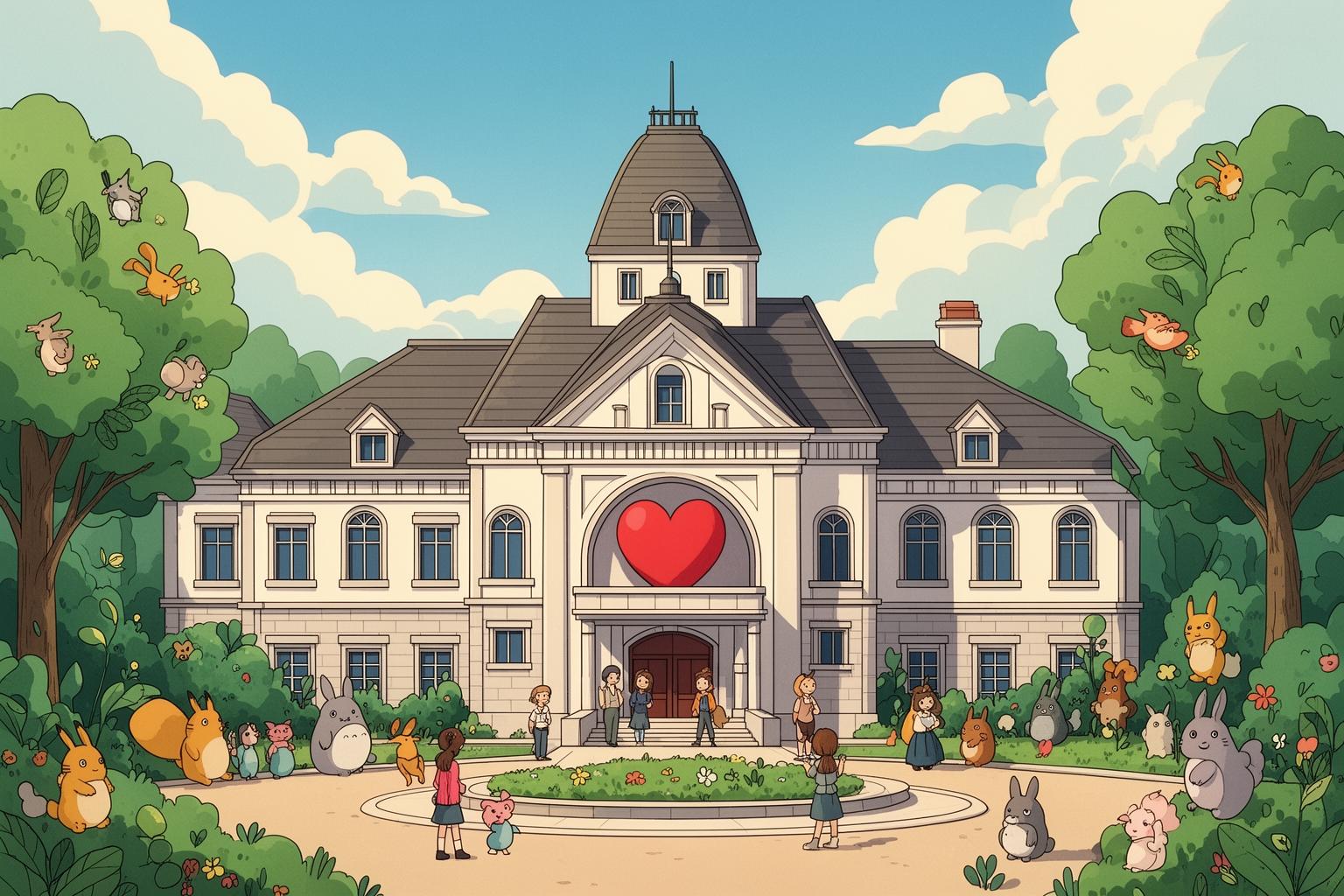
Approaching the Ghibli Museum feels like discovering a hidden villa straight out of a Miyazaki film. It’s not a grand or imposing building, but rather an organic, whimsical structure that seems to have naturally risen from the earth. Draped in ivy, with rounded edges, a turret, and a vibrant mosaic of colorful tiles, the building almost feels alive. Here, the true essence of getting lost begins. There is no fixed path or cordoned-off route to follow. You receive a map, but it serves more as a gentle suggestion—an invitation to wander and uncover the museum’s wonders at your own rhythm.
A Building That Breathes Imagination
The architecture itself is the museum’s first exhibit. Every detail exudes playfulness and artistry. Peer closely at the stained-glass windows, and you’ll find intricate portraits of beloved characters like Totoro, Kiki, and Jiji. Custom-designed elements such as door handles, light fixtures, and even water fountains are fantastical works of art. The building is a maze of spiral staircases, tiny doorways, bridged walkways, and concealed balconies, crafted to spark curiosity and encourage you to peek around corners, wondering what might lie above or below.
The undeniable highlight of the exterior is the Rooftop Garden. After climbing a winding, caged spiral staircase, you step into the open air to come face-to-face with a towering, five-meter-tall Robot Soldier from Castle in the Sky. Silent and gentle, it stands as the museum’s guardian, with moss and vines beginning to climb its legs. It’s a striking and poignant sight, one of the few places where photography is openly welcomed. From this vantage point, you can gaze out over the lush canopy of Inokashira Park, feeling worlds away from the busy city. It’s a moment of peaceful reflection, connecting you to the film’s themes of nature, technology, and bittersweet beauty.
The Magic of Movement: The Central Hall and Permanent Exhibits
Passing through the heavy wooden entrance doors, you enter the Central Hall, a vast, multi-story space that functions as the museum’s vibrant heart. Sunlight pours down from a glass dome above, illuminating a mesmerizing jumble of balconies, bridges, and a swirling ceiling fan. An antique-style elevator with a gilded dial slowly transports guests between floors. This space feels less like a museum lobby and more like the interior of Howl’s moving castle—a place full of constant motion and hidden mechanisms. Here, the museum’s strict no-photography rule inside the building takes effect. What might seem disappointing at first soon reveals itself as a gift—it encourages you to put away your phone and fully engage with your surroundings, seeing with your own eyes and creating memories rather than mere images. The collective wonder of visitors—their gasps and quiet murmurs—becomes the soundtrack of this enchanting place.
The ground floor hosts the permanent exhibits focused on the history and science of animation. These are far from dry, academic displays; instead, they offer a magical exploration of how still images create the illusion of life. You’ll encounter breathtaking, three-dimensional zoetropes featuring models of characters like Totoro and the Catbus spinning under strobe lights, appearing to leap, run, and bounce in a fluid, hypnotic dance. Another room, “Where a Film is Born,” is a lovingly detailed recreation of an animator’s studio. The space overflows with inspiration and creative clutter: walls covered with sketches and concept art, shelves weighed down by art books from around the globe, half-finished drawings scattered on desks, and jars filled with sharpened pencil stubs. It feels as though the artist has just stepped away for a moment’s tea. This exhibit does more than show how a Ghibli film is made; it conveys the passion, the frustration, and the pure joy of the creative process.
A Secret for Your Eyes Only: The Saturn Theater
Your ticket to the Ghibli Museum is a special keepsake: a small strip of real 35mm film print from one of the studio’s feature films. Holding it up to the light reveals three frames from a cherished scene—a tiny, tangible piece of cinematic history. This unique ticket also grants entry to a screening at the cozy Saturn Theater on the ground floor. Here, visitors can watch one of several original animated shorts created exclusively for the museum, unavailable anywhere else. The lineup rotates, so you never know quite what you’ll see. It might be the charming sequel Mei and the Kittenbus, the delightful Mr. Dough and the Egg Princess, or another whimsical tale from the Ghibli team. The theater is small and intimate, and as the lights dim and the vintage projector clatters to life, you feel like you’re being let in on a precious secret. These films are pure, distilled Ghibli magic, often wordless, telling their heartwarming stories through stunning visuals and music.
Beyond the Exhibits: Savoring the Ghibli Experience
A visit to the Ghibli Museum captivates all the senses, including taste and the excitement of discovering the perfect treasure to bring home. The experience goes beyond the exhibition halls, extending into charming areas designed for rest, refreshment, and reflection.
The Straw Hat Café: A Taste of Ghibli
Located on the upper level with a welcoming outdoor terrace, the Straw Hat Café embodies the Ghibli spirit by offering simple, wholesome, and delicious food that feels like a comforting embrace. Rather than focusing on elaborate novelty dishes, it serves hearty, satisfying meals made with care. The menu often includes favorites such as a thick-cut pork cutlet sandwich, savory minestrone soup, and fluffy, cloud-like slices of strawberry shortcake. The atmosphere is rustic and cozy, with wooden furniture and warm lighting. Expect a wait, as the café is very popular and does not accept reservations. The line speaks to its quality and charm. Many visitors find it an ideal spot to sit, reflect on the wonders they’ve experienced, and recharge before continuing their exploration. It offers a chance to enjoy a meal that feels as if it could have been served in the worlds of Kiki’s Delivery Service or Porco Rosso.
Mamma Aiuto! The Treasure Trove Souvenir Shop
Named after the spirited sky pirate gang from Porco Rosso, the museum’s gift shop, Mamma Aiuto!, is an attraction in itself. This isn’t a typical souvenir stand filled with mass-produced trinkets. Instead, it’s a treasure trove of beautifully crafted, exclusive merchandise unavailable anywhere else. The shelves brim with everything a Ghibli fan could wish for: plush Totoros of all sizes, elegant music boxes playing iconic themes, intricate pins, and stationery adorned with stunning artwork. You can find exquisite replicas of the lapis lazuli amulet from Castle in the Sky or a delicate model of the Flapter. The shop also offers a wonderful collection of art books, postcards, and those coveted film strip bookmarks. It’s easy to get carried away here, but every item feels like a carefully curated work of art—a fitting memento of your pilgrimage to this enchanting place.
Inokashira Park and Kichijoji: Extending Your Magical Day
The magic of the Ghibli Museum doesn’t have to end once you step outside its doors. Its strategic location invites you to continue your journey of discovery in the beautiful surrounding area. Spending a full day in Mitaka and the neighboring Kichijoji is an ideal way to complete your Ghibli experience.
The Tranquil Beauty of Inokashira Park
The museum is nestled in the heart of Inokashira Park, one of Tokyo’s most beloved green spaces. After delving into the imaginative realms of Ghibli, stepping into the park’s natural surroundings feels like a perfect continuation. The park’s centerpiece is its large central pond, where you can rent swan-shaped paddle boats and glide across the water. A quaint shrine dedicated to Benzaiten, the goddess of love and fortune, rests on an island in the pond. On weekends, the park buzzes with street performers, musicians, and local artists selling their crafts. It’s an ideal spot for a leisurely walk, a picnic on the grass, or simply sitting on a bench to watch the world go by. The park’s strong connection to nature deeply resonates with the environmental themes often found in Miyazaki’s films, making it a fitting companion to the museum.
Kichijoji’s Bohemian Vibe
Just a short walk from the park leads you to Kichijoji, a neighborhood frequently ranked among the most desirable places to live in Tokyo. It perfectly blends trendy and laid-back, with a bohemian, artistic vibe. The area is a shopper’s paradise, featuring a mix of large department stores, charming covered shopping arcades (shotengai), and numerous independent boutiques offering unique clothing, vintage items, and artisanal crafts. However, the true heart of Kichijoji’s culinary and social scene is Harmonica Yokocho. This maze of narrow, lantern-lit alleyways just north of the station dates back to the post-war era. These tight passages are packed with standing bars (tachinomi), yakitori stalls, ramen shops, and tiny gyoza counters, each seating only a few people. As evening sets in, the alleys fill with smoke, laughter, and the clinking of glasses. Enjoying dinner and a drink here is an authentic, atmospheric experience—a wonderful contrast to the curated whimsy of the museum and a perfect way to conclude your day of exploration.
Practical Wisdom for the Aspiring Pilgrim
A bit of preparation can greatly enhance your Ghibli pilgrimage, making it as smooth and enjoyable as possible. Keep these final tips in mind as you plan your visit.
The No-Photography Rule: A Blessing in Disguise
It bears repeating: photography and videography are strictly prohibited inside the museum building. The staff are polite yet firm about this rule. Embrace it. Resisting the urge to document everything through a lens allows you to be fully present. You’ll notice the intricate details in the woodwork, the flicker of the zoetrope, and the expressions on the faces of fellow visitors. This fosters a personal, internal experience, ensuring your memories of the museum are vivid and sensory rather than just a collection of pixels on a screen.
Pacing Yourself and What to Bring
Though the museum isn’t large, its richness in detail means you shouldn’t rush. Plan to spend at least two to three hours inside to comfortably take everything in. Including the café, the rooftop garden, and the gift shop, you can easily spend half a day there. To turn it into a full day, combine your visit with a leisurely stroll around Inokashira Park and an evening in Kichijoji. Wear comfortable shoes, as there will be a lot of walking and standing. Most importantly, don’t forget your passport. Your ticket will be checked against your ID at the entrance, and mismatched documents will result in denied entry.
A Note on Accessibility
The museum features a whimsical, multi-level design that includes many stairs. However, it is equipped with a small, charming elevator, and the staff are extremely helpful in assisting visitors with mobility needs. While most areas are accessible, some narrow passages and smaller spaces may feel a bit tight. This reflects the museum’s inclusive spirit, successfully integrating accessibility into its unique and unconventional architectural design.
Your journey to the Ghibli Museum is far more than a visit to a tourist attraction. It is a deep dive into the heart of one of the world’s most beloved animation studios. It celebrates creativity, reminds us of the power of storytelling, and rekindles a sense of childlike wonder you might have thought was lost. Leaving the museum and walking back through the darkening park, you feel transformed. The world seems a little more magical, the rustling trees sound a bit like whispers from Totoro, and the sky feels full of possibilities. You arrived to see how the magic is made, and you leave carrying a piece of it with you.








