
There’s a certain magic woven into the fabric of Julian Fellowes’ The English Game, a series that doesn’t just tell a story but transports you to a bygone era. It’s a world of grit and grandeur, of mud-caked boots and starched collars, where the very soul of modern football was forged in the fiery crucible of the Industrial Revolution. The show captured our imaginations with its compelling drama of class struggle, sporting passion, and the revolutionary shift from the brutish ‘hacking’ game of the elite to the strategic ‘passing’ game of the working class. But beyond the brilliant performances and sharp script, the series was a visual masterpiece, painting a breathtakingly authentic portrait of Victorian England. The looming mills, the cobblestone streets slick with rain, the opulent halls of power—these weren’t just backdrops; they were characters in their own right, whispering tales of ambition, struggle, and change. For those of us who fell under its spell, the desire to walk those same streets, to breathe that same air, is undeniable. This isn’t just about visiting a film set; it’s about making a pilgrimage to the very heart of history, to the places where the beautiful game found its voice.
This journey will take us away from the familiar lanes of London and deep into the proud, industrial heart of Northern England, primarily West Yorkshire. This is a region carved by industry, where grand Victorian architecture stands as a testament to immense wealth and innovation, and where the spirit of the communities that fueled a global empire can still be felt in the rhythm of daily life. We’ll explore the UNESCO World Heritage site that became the town of Darwen, wander through the merchant quarters that doubled as the corridors of power, and stand on the grounds where the on-screen footballing battles were waged. It’s a chance to peel back the layers of time and connect with the real stories, the real people, and the real places that gave The English Game its powerful, resonant soul. So lace up your most comfortable boots, and let’s step back in time, following the ghosts of Fergus Suter and Arthur Kinnaird through the landscapes that shaped their world.
If you’re captivated by the idea of exploring cinematic history firsthand, you might also enjoy a pilgrim’s guide to the filming locations of Chinatown.
The Heart of the Industrial North: Saltaire, West Yorkshire
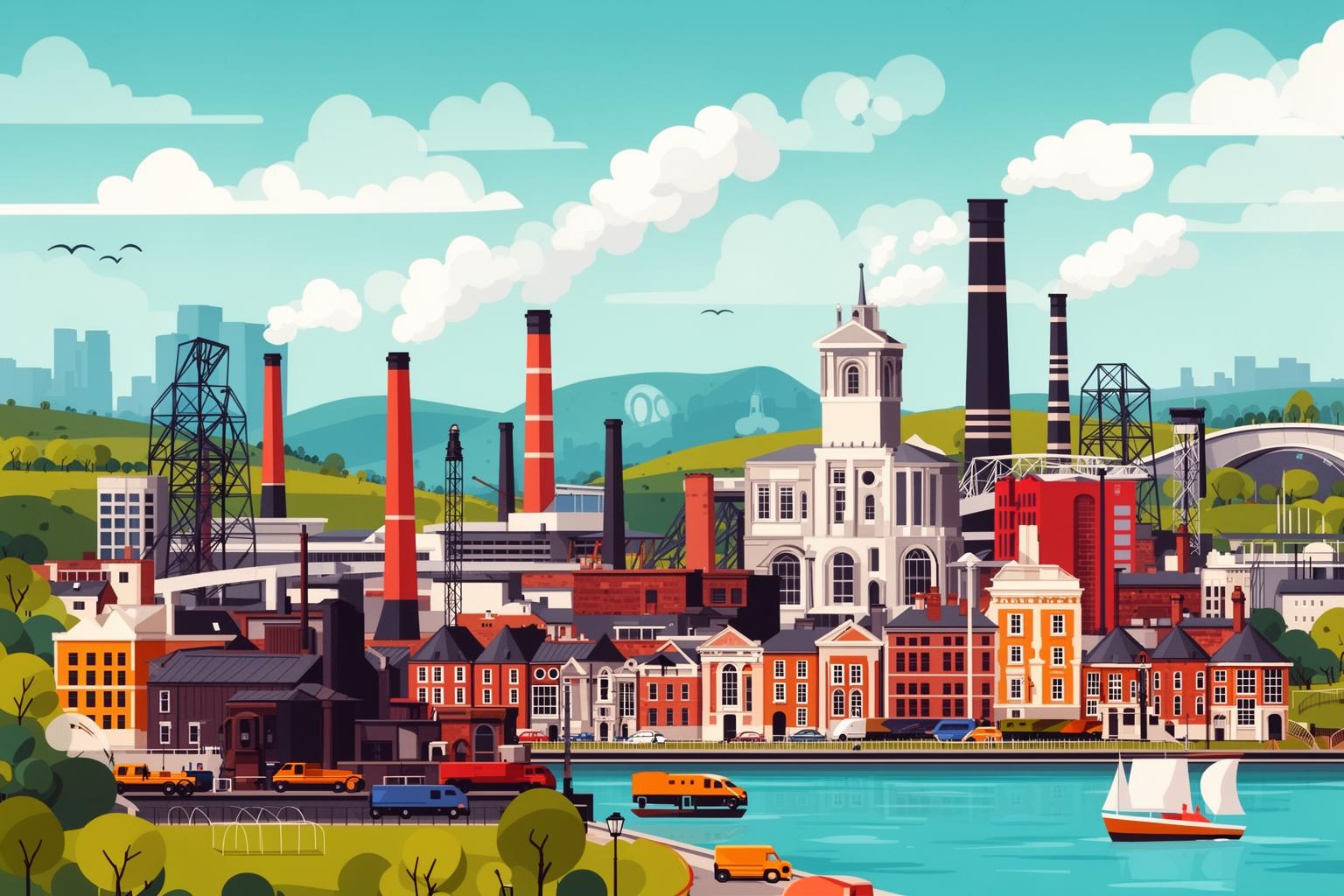
The essence of The English Game‘s working-class heroes lies in the fictionalized version of Darwen, a town shaped by the imposing cotton mill and the close-knit community of its workers. To bring this world to life, the filmmakers discovered the ideal stand-in not in Lancashire, but in the impeccably preserved Victorian model village of Saltaire in West Yorkshire. Stepping into Saltaire feels like stepping onto the set itself. The sensation of time collapsing is immediate and profound. The air is thick with history, and you can almost hear the ghostly clatter of looms and the chatter of workers heading home after a long day. This is not just a collection of old buildings; it is a living, breathing monument to an era of great change and ambition, making it the emotional heart of our journey.
A UNESCO World Heritage Site as Darwen
Recognized as a UNESCO World Heritage site for its exceptional preservation and historical importance, Saltaire is a triumph of urban planning. Founded in 1851 by Sir Titus Salt, a philanthropic wool baron who relocated his entire factory and workforce from the polluted, overcrowded city of Bradford, his goal was to build a healthy, orderly, and flourishing community, complete with sturdy stone houses, a hospital, a school, a church, and, naturally, the massive Salts Mill. This real-life story of a visionary industrialist crafting a structured community for his workers offers a compelling and somewhat kinder parallel to the show’s mill owner, Mr. Walsh. The architecture is impressively uniform, constructed from honey-colored local sandstone, producing a harmonious and striking aesthetic. The grid of terraced houses, broad streets, and the immense mill complex immediately conjure the world of Fergus Suter and his teammates. The filmmakers had little to do to transform this village into 1870s Darwen; its authenticity is its greatest strength. The cobblestone streets, which appear so cinematic on screen, are genuinely real, their uneven surfaces narrating more than a century and a half of footsteps, carts, and lives passed.
Walking in Fergus Suter’s Footsteps
Strolling through Saltaire is an exercise in immersive storytelling. Begin on Victoria Road, the village’s main thoroughfare. As you walk, you’ll recognize the backdrop of numerous scenes: workers trudging to the mill through early morning mist, children playing on pavements, and Fergie and Jimmy Love maneuvering through their new lives. The uniform facades of the workers’ cottages line the street, their neatness and order reflecting Sir Titus Salt’s vision of a disciplined workforce. Notice the distinctive ginnels, or alleyways, that cut between houses, adding rich texture to the show’s streetscapes. The entire village feels like a time capsule, carefully planned and beautifully preserved. The atmosphere carries a quiet dignity. This is no sanitized museum piece; people live here, their modern lives unfolding against this incredible historical setting. The best way to experience it is to simply wander. Turn down Caroline Street, stroll along Albert Terrace, and let the rhythm of the architecture guide you.
Your walk should naturally lead you to the village’s magnificent centerpiece: Salts Mill. In the series, the mill symbolizes both opportunity and oppression for the people of Darwen. Today, this T-shaped giant, once the largest industrial building in the world, has been revitalized. It no longer houses deafening machinery but serves as a vibrant cultural hub. Inside its vast, light-filled galleries is the world’s largest permanent collection of works by Bradford-born artist David Hockney. The splash of his vivid California swimming pools against the stern industrial brick creates a charming anachronism. The mill also contains independent shops, an excellent bookstore, and several cafes. It’s the perfect spot to appreciate the scale of the industrial past while soaking up the creative energy of the present. Grab a coffee, sit by one of the enormous arched windows, and gaze out over the village you’ve explored. You can sense the powerful shift from a world of industrial labor to one of art, leisure, and culture—a transformation that mirrors the very social changes the English game itself helped to bring about.
Bradford’s Victorian Grandeur: Little Germany and City Hall
While Saltaire represented the gritty, working-class core of the series, the production required a different type of location to depict the wealth, power, and privilege of the Old Etonians and the Football Association. For this, they turned to the nearby city of Bradford, a 19th-century textile industry powerhouse whose city center features some of the finest Victorian architecture in Britain. The contrast is immediate and striking. A short train journey from the orderly, modest stone of Saltaire brings you into a world of ornate Neoclassical grandeur, a cityscape designed to convey wealth and imperial confidence. This is where the other side of The English Game’s story unfolds—the realm of backroom deals, gentlemen’s agreements, and the battle to maintain control over a rapidly evolving sport.
The Merchants’ Quarter as Affluent London
To evoke the feel of exclusive 1870s London, the filmmakers utilized a unique and well-preserved commercial district in Bradford called Little Germany. Its name stems from the large number of German Jewish wool merchants who settled here in the mid-19th century, constructing magnificent, high-end warehouses to store and trade their goods. These are not simple industrial buildings; they are architectural landmarks. Strolling through the narrow streets of Little Germany, you are surrounded by imposing, intricately decorated facades in Italianate and Neoclassical styles. Here, scenes show Arthur Kinnaird and his peers stepping from elegant carriages, their top hats framed against grand stone buildings. The vicinity around Cater Street and Currer Street is especially recognizable. The tall, stately warehouses create a canyon-like effect, perfectly emulating the dense, prosperous atmosphere of the City of London at its imperial peak. The fine detail in the stonework, arched windows, and sheer verticality of the buildings evoke an aura of immense financial power. This world stands in stark contrast to the humble terraced houses of Saltaire, and the series cleverly uses this visual opposition to highlight the class divide central to its story.
Bradford City Hall: The Home of the FA
Some of the most crucial scenes in The English Game are set inside the distinguished Football Association headquarters, where the rules of the game—and society—were debated and decided. The stunning Venetian Gothic interiors of Bradford City Hall offered the perfect backdrop for these tense moments. Completed in 1873, the building is a triumph of Victorian municipal pride, designed to symbolize Bradford’s status as the ‘wool capital of the world.’ Its interiors are visually striking and are showcased to great effect in the series. The most notable location is the magnificent council chamber, with its rich wood paneling, ornate ceiling, and formal seating—where the FA committee, led by Darwen’s Francis Marindin, held critical meetings that shaped the fate of clubs and players. The grand central staircase and opulent corridors also feature prominently, providing settings for the private conversations and political maneuvering that defined the era. While City Hall remains an active administrative center, its exterior alone—with its soaring clock tower—is a landmark worth visiting. Dominating Centenary Square, a modern public space offering an excellent vantage point to appreciate the building’s historical grandeur, it’s easy to imagine the weighty history debated within its walls, both in reality and in the world depicted by the show.
The Pitch and the Pub: Keighley and the Worth Valley
Certainly, a football story means little without the game itself. The series was praised for the authenticity of its match scenes, which portrayed the raw, chaotic, and often brutal nature of 19th-century football. These scenes were not shot on the pristine, manicured pitches seen today. Rather, the production team found locations that could be transformed into the muddy, uneven fields characteristic of the era, where the innovative ‘passing game’ collided with the physical ‘hacking’ tactics of the established order.
The Historic Turf of Keighley
Much of the on-field action was filmed on playing fields around the town of Keighley, another industrial center located in the Worth Valley. These sites provided a blank slate that could be dressed to appear authentically Victorian. The production team went to great lengths to recreate the primitive conditions of early football grounds—the basic goalposts, simple rope barriers for spectators, and most importantly, the mud. The mud almost acts as a character in the show, representing the unpolished, grounded reality of working-class teams. Filming these scenes amid the often harsh weather of West Yorkshire added a layer of realism that couldn’t be faked. Although the exact fields are not major tourist spots, exploring the Keighley area gives a vivid sense of the landscape. This is Brontë country, marked by rugged hills and dramatic moorland that feels rich with history and drama. One wonderful way to soak in this atmosphere is by riding the Keighley and Worth Valley Railway, a heritage steam train line that winds through the stunning scenery once home to the famous literary sisters. The lovingly preserved stations and vintage carriages serve as a direct connection to the era of The English Game, making it easy to imagine the Darwen team traveling to an away match by such a train.
A Pint in the Past: The Local Pubs
The pub serves as the social heart of the community in the series—a place where victories are toasted, defeats mourned, and plans laid over a pint of ale. Although many interior pub scenes were probably filmed on carefully constructed sets, the spirit of these establishments remains alive throughout Yorkshire. To capture that same sense of warmth, history, and camaraderie, visiting a traditional local pub is a must for any English Game pilgrimage. In Saltaire, pubs like The Rosse or The Boathouse Inn, situated on the canal, offer an authentic taste of local life. These venues have served the community for generations. Inside, you’ll find dark wood, cozy corners, and a friendly ambiance that define a true English pub. It is here, over a hand-pulled pint of Yorkshire bitter, that the show’s world feels most tangible. You can easily picture Fergus Suter and Jimmy Love sharing a drink at a similar table, their Scottish accents cutting through local chatter. This reminds us that the story of football is about more than what happens on the pitch; it’s also about the community and the shared sense of belonging it creates.
Beyond the North: Other Key Locations
While the heart of the series beats in West Yorkshire, the story of class division demanded locations capable of depicting the exclusive world of the upper crust. The lives of Arthur Kinnaird and the Old Etonians stood far apart from the industrial smoke of Darwen, prompting the filmmakers to seek out grand country estates and refined urban architecture to reflect this contrast.
The Grand Estates of the Old Etonians
To portray the stately homes of the wealthy elite, the production utilized several country houses, most notably the Broughton Hall Estate near Skipton in North Yorkshire. This stunning Georgian manor, set within over 3,000 acres of immaculate parkland, served as the backdrop for the Kinnaird family’s opulent lifestyle. The elegant interiors, furnished with fine art, antiques, and soaring ceilings, starkly contrast the cramped workers’ cottages of Saltaire. The expansive lawns and landscaped gardens, where gentlemen might leisurely practice their sport, underscore the vast privilege and resources available to the upper-class teams. Visiting Broughton Hall, or any of the grand stately homes in this part of England, offers a tangible insight into the gulf between the two worlds portrayed in the show—a divide of not only wealth but also space, leisure, and opportunity.
Liverpool’s Architectural Doubles
For certain grand urban scenes requiring a specific monumental atmosphere, the production also turned to Liverpool. Like Bradford, Liverpool is rich in Victorian architecture, built on the vast wealth of its port. Areas such as St. George’s Plateau, bordered by the neoclassical masterpieces of St. George’s Hall and the Walker Art Gallery, have long been favored by filmmakers aiming to replicate the grandeur of historic London. These architectural landmarks provided the perfect backdrop for some of the show’s most striking cityscapes, adding an extra layer of authenticity to the world on screen. For film enthusiasts visiting, spotting these Liverpudlian landmarks offers a fun, behind-the-scenes perspective on this vibrant city.
Crafting Your “English Game” Itinerary

Exploring the filming locations of The English Game offers a wonderfully immersive journey into Northern England’s industrial and cultural heritage. The key sites in West Yorkshire are conveniently close, making for an ideal long weekend escape. With some planning, you can easily follow the footsteps of your favorite characters and take in the dramatic landscapes that brought their story to life.
A Weekend in West Yorkshire
For a smooth and enjoyable visit, consider basing yourself in the vibrant city of Leeds or the historically rich city of Bradford. Both provide excellent transport links and a variety of accommodation options. From either city, day trips are easily manageable.
A perfect first day would focus on Saltaire and Bradford. Begin your morning in Saltaire, arriving by train to be dropped in the heart of the village for the most authentic experience. Spend a few hours wandering the streets, soaking up the unique atmosphere before heading to Salts Mill. Dedicate at least two to three hours to exploring the galleries, shops, and cafes housed in this impressive building. In the afternoon, take the short train ride back to Bradford. Visit Little Germany to admire the grand merchant palaces, then walk over to Centenary Square to appreciate the imposing exterior of City Hall. This itinerary offers a striking contrast between the working-class and elite worlds that define the series.
On day two, immerse yourself in the surrounding landscape. Catch the train to Keighley and board a steam train on the Keighley and Worth Valley Railway. The journey itself is a highlight, providing stunning views of the rugged countryside featured prominently in the show. You can disembark at Haworth, a quaint village with steep gables renowned as the home of the Brontë sisters. While not a direct filming site, its moody, windswept ambiance complements the aesthetic of The English Game and adds a rich literary layer to your trip.
Practical Tips for the Modern Pilgrim
Getting around this region is fairly straightforward. The train network efficiently connects the main towns and cities of Leeds, Bradford, Saltaire, and Keighley. For more remote places like the Broughton Hall Estate, renting a car for a day offers the best flexibility. The best times to visit are spring and autumn when the mild weather is perfect for walking. However, a winter visit is also worthwhile—the moody skies and bare trees create an atmospheric, almost cinematic landscape true to the series—just be sure to bring a warm, waterproof coat.
From a style and comfort standpoint, sturdy walking shoes are essential. The cobblestones of Saltaire and Yorkshire’s hills demand good footwear. The notoriously changeable northern weather means dressing in layers is key. A stylish trench coat or waxed jacket will keep you dry and look fitting amid the historic surroundings. For women, these areas are generally very safe for tourists, though, as with any travel, staying aware of your surroundings and securing your belongings in busy city centers is wise. One more practical note: the beautiful cobblestone streets can be uneven and slippery when wet, so watch your step as you admire the architecture.
A trip to The English Game locations is far more than a simple sightseeing tour—it’s a journey into a defining moment in history. It’s a chance to stand in the shadows of the great mills that powered an empire and to walk the ornate halls where the future of the world’s favorite sport was decided. You can feel the unyielding spirit of the North, a region that has deeply influenced England’s character. This is a landscape that tells a story of innovation, community, struggle, and the enduring power of a simple game to unite people and bridge divides. So go ahead—walk the cobblestones, listen for the echoes of crowds in the valleys, and discover the grit and glory that forged a game and changed the world, one glorious pass at a time.