Los Angeles is a city built on celluloid dreams, a sprawling metropolis of sun-bleached boulevards and shadowed canyons where reality and fantasy bleed into one another. No filmmaker has ever captured this beautiful, terrifying duality quite like David Lynch, and no film distills his vision of the city into a more potent, intoxicating elixir than Mulholland Drive. To watch this film is to fall into a rabbit hole, a neo-noir puzzle box that trades answers for ever-deeper questions. To visit its filming locations is to take a step further, to walk through the looking glass and feel the phantom vibrations of its mystery under your own feet. This isn’t just a location scout; it’s a pilgrimage into the very heart of the Hollywood nightmare, a journey along a road that promises stardom but often leads to a dark, winding oblivion. The story of Betty and Rita, of Diane and Camilla, is etched into the very asphalt and stucco of these places. We chase their ghosts from a bright, optimistic courtyard apartment to a diner where dread is served alongside coffee, from a grand, silent theater to the precipice of a canyon overlook where the city of angels lays itself bare, glittering and monstrous. This journey is about more than just seeing where a movie was made. It’s about stepping into its atmosphere, breathing the same air thick with jasmine and exhaust, and feeling the unsettling shimmer of Lynch’s dream logic as it hangs over the Southern California landscape. It’s about understanding that in Los Angeles, every sunlit corner can hide a dark secret, and the most terrifying monsters are the ones we find waiting for us in the mirror. So, buckle up. We’re taking a drive. The road is dark, the future is uncertain, and there is no hay banda. There is no band. It is all an illusion.
If you’re inspired to embark on a cinematic pilgrimage to Greece, consider following the sun to the filming locations of ‘Before Midnight’.
The Road to Nowhere: Driving Mulholland Drive
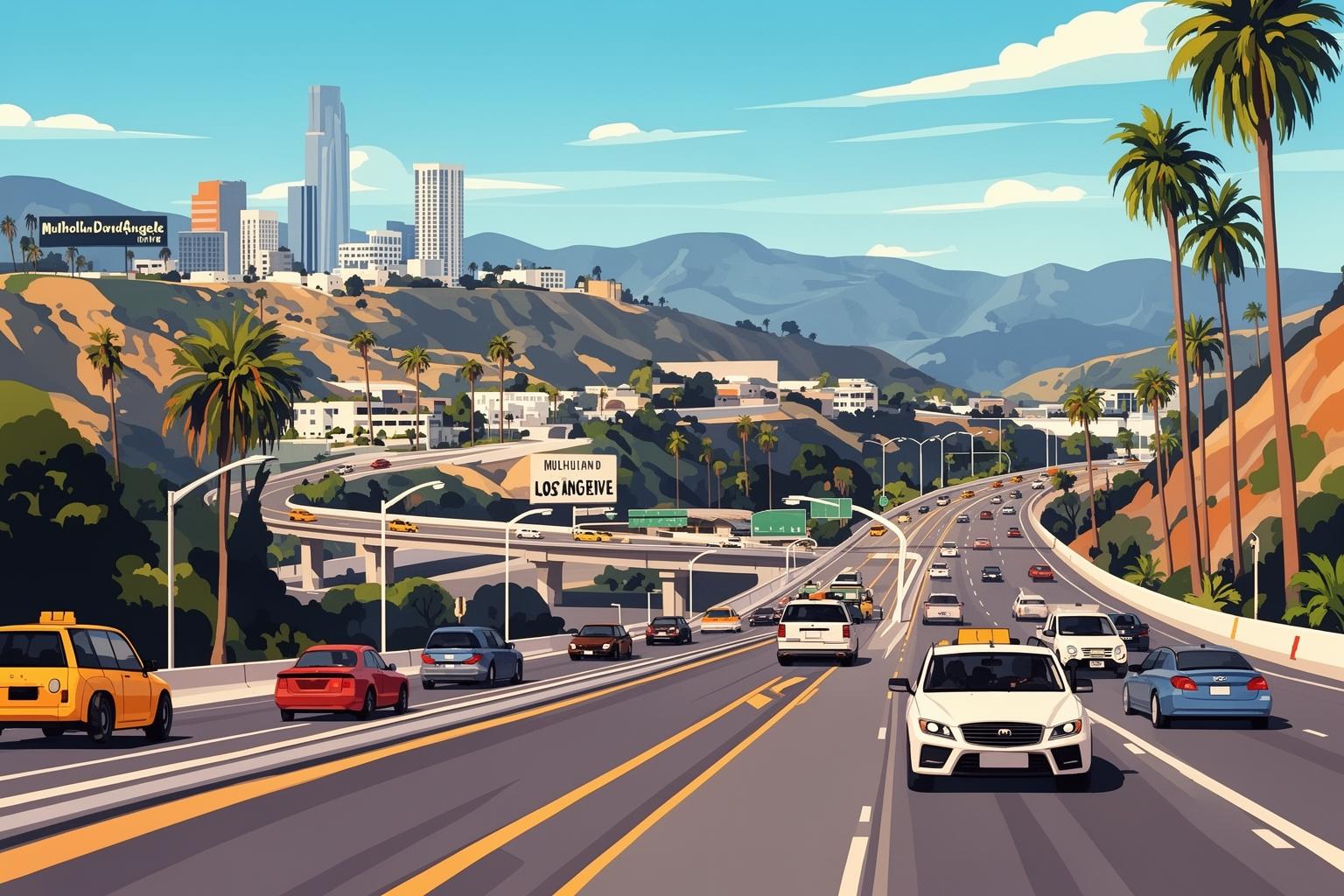
The film’s titular artery is more than mere geography; it serves as the central metaphor, the serpent’s spine winding through the Hollywood Hills, dividing the expansive San Fernando Valley from the glamorous basin of Los Angeles. It marks both a physical and psychological boundary between two worlds, two identities, two realities. Driving Mulholland Drive is the crucial first step in this pilgrimage, a rite of passage that attunes your senses to the film’s rhythm. It is not a highway but a slow, reflective journey that demands careful attention, much like the film itself.
The Serpent’s Spine: The Physical Road
To grasp its significance, you must experience it behind the wheel. The journey starts just off the 101 freeway, climbing into the hills where the urban grid dissolves into winding, unpredictable curves. The road hugs the mountainside, a slender ribbon of asphalt bordered by sheer drops on one side and the secluded, luxurious homes of Hollywood’s elite on the other. In daylight, the California sun blazes down, casting deep canyons into sharp relief. Bougainvillea and hibiscus cascade over retaining walls in vibrant pinks and reds, a deceptive cheerfulness that conceals the secrets behind tall gates and privacy hedges. You’ll encounter turnouts and scenic overlooks, each offering a unique, breathtaking panorama of the city below. Driving here is a form of meditation—you cannot rush it. You must submit to its rhythm, the endless switchbacks enforcing a slower pace, urging you to observe, to absorb the atmosphere of wealth, isolation, and quiet despair saturating these hills. Here, along these curves, the film’s opening sequence takes place: the shocking, violent car crash that births the amnesiac Rita and sets the entire mystery in motion. As you drive, you can almost hear the screech of tires, the phantom glare of headlights rounding a blind bend. This is a place of transition, a liminal zone where lives can be broken and remade in an instant.
Overlooks and Illusions: The City of Dreams
Among the many famous overlooks on Mulholland Drive, the Jerome C. Daniel Overlook resonates most with the film’s spirit. It is here that Betty and Rita, in a fleeting moment of fragile connection, gaze out over the twinkling expanse of city lights. The view is utterly intoxicating. From this vantage, Los Angeles transcends its identity as a collection of streets and buildings to become a pure abstraction—a shimmering carpet of infinite possibility. It is the dream made tangible, the lure that draws thousands of hopefuls like Betty to this town each year. Standing here, you can feel that pull—the distant hum of the city, the cool night air, the vastness of the vista—it’s a hypnotic experience. Yet Lynch frames this beautiful moment with a palpable sense of menace. We know this perfect, sparkling view is an illusion. Beneath that sea of light lie countless stories of failure, heartbreak, and corruption. The overlook serves as a precipice both literally and figuratively. It symbolizes the height of Betty’s hope, the moment just before the plunge into Diane Selwyn’s nightmarish reality. Visiting at night fully immerses you in this duality. The beauty is undeniable, but the film’s dark undercurrent is unavoidable. You look at the lights and don’t just see a city; you see a labyrinth of shattered dreams, a place where the search for a key can unlock horrors beyond imagination.
A Place Behind Winkie’s: The Heart of the Nightmare
Among the many unsettling moments in Mulholland Drive, the sequence at Winkie’s Diner stands out as perhaps the most expertly crafted display of pure, unfiltered dread. This scene seeps into your subconscious, lingering there—a perfect embodiment of the film’s ability to evoke terror from the ordinary. The diner, a quintessential coffee shop, becomes the setting for a waking nightmare that feels disturbingly real.
From Winkie’s to Cesar’s: The Diner of Dread
In the film, Winkie’s appears as a brightly lit, somewhat worn diner, a place of everyday comfort that turns deeply corrupted. Here, a man named Dan recounts to his friend a recurring dream about a terrifying figure lurking behind the diner. The scene is a masterful example of building tension through dialogue and atmosphere. The calm, steady camera work, the banal environment, and the quiet honesty of Dan’s fear all merge to generate an almost unbearable sense of approaching doom. The actual filming location is a restaurant in Gardena named Cesar’s Restaurant, quite a distance from the Hollywood-centric settings seen elsewhere in the film. This geographic separation enhances its eerie quality; it represents a detour into a different, less glamorous area of LA—a venture into the city’s subconscious. Visiting Cesar’s today is an uncanny experience. The layout is instantly familiar: red vinyl booths, a long Formica countertop, the pass-through window to the kitchen—it’s all intact. The spirit of Winkie’s lingers strongly here. Sit in the same booth by the window where Dan and his friend sat. Order a coffee. As a food lover, I can say the coffee is typical diner fare—strong, hot, and comforting—but while sipping it, a chill is hard to shake. The sunlight filtering through the windows feels altered, charged with a latent unease. Watching the other patrons, hearing the comforting clatter of cutlery and murmur of conversation, it all seems like a fragile mask stretched over something terrible. The staff know their place in cinematic lore, yet the restaurant doesn’t exploit this fame. It remains a humble, straightforward local spot, which only intensifies the lingering sense of Lynchian dread. It serves as a reminder that horror doesn’t always inhabit gothic castles; sometimes it waits for you in a brightly lit diner on a sunlit afternoon.
The Man Behind the Wall: Confronting the Unseen
The true horror of the Winkie’s scene reaches its peak outside, in the alley behind the diner. This is where Dan faces the subject of his dream—the horrifying homeless man whose grotesque face plunges Dan into a fatal shock. Finding this exact spot is a pilgrimage for many fans. The alley is as ordinary as the diner—a simple brick wall, a couple of dumpsters, cracked asphalt. There is nothing inherently scary about it. Yet standing there, in that quiet space behind the restaurant, the film’s atmosphere floods back. You find yourself staring at the corner of the wall, half-expecting that nightmarish face to suddenly appear. The power of this location lies in its sheer ordinariness. Lynch transformed this unremarkable space into a vessel of psychic trauma that refuses to fade. It becomes a physical embodiment of a psychological reality: the thing we dread most often hides just out of view, just around the corner from our everyday lives. Visiting this spot isn’t about witnessing something spectacular; it’s about sensing the echo of a cinematic nightmare. It’s a quiet, reflective moment where the line between reality and film feels almost nonexistent. Standing there, heart racing slightly faster than normal, you realize the monster behind Winkie’s was more than a character—it was a symbol of the terrifying, irrational truths that our waking minds desperately try to suppress.
No Hay Banda: The Illusions of Club Silencio
Club Silencio represents the film’s thematic heart, a place where the meticulously crafted illusion of Betty’s dream world is violently torn aside to expose the painful, illusory nature of her reality. It’s a theater of sorrow, a red-draped purgatory where performance and raw emotion clash. The sequence ranks among the most mesmerizing and emotionally shattering in Lynch’s entire body of work, and its physical setting stands as a landmark of old Hollywood.
The Tower Theatre: A Palace of Broken Dreams
The exterior and lobby of Club Silencio were shot at the Tower Theatre on Broadway in Downtown Los Angeles. Opened in 1927, it was the city’s first movie palace equipped for sound— a temple devoted to the new era of talking pictures. Its history is deeply intertwined with the magic of cinematic illusion. Walking along Broadway, the theater’s ornate, cream-colored terracotta facade catches the eye, a relic from a more glamorous time. The narrow, vertical blade sign still boldly proclaims its name, though the lights have long since dimmed. The architecture combines lavish Spanish, Romanesque, and Moorish influences, designed to transport visitors to another world before the film even started. For many years, the theater lay dormant—a beautiful, decaying ghost. This state of faded grandeur perfectly suited Lynch’s vision, embodying the decline of the Hollywood dream: a once-grand palace now inhabited by echoes and illusions. Recently, the Tower Theatre has been thoughtfully restored and transformed into an Apple Store. This modern reinvention adds a striking, almost dissonant layer to the pilgrimage. You enter through the same grand doors as Betty and Rita, but instead of a dimly lit, mysterious lobby, you are met with the bright, minimalist design of a tech giant. Sleek tables displaying the latest devices now occupy the space beneath the restored, ornate ceiling. The grand staircase remains, as does the magnificent archway that leads into the main auditorium. It is a collision of eras, juxtaposing the analog dream factory of old Hollywood with the digital dream factory of Silicon Valley.
Crying to a Recording: The Silencio Experience
Standing in the main area of the former auditorium offers a profound experience. This is where Rebekah Del Rio delivered her breathtaking, a cappella Spanish version of Roy Orbison’s “Crying.” The stage, proscenium arch, and restored balconies from which Betty and Rita witnessed the strange, heartrending performance are still visible. The atmosphere has changed—now filled with the quiet buzz of commerce rather than a lone, sorrowful voice—but the space itself preserves its power. You can stand on the very spot where the singer collapsed, where the Emcee’s cryptic words—”It is all a recording. It is all an illusion”—lingered in the air. The irony that this place now serves as a temple to technology, a realm of perfect digital recordings and flawless reproductions, is not lost. The tension between artifice and reality is ingrained in the building’s current role. Visitors can freely explore the space, glance up at the restored ceiling, and imagine the red curtains, the enigmatic magician, and the overwhelming emotional weight of that scene. It powerfully illustrates how Lynch employs real locations not merely as settings but as active elements in his storytelling, imbuing them with an emotional residue that outlasts any individual occupant. Surrounded by cutting-edge technology, if you close your eyes, you can still hear the echo of that voice, crying to a recording, and feel the ghostly heartbreak of Club Silencio.
The Courtyards of Conspiracy: Hollywood Apartments
Much of Mulholland Drive unfolds within the intimate, hidden spaces of Hollywood apartment buildings. These are not grand estates but the everyday homes of actors, writers, and dreamers. The film delves into the contrast between their bright, inviting exteriors and the dark, sordid dramas playing out behind their walls. These courtyards serve as stages for hope, despair, and blurred identities.
Aunt Ruth’s Apartment: Il Borghese’s Eerie Elegance
Rita hides in the apartment of Betty’s Aunt Ruth, a successful actress away on a shoot. This apartment is the focal point of the film’s first half—the sanctuary where Betty and Rita’s relationship blossoms and their investigation begins. This key setting is the stunning Il Borghese, a historic West Hollywood apartment building. Built in the 1920s, it exemplifies Italian Renaissance Revival architecture. Discovering it feels like finding a hidden European villa tucked just off Sunset Boulevard. The building centers around a magnificent, shaded courtyard. A tiered fountain bubbles softly at its heart, surrounded by lush ferns, sculpted hedges, and classical statues. The atmosphere exudes old-world elegance and deep tranquility. It feels secluded, a world unto itself. This sense of isolation is central to the film. Though beautiful, the courtyard also feels like a gilded cage. One can imagine Betty and Rita sitting by the fountain, their whispered conversations lost beneath dense foliage. Visitors glimpse this private world only through ornate iron gates from the street, yet even from outside, its power is palpable. The arched windows and wrought-iron balconies overlook the courtyard, evoking a sense of voyeurism akin to the film’s invitation. Il Borghese embodies the alluring, sophisticated side of the Hollywood dream, but its quiet, almost mournful stillness hints at the emptiness and secrets lurking beneath that beautiful surface.
The Hopeful’s Haven: Betty’s Sierra Bonita Apartment
In sharp contrast to Il Borghese’s shadowy elegance, the apartment complex where Betty first arrives radiates sunny Californian optimism. This is the Sierra Bonita Apartments, a classic Hollywood courtyard complex where Betty is supposed to stay with her aunt. Upon arrival, filled with wide-eyed ambition, she is greeted by a cheerful courtyard bathed in sunlight, palm trees, and friendly, quirky neighbors. The location perfectly captures the mood of a classic 1940s Hollywood film. The pink stucco, turquoise trim, and gentle hum of neighbors chatting across the courtyard paint a picture of a tight-knit community of dreamers. This is the Hollywood Betty anticipated finding. Situated just south of Hollywood Boulevard, visiting the complex is like stepping back in time. It is a beautifully preserved example of this quintessential LA architectural style. From the entrance, you can look into the courtyard, which appears almost exactly as it does in the film. You can see the path Betty took, beaming with excitement, and the doors of the individual apartments, imagining Coco, the formidable landlady, emerging from one. This location is crucial as it establishes the bright, hopeful tone of Betty’s dream before it begins to sour. It is the “before” picture. The place still feels remarkably pleasant and charming in reality—an oasis of calm amid bustling Hollywood. Yet, knowing what unfolds later in the film, the cheerful facade feels fragile, almost poignant. It serves as a reminder that in Lynch’s world, even the sunniest, most idyllic locales can become gateways to the darkest nightmares.
The Puppet Masters and Their Pawns

The world of Mulholland Drive is inhabited by shadowy figures who operate behind the scenes—mobsters, mysterious cowboys, and influential studio executives who dictate the destinies of artists like the beleaguered director Adam Kesher. The settings linked to these characters symbolize the corrupt, relentless machinery of Hollywood’s power structure.
Adam Kesher’s Domain: A Mid-Century Modern Nightmare
Director Adam Kesher’s stunning home in the Hollywood Hills becomes a place of humiliation and loss of control. After being coerced by mobsters into casting an actress he dislikes, he returns to discover his wife cheating on him and his belongings cast out onto the street. The house itself is a striking example of mid-century modern architecture, perched high above the city with sweeping views. Since the real house is a private residence, it can only be seen from the street, yet its sleek lines, glass walls, and harmony with the surrounding landscape remain evident. It epitomizes the height of Hollywood success—a beautiful home, a creative career, a glamorous life. Yet, Lynch depicts how swiftly this dream can become a prison. The glass walls offer no privacy, only exposure. The elegant home transforms into a stage for Adam’s helplessness. He is literally and metaphorically shut out of his own life. The location captures the fragile nature of success in Hollywood. The same hills that provide breathtaking views and solitude can also become a place of deep isolation and vulnerability, where money and power can strip everything away in an instant.
The Gates of Power: Paramount Studios
When Adam Kesher is called to meet the enigmatic Castigliane brothers, he drives his convertible onto a studio lot. The iconic gates he passes through are the Bronson Gate entrance to Paramount Studios. This gate is a Hollywood landmark, emblematic of the Golden Age of cinema. Countless stars and moguls have entered through this very archway. In Mulholland Drive, Lynch uses it to symbolize the imposing, impenetrable fortress of the studio system. For an artist like Adam, crossing the threshold is like stepping into the lion’s den. The gates mark the boundary between the outside world and the secluded, powerful core where careers are made and shattered on a whim. Visiting the Bronson Gate today is a simple yet profound experience. Situated on Bronson Avenue, apart from the main Melrose entrance, it is easily accessible. You can stand on the sidewalk and view the famous arch—the same perspective Adam had from his car. It represents a tangible piece of film history, not only for Mulholland Drive but countless other movies. It feels like the very heart of the dream factory, where the abstract idea of “Hollywood” becomes a physical place. It’s a reminder that beneath all the glitz and glamour, Hollywood is an industry—a machine governed by a ruthless logic and unforgiving rules.
An LA Institution: Pink’s Hot Dogs
In a brief but unforgettable scene, a somewhat bungling hitman fails a job and discusses a “fat-ass book of addresses” at a classic Los Angeles landmark: Pink’s Hot Dogs. This small moment injects a gritty, authentic piece of LA into the film’s surreal dreamscape. Pink’s is a Hollywood institution, a family-run hot dog stand famous for its chili dogs since 1939. It is noisy, chaotic, and utterly beloved. Visiting Pink’s is a quintessential LA experience. The stand, with its iconic pink-and-white color scheme, sits on La Brea Avenue and is renowned for the long lines that often stretch around the block at all hours. As a foodie, I can attest the wait is worthwhile. The menu offers a vast selection of specialty hot dogs named after celebrities. The snap of the casing, the rich chili, the generous toppings—it’s an indulgent and satisfying meal. Eating a chili dog at one of the outdoor tables, you partake in a local rite. The film’s scene captures the slightly seedy, transactional atmosphere that can exist even in the most public places in LA. The hitman talks about a murder while those around him simply try to enjoy their lunch. It’s another example of the dark undercurrent lurking in plain sight. For visitors, a stop at Pink’s grounds the surreal journey in something real, tasty, and quintessentially Los Angeles.
A Practical Guide to Your Lynchian Journey
Embarking on a Mulholland Drive pilgrimage requires some preparation. Los Angeles is an expansive, sprawling city, and the film’s locations are spread across various neighborhoods. With the right strategy, you can navigate this dreamscape both efficiently and safely.
Navigating the Dreamscape: Getting Around LA
There is one non-negotiable rule for this adventure: you need a car. Los Angeles is a city built around the automobile, and many key sites, especially Mulholland Drive itself and Adam Kesher’s house in the hills, are inaccessible by public transit. Renting a car will give you the freedom to explore at your own pace and fully engage with the driving experience that is central to the film’s aesthetic. Be prepared for traffic; it’s an unavoidable aspect of the LA experience. Use a GPS app like Google Maps or Waze to find your way, but also build in extra time and try to enjoy the drive. Cruising down Sunset Boulevard with the windows down while listening to Angelo Badalamenti’s haunting soundtrack is an atmospheric experience in its own right. Parking can be tricky, particularly in Hollywood and West Hollywood. Pay close attention to parking signs to avoid costly tickets. For places like the Tower Theatre downtown, a paid parking garage is often the simplest option.
When to Chase the Shadows: Best Times to Visit
The time of day can greatly influence the mood of these locations. Drive Mulholland Drive in the late afternoon during the golden hour, when the sun casts long shadows over the canyons and bathes the city in a warm, ethereal glow. Then, return to an overlook after dark to see the glittering, hypnotic sea of lights that so enchanted Betty and Rita. Apartment courtyards like Il Borghese and Sierra Bonita are best appreciated during daylight, when the sun illuminates their architectural details and landscaping. The alley behind Cesar’s Restaurant (Winkie’s) carries a unique sense of dread at any time, but the harsh midday sun can make its shadows appear even darker and more menacing. Los Angeles generally enjoys pleasant weather year-round, but spring and fall offer the most comfortable temperatures for exploring. Summer can be very hot, especially if you plan to do a lot of walking.
What to Bring to the Abyss
Beyond your car and GPS, a few items can enhance your pilgrimage. A good camera is essential for capturing the unique atmosphere at each location. Wear comfortable walking shoes, as you’ll frequently be getting in and out of your car and might want to explore nearby neighborhoods on foot. Bring sunglasses and sunscreen, as the California sun is intense. To fully immerse yourself, create a playlist featuring Angelo Badalamenti’s score and the songs from the film to play as you drive between sites. Above all, bring an open mind and a willingness to embrace ambiguity. This journey isn’t about finding answers but about experiencing the mystery. Let the city speak to you, allow the locations to evoke their own emotions, and permit yourself to get a little lost in the beautiful, unsettling dream that is David Lynch’s Los Angeles.
The Dream Has Ended: Final Thoughts from the City of Angels
To follow the footsteps of Betty, Rita, and Diane through Los Angeles is to experience Mulholland Drive on a visceral, physical level. The journey shifts the film from a puzzle to be solved into a landscape to be inhabited. You come to realize that the true protagonist of the story is the city itself—this alluring, cruel, and mysterious place that promises everything but often leaves its dreamers with only a blue key to a box full of sorrow. Standing in the alley behind Cesar’s or gazing out from the Hollywood Hills, you won’t find a clear explanation for the film’s mysteries. Instead, you encounter something more profound: a feeling. You sense the lingering ache of Diane Selwyn’s heartbreak, the vivid spark of Betty’s ambition, and the deep, terrifying silence that follows the end of an illusion. The pilgrimage leaves you with the eerie impression that the film is still unfolding, its ghostly narrative replaying endlessly in the sunlit courtyards and on the shadowy, winding streets of the city. You depart not with answers, but with a deeper appreciation for the questions, and the chilling awareness that in the city of dreams, you are never truly awake.